

Aquarium Filtration
Filter Types | Advantages & Disadvantages
Filter Types | Advantages & Disadvantages
Overview
The purpose of this article is to help the reader choose the right filter or filters for their aquarium filtering needs and also help with troubleshooting of existing filters (or even bring back to life a "dead" filter as in the case of canister filters with failed motors). A lot of this article is simply subjective based on my experience, however the troubleshooting sections are much more objective and useful regardless of whether one agrees with my reviews and experience.
There are several different types of aquarium filters, each aquarium filter with advantages and disadvantages. I have found over the years that most filters work best when used in combination to compliment each other, this redundancy is also important for peace of mind in case one filter fails, another will keep your aquarium filtering.
I would also like to point out that I am a big believer in filter redundancy, meaning having more than one filter or at least more than one water circulation device which even an air pump driven air stone counts as. In fact, a simple air stone creates good vertical circulation which is often a compliment to a filter that creates “cross circulation”. Non Stop air pumps are a better yet compliment to filter redundancy since these pumps have a self contained battery pack that allows the pump to continue operation even after a power failure.
Back to an air pump/air stone combination, this can still perform some bio filtration simply by moving current and adding dissolved oxygen (at the surface via gas exchange, not by virtue of the column of bubbles); this current will move water by nitrifying aerobic bacteria clinging to the surface of rocks, décor and in the case of marine aquariums, live rock which, by itself is a very efficient bio filter provided ample water current is provided around the live rock.
Product Resources:
• Non Stop AC/DC Air Pump
• Million-Air; Professionally Proven Reliable Aquarium Air Pumps
As per "Live Rock", the use of power heads, especially the newer propeller pumps (such as the Koralia or better yet Seio line propeller pumps) that direct water around and through this live rock is essentially a primary bio filter for this marine aquarium!
Product Resource:
• Seio Propeller Pumps, Glass Mount Aquarium Water Pump; Model 320, 530
An important aspect of filter redundancy is back up bio filtration, which is also useful for “seeding” new aquariums or quarantine/hospital aquariums, added mechanical filtration, added water movement, and preventing filter emergencies (especially while you are sleeping, out of town, at work, etc.), since your second filter takes care of filtration until you can fix or replace the failed filter.
Further Reference:
• Using Seasoned Filter Media to Seed a new Aquarium.
Another aspect of dual filters is to compliment each other. For instance Sponge Filters, especially the premium AAP Hydro Sponge Filter, along with Fluidized Filters (which are unsurpassed by ANY filter for bio filtration capacity) are excellent bio filters, but not as good at some mechanical filtration (though certain Sponge Filters can be a reasonably good mechanical filter); so a good mechanical filtering canister filter or HOB filter that also has good mechanical filtering characteristics would be a good compliment to the previously mentioned filters. If just Sponge Filters are used, using a reticulated (PRO) Sponge and high capacity standard sponge can also compliment each other.
Product Resources:
• Hydro Sponge Premium Aquarium Filters from AAP
• TMC Bio Fluidized Sand Bed Filter
ABOUT THIS ARTICLE: I give my OPINION/REVIEW with each of these types of filters, based on 38 + years maintaining a large aquarium maintenance company in Los Angeles, California. I used many different types and brands of filters during this time, and continue to try new ones out. As well many reviews are NOT only based on my professional use (often dozens or more of any one filter), but also based on feedback from other informed aquarium professional maintenance colleagues I generally talk/meet with at least once per month.
These reviews are not meant to be the end all, as it is far from a complete list, but hopefully this can help readers with similar filters make good decisions. More importantly as I noted earlier, the troubleshooting tips for many of the "types" of filters reviewed here are more universal and objective. Hopefully reader will find these very useful, even when they might disagree with a review.
Further Reading:
• My Aquarium Keeping Bio/Experience
A few notes before I get started here: If I am somewhat critical of a certain filter, often it is just because of over blown hype around this filter, not that it does not necessarily work.
I attempt to give practical and educated/professional tips to getting the most out of your filter. I attempt to avoid the anecdotal reviews that permeate much of the internet such as those surrounding the Rena Smart HOB filter where uninformed users give negative reviews of what is in reality the positive of this filter: its unmatched HOB filter efficiency (see the HOB filter section for more).
This is why I strongly recommend readers avoid the popular Internet trend of customer reviews (such as on Amazon), as what I have found is often persons are simply not using their products correctly (in negative reviews) or are giving positive reviews of equipment based on initial use, however long term use often reveals a short lived defective product (such as the plethora of Internal UVs or the Turbo-Twist)
I should point out that I do not believe in "magic" filters, conditioners, etc. that will do everything. Even products I really believe in, such as the AAP Wonder Shell, could use some renaming. If it was up to me, the Wonder Shell, is not a “Wonder” but a useful tool (maybe “mineral block”).
As with Medication/Treatment Charts, I do NOT agree with charts or calculators for matching filtration to aquarium bio loads, as everyone I have ever seen is severely flawed, often then providing a false sense of security. I have been contacted many times over the years as to fish aquarium problems where the bio load exceeded capacity by persons who have used such charts. As with medications, I think it is FAR MORE IMPORTANT TO EDUCATE a new aquarium keeper to ALL aspects of aquarium keeping then recommend a good mentor for suggestions with their aquarium set up.
Finally, Although I obviously provide links to filters/products I sell, the reviews are based on real world use of literally 1000's of filters (& other products) by me and my colleagues, and the products that I sell are based on positive results in long term use. I would only sell what I would use for me or my clients (with my clients, if I sold junk, I was responsible for free visits to fix problems, so selling junk was not good for the business bottom line either). I sell several filters that are great and that I believe in, even though they are not moneymakers (examples include many of the API filters which have absolutely NO profit margin). I just want people to be happy with them and enjoy their pond or aquarium.
Please note that since this article is much more "subjective" than many of my other articles, it is far from an exhaustive list of every filter; good or bad. In each section below, I discuss the attributes (and weaknesses) of each type of filter and I give trouble shooting tips for each as well.
For Marine Aquarium filter systems/combination suggestions, please see this article:
• Marine (Saltwater) Aquarium Filter Set Up Suggestions
For Freshwater Aquarium filter systems/combination suggestions, please see this article:
• Freshwater Aquarium Filter Set Up Suggestions
Important Filter Parameters to aid in Choosing a Filter: These parameters are important to consider. I will rate a few different brands in these categories where applicable (please only use this as a guide).
1. Capacity: By this I mean the amount of bio load and debris a certain filter can hold. I will rate this (based on comparisons to similar size filters, in other words a Hydro Sponge I will not be compared to Via Aqua 750 Canister Filter).
2. Bio Load capacity: Similar to above, however this pertains to bio filtration (nitrifying, not de-nitrifying) abilities in particular.
3. Flow By: This is the efficiency of a given filter to trap particulates of a given size without the water going around the media. I have determined this by measuring a micron filter insert, sponge or other Media’s debris collection after a given time.
4. Head Pressure: This is the ability of the filter or pump to lift vertically. Many pumps and filters will claim 300 gph at 0 head pressure, however when devices such as a UV Sterilizer are added or the filter/pump has to lift vertically any distance (such as a canister filter on the floor), many pumps/filters will have much lower gph. This is a common problem with Fluval Canister filters for instance.
Please Reference this article for much more about Head Pressure (a MUST Read):
• Head Pressure in Aquarium and Pond Water Filters/Pumps
There are several different types of aquarium filters, each aquarium filter with advantages and disadvantages. I have found over the years that most filters work best when used in combination to compliment each other, this redundancy is also important for peace of mind in case one filter fails, another will keep your aquarium filtering.
I would also like to point out that I am a big believer in filter redundancy, meaning having more than one filter or at least more than one water circulation device which even an air pump driven air stone counts as. In fact, a simple air stone creates good vertical circulation which is often a compliment to a filter that creates “cross circulation”. Non Stop air pumps are a better yet compliment to filter redundancy since these pumps have a self contained battery pack that allows the pump to continue operation even after a power failure.
Back to an air pump/air stone combination, this can still perform some bio filtration simply by moving current and adding dissolved oxygen (at the surface via gas exchange, not by virtue of the column of bubbles); this current will move water by nitrifying aerobic bacteria clinging to the surface of rocks, décor and in the case of marine aquariums, live rock which, by itself is a very efficient bio filter provided ample water current is provided around the live rock.
Product Resources:
• Non Stop AC/DC Air Pump
• Million-Air; Professionally Proven Reliable Aquarium Air Pumps
As per "Live Rock", the use of power heads, especially the newer propeller pumps (such as the Koralia or better yet Seio line propeller pumps) that direct water around and through this live rock is essentially a primary bio filter for this marine aquarium!
Product Resource:
• Seio Propeller Pumps, Glass Mount Aquarium Water Pump; Model 320, 530
An important aspect of filter redundancy is back up bio filtration, which is also useful for “seeding” new aquariums or quarantine/hospital aquariums, added mechanical filtration, added water movement, and preventing filter emergencies (especially while you are sleeping, out of town, at work, etc.), since your second filter takes care of filtration until you can fix or replace the failed filter.
Further Reference:
• Using Seasoned Filter Media to Seed a new Aquarium.
Another aspect of dual filters is to compliment each other. For instance Sponge Filters, especially the premium AAP Hydro Sponge Filter, along with Fluidized Filters (which are unsurpassed by ANY filter for bio filtration capacity) are excellent bio filters, but not as good at some mechanical filtration (though certain Sponge Filters can be a reasonably good mechanical filter); so a good mechanical filtering canister filter or HOB filter that also has good mechanical filtering characteristics would be a good compliment to the previously mentioned filters. If just Sponge Filters are used, using a reticulated (PRO) Sponge and high capacity standard sponge can also compliment each other.
Product Resources:
• Hydro Sponge Premium Aquarium Filters from AAP
• TMC Bio Fluidized Sand Bed Filter
ABOUT THIS ARTICLE: I give my OPINION/REVIEW with each of these types of filters, based on 38 + years maintaining a large aquarium maintenance company in Los Angeles, California. I used many different types and brands of filters during this time, and continue to try new ones out. As well many reviews are NOT only based on my professional use (often dozens or more of any one filter), but also based on feedback from other informed aquarium professional maintenance colleagues I generally talk/meet with at least once per month.
These reviews are not meant to be the end all, as it is far from a complete list, but hopefully this can help readers with similar filters make good decisions. More importantly as I noted earlier, the troubleshooting tips for many of the "types" of filters reviewed here are more universal and objective. Hopefully reader will find these very useful, even when they might disagree with a review.
Further Reading:
• My Aquarium Keeping Bio/Experience
A few notes before I get started here: If I am somewhat critical of a certain filter, often it is just because of over blown hype around this filter, not that it does not necessarily work.
I attempt to give practical and educated/professional tips to getting the most out of your filter. I attempt to avoid the anecdotal reviews that permeate much of the internet such as those surrounding the Rena Smart HOB filter where uninformed users give negative reviews of what is in reality the positive of this filter: its unmatched HOB filter efficiency (see the HOB filter section for more).
This is why I strongly recommend readers avoid the popular Internet trend of customer reviews (such as on Amazon), as what I have found is often persons are simply not using their products correctly (in negative reviews) or are giving positive reviews of equipment based on initial use, however long term use often reveals a short lived defective product (such as the plethora of Internal UVs or the Turbo-Twist)
I should point out that I do not believe in "magic" filters, conditioners, etc. that will do everything. Even products I really believe in, such as the AAP Wonder Shell, could use some renaming. If it was up to me, the Wonder Shell, is not a “Wonder” but a useful tool (maybe “mineral block”).
As with Medication/Treatment Charts, I do NOT agree with charts or calculators for matching filtration to aquarium bio loads, as everyone I have ever seen is severely flawed, often then providing a false sense of security. I have been contacted many times over the years as to fish aquarium problems where the bio load exceeded capacity by persons who have used such charts. As with medications, I think it is FAR MORE IMPORTANT TO EDUCATE a new aquarium keeper to ALL aspects of aquarium keeping then recommend a good mentor for suggestions with their aquarium set up.
Finally, Although I obviously provide links to filters/products I sell, the reviews are based on real world use of literally 1000's of filters (& other products) by me and my colleagues, and the products that I sell are based on positive results in long term use. I would only sell what I would use for me or my clients (with my clients, if I sold junk, I was responsible for free visits to fix problems, so selling junk was not good for the business bottom line either). I sell several filters that are great and that I believe in, even though they are not moneymakers (examples include many of the API filters which have absolutely NO profit margin). I just want people to be happy with them and enjoy their pond or aquarium.
Please note that since this article is much more "subjective" than many of my other articles, it is far from an exhaustive list of every filter; good or bad. In each section below, I discuss the attributes (and weaknesses) of each type of filter and I give trouble shooting tips for each as well.
For Marine Aquarium filter systems/combination suggestions, please see this article:
• Marine (Saltwater) Aquarium Filter Set Up Suggestions
For Freshwater Aquarium filter systems/combination suggestions, please see this article:
• Freshwater Aquarium Filter Set Up Suggestions
Important Filter Parameters to aid in Choosing a Filter: These parameters are important to consider. I will rate a few different brands in these categories where applicable (please only use this as a guide).
1. Capacity: By this I mean the amount of bio load and debris a certain filter can hold. I will rate this (based on comparisons to similar size filters, in other words a Hydro Sponge I will not be compared to Via Aqua 750 Canister Filter).
2. Bio Load capacity: Similar to above, however this pertains to bio filtration (nitrifying, not de-nitrifying) abilities in particular.
3. Flow By: This is the efficiency of a given filter to trap particulates of a given size without the water going around the media. I have determined this by measuring a micron filter insert, sponge or other Media’s debris collection after a given time.
4. Head Pressure: This is the ability of the filter or pump to lift vertically. Many pumps and filters will claim 300 gph at 0 head pressure, however when devices such as a UV Sterilizer are added or the filter/pump has to lift vertically any distance (such as a canister filter on the floor), many pumps/filters will have much lower gph. This is a common problem with Fluval Canister filters for instance.
Please Reference this article for much more about Head Pressure (a MUST Read):
• Head Pressure in Aquarium and Pond Water Filters/Pumps
Under Gravel Filter (UGF)
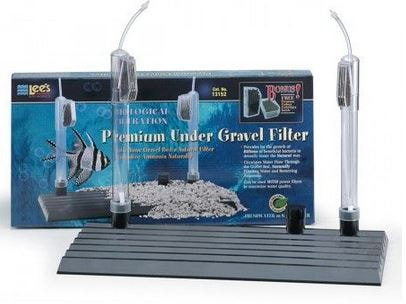
An old standby that is good for biological filtration (the conversion of fish waste from ammonia and nitrites to less harmful nitrates), but is poor to fair for mechanical filtration (the removal of debris- organic and inorganic). For biological filtration the under-gravel filter still has some drawbacks to consider too, but generally when used in an incorrect application.
It is noteworthy that I set up the entire Bahooka Restaurant (this restaurant was featured in "Fear and Loathing in Las Vegas" and had 110+ aquariums, most over 75 gallons) with only under-gravel filters and they preformed well under the proper care and optimum conditions for this type of filter (some even planted too).
Although I have used many over the years with good to very good results (regular vacuuming and lower bio load is needed for good results), I do not generally recommend them for high bio load aquariums (but again not because they do not work for the correct application and maintenance, because they do despite anecdotal comments to the contrary).
There was one under gravel filter that stood out that is no longer available; The Nektonics UGF, with its raised ridges without slots allowed for a much better water flow especially over time when cheaper flat plate designs were packing and slowing the flow rate. I have actually clocked a higher flow rate with Nektonics UGF vs. a flat plate UGF using a 1 gallon jug placed just under the out flow and timing the fill rate. It is noteworthy that Perfecto & Lees Premium (pictured above) has a similar design under gravel filter to Nektonics.
It is noteworthy that I set up the entire Bahooka Restaurant (this restaurant was featured in "Fear and Loathing in Las Vegas" and had 110+ aquariums, most over 75 gallons) with only under-gravel filters and they preformed well under the proper care and optimum conditions for this type of filter (some even planted too).
Although I have used many over the years with good to very good results (regular vacuuming and lower bio load is needed for good results), I do not generally recommend them for high bio load aquariums (but again not because they do not work for the correct application and maintenance, because they do despite anecdotal comments to the contrary).
There was one under gravel filter that stood out that is no longer available; The Nektonics UGF, with its raised ridges without slots allowed for a much better water flow especially over time when cheaper flat plate designs were packing and slowing the flow rate. I have actually clocked a higher flow rate with Nektonics UGF vs. a flat plate UGF using a 1 gallon jug placed just under the out flow and timing the fill rate. It is noteworthy that Perfecto & Lees Premium (pictured above) has a similar design under gravel filter to Nektonics.
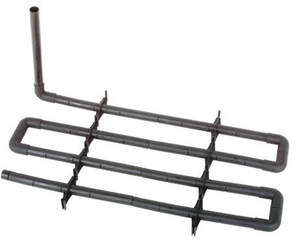
Another style of under gravel filter that was somewhat popular in the 1970s into the early 80s was the tube style. These tubes could be plastic or sometimes homemade from PVC pipes with slits or holes cut on the bottom for intake of water through the gravel. These have been brought back to life recently by at least one company I know of.
I had extensive experience using these in the 1970s into the 80s and in every case the flow pattern and resulting bio filtration was poor with the pipe design compared to other under gravel filter designs. Worse, I found these types of under gravel filters tended to allow the accumulation of organic matter that would in turn attract Saprolegnia growths.
In EVERY case when I removed these filters for even another better designed under gravel filter, the problems with Saprolegnia and other opportunistic diseases improved dramatically. About the only positive of these tube style UG filters is they work better for planted tanks as they do not interfere with roots as much as other designs.
Further Reference:
• Aquarium Saprolegnia
Most UG filters also do not perform chemical filtration although some have small carbon cartridges that go on the exhaust of the lift tube (Lee’s makes such a UGF).
If used, I recommend a HOB (power filter) as a compliment, they have better mechanical and chemical filtration, but tend to be lacking in biological filtration (some are better than others for this).
Here are a few reasons when Not to use an Under Gravel Filter: Under Gravel Filters are also not always a good choice planted aquariums; the roots have a hard time thriving with the filter just below the gravel (although you can add potted aquarium plants or aquascape in a way that better supports root systems).
UGFs are also poor (or non existent) for de-nitrification, as they do not allow for the fine sand and anaerobic bacteria needed for Nitrate removal.
Problems with Organic Mulm/ Sludge: One reason behind my lack of sometimes recommending an under gravel filter is the buildup of organic mulm. This leads to high DOC (Dissolved organic compounds) from the amount of nitric acid products from decomposition. This in turn lowers GH, KH, and increases Nitrates and Redox, none of which is good. This can be reduced by regular vacuuming and/or siphoning under the plate with a siphon tube or using a reverse flow Power Head (although my experience shows that a reverse flow does not affect over all results).
Also the corrugated design of the Nektonics UG filter also reduces DOC considerably. However these patented UG filters are no longer made, but is one or something similar, these would be the best choice for a UG filter (including over a flat plate with reverse flow).
To siphon under the plate, I usually move gravel away from the lift tubes then disconnect the lift tubes. After this I run a siphon tube (as large as will fit under the plate) and suck as much organic detritus (muck or whatever else you want to call it) as possible.
References:
• The Importance of a Balanced Aquarium Redox Potential
• Bio Load in Aquarium or Pond
Potential problems when an under gravel filter is either shut down manually or via a power failure/pump failure. This relates to the last point, in that if copious amounts of mulm/sludge build up under the plate(s) and/or the gravel and then power is cut, the aerobic bacteria living in areas of nitrification will die quickly (usually within 4 hours) and this die off will quickly lower dissolved oxygen levels to dangerous levels for fish, as well anaerobic sulfur reducing bacteria will quickly take over (especially in areas of sludge/mulm) and this will add potentially toxic Hydrogen Sulfate to the aquarium. If considering the removal of an Undergravel filter, I would first clean under the plate well then start a Sponge or other efficient bio filter, then removal the plate(s) every three weeks.
Please Reference:
• Hydrogen Sulfate production in aquariums
Often owners of UG Filters will add more gravel thinking “more is better”, while it is true that tanks with Under Gravel filters generally need more gravel than tanks without (2-3” vs. 1.5 -3” of gravel), adding copious amounts of gravel simply leads to what is called channeling and this results in dead areas and often more problems with DOC. The bottom line is if considering, note the drawbacks and that not all are equal or rather consider an AAP Sponge Filter or if your budget allows; a Fluidized Sand Bed Filter (which is unsurpassed by ANY bio filter in capacity and efficiency).
Product Resources:
• Hydro Sponge Premium Aquarium Sponge Filters
• AAP Fluidized Sand Bed Filters
Potential UGF Problems/Maintenance: Make sure to use a bottle brush to keep the lift tubes flowing smoothly, vacuum regularly especially around the lift tubes to prevent organic build up that can impede flow. Flow will be poor if too fine a gravel or sand is used, #3 gravel works best. If you use too coarse of gravel (especially do not use marbles), bio filtration will not be effective (and mechanical filtration will also be poor). If gravel is too shallow near the lift tubes, you will get a poor circulation pattern. Make sure gravel is deepest near the lift tubes. As noted earlier, make sure to siphon underneath the plates to keep problem causing mulm/sludge to a minimum.
All negatives aside, I can state that I've run many fresh & saltwater aquariums with undergravel filters with great success, just note that not all designs are the same and that bio load is more sensitive as are control of nitrates. With the Bahooka Restaurant, I performed regular vacuuming and kept low bio loads and here they worked well and actually fit better with there decor since I could hide them easily and ran ran air pressure from a large pump to all the filters.
In Summary: Do not believe the many anecdotal negatives that these filters are junk, because they are not; but these filters are certainly not for everyone either.
I had extensive experience using these in the 1970s into the 80s and in every case the flow pattern and resulting bio filtration was poor with the pipe design compared to other under gravel filter designs. Worse, I found these types of under gravel filters tended to allow the accumulation of organic matter that would in turn attract Saprolegnia growths.
In EVERY case when I removed these filters for even another better designed under gravel filter, the problems with Saprolegnia and other opportunistic diseases improved dramatically. About the only positive of these tube style UG filters is they work better for planted tanks as they do not interfere with roots as much as other designs.
Further Reference:
• Aquarium Saprolegnia
Most UG filters also do not perform chemical filtration although some have small carbon cartridges that go on the exhaust of the lift tube (Lee’s makes such a UGF).
If used, I recommend a HOB (power filter) as a compliment, they have better mechanical and chemical filtration, but tend to be lacking in biological filtration (some are better than others for this).
Here are a few reasons when Not to use an Under Gravel Filter: Under Gravel Filters are also not always a good choice planted aquariums; the roots have a hard time thriving with the filter just below the gravel (although you can add potted aquarium plants or aquascape in a way that better supports root systems).
UGFs are also poor (or non existent) for de-nitrification, as they do not allow for the fine sand and anaerobic bacteria needed for Nitrate removal.
Problems with Organic Mulm/ Sludge: One reason behind my lack of sometimes recommending an under gravel filter is the buildup of organic mulm. This leads to high DOC (Dissolved organic compounds) from the amount of nitric acid products from decomposition. This in turn lowers GH, KH, and increases Nitrates and Redox, none of which is good. This can be reduced by regular vacuuming and/or siphoning under the plate with a siphon tube or using a reverse flow Power Head (although my experience shows that a reverse flow does not affect over all results).
Also the corrugated design of the Nektonics UG filter also reduces DOC considerably. However these patented UG filters are no longer made, but is one or something similar, these would be the best choice for a UG filter (including over a flat plate with reverse flow).
To siphon under the plate, I usually move gravel away from the lift tubes then disconnect the lift tubes. After this I run a siphon tube (as large as will fit under the plate) and suck as much organic detritus (muck or whatever else you want to call it) as possible.
References:
• The Importance of a Balanced Aquarium Redox Potential
• Bio Load in Aquarium or Pond
Potential problems when an under gravel filter is either shut down manually or via a power failure/pump failure. This relates to the last point, in that if copious amounts of mulm/sludge build up under the plate(s) and/or the gravel and then power is cut, the aerobic bacteria living in areas of nitrification will die quickly (usually within 4 hours) and this die off will quickly lower dissolved oxygen levels to dangerous levels for fish, as well anaerobic sulfur reducing bacteria will quickly take over (especially in areas of sludge/mulm) and this will add potentially toxic Hydrogen Sulfate to the aquarium. If considering the removal of an Undergravel filter, I would first clean under the plate well then start a Sponge or other efficient bio filter, then removal the plate(s) every three weeks.
Please Reference:
• Hydrogen Sulfate production in aquariums
Often owners of UG Filters will add more gravel thinking “more is better”, while it is true that tanks with Under Gravel filters generally need more gravel than tanks without (2-3” vs. 1.5 -3” of gravel), adding copious amounts of gravel simply leads to what is called channeling and this results in dead areas and often more problems with DOC. The bottom line is if considering, note the drawbacks and that not all are equal or rather consider an AAP Sponge Filter or if your budget allows; a Fluidized Sand Bed Filter (which is unsurpassed by ANY bio filter in capacity and efficiency).
Product Resources:
• Hydro Sponge Premium Aquarium Sponge Filters
• AAP Fluidized Sand Bed Filters
Potential UGF Problems/Maintenance: Make sure to use a bottle brush to keep the lift tubes flowing smoothly, vacuum regularly especially around the lift tubes to prevent organic build up that can impede flow. Flow will be poor if too fine a gravel or sand is used, #3 gravel works best. If you use too coarse of gravel (especially do not use marbles), bio filtration will not be effective (and mechanical filtration will also be poor). If gravel is too shallow near the lift tubes, you will get a poor circulation pattern. Make sure gravel is deepest near the lift tubes. As noted earlier, make sure to siphon underneath the plates to keep problem causing mulm/sludge to a minimum.
All negatives aside, I can state that I've run many fresh & saltwater aquariums with undergravel filters with great success, just note that not all designs are the same and that bio load is more sensitive as are control of nitrates. With the Bahooka Restaurant, I performed regular vacuuming and kept low bio loads and here they worked well and actually fit better with there decor since I could hide them easily and ran ran air pressure from a large pump to all the filters.
In Summary: Do not believe the many anecdotal negatives that these filters are junk, because they are not; but these filters are certainly not for everyone either.
HOB (Power Filter)
|
|
|
INCLUDING:
• Aqua Clear
• AAP/SeaChem Tidal
• Penguin & Emperor
• API SuperClean, VitaLife, Millineum
• Whisper, Aqueon
• Premium HOB Filters; Rena Smart Filter
• SunSun & Other Economy Filters
• Further Hang-On Filter Information
• HOB Filter Troubleshooting
HOB filters (hang on the back- power filters) are quite popular for good reason. They are generally inexpensive and simple to operate. Most of these filters are good for mechanical and chemical filtration, while many are generally poor to fair for bio filtration as the single cartridge HOB filters do not retain healthy bio colonies. This does vary widely with the model and can be improved via add-ons as well.
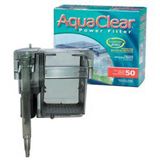
The Aqua Clear is better than most HOBs for biological filtration (if not the best) and is deservedly very popular for this reason among many experienced aquarists. However its flow design and filter media type tends to lead to flow-by, resulting in poor mechanical filtration especially for more fine debris/organic mulm. For those doubting this, I performed tests using a “light” compost in the water and the Aqua Clear faired worse than all others tested.
I should also note that the Aqua Clear Filters have poor impellers and impeller well design that more easily warp, and from my records (based on literally 100s of Aqua Clear applications in my large aquarium maintenance company), have a higher than average break down record than many other HOBs due to the impeller and impeller well/motor design. This of course does not make these a bad filter, as I have had more good ACs than bad ones, but this is still a noteworthy flaw that many should be aware of.
Another "non-issue" in my opinion is that the filter media such as the carbon or sponge might float up in the basket. This can be remedied by soaking and removing any and all air prior to introduction to the filter, then placing a small rock on the basket (this may not work for all models though). So not let this minor issue deter you from the Aqua Clear if you like other features about this filter.
Before I seem too hard on these filters, they do have a lot of bio and coarse mechanical capacity and flexibility especially in the larger models, which is where I would recommend their purchase.
However, I do not buy the argument by supporters of Aqua Clears that the cartridge style filter is more expensive to operate and vastly less efficient biologically.
The design of the SunSun, SuperClean, VitaLife, & other filter cartridges allows for multiple rinsings before the fiber degrades. As well, with a pre-filter (such as the AAP Filter Max), the cartridges can last a long time (often a few months) and many of the better models, such as the Whisper, Rena Smart Filter & SuperClean, Aqueon, SunSun, etc, come with grids, bio stars, ceramics, or sponges to improve bio capacity.
The Aqua Clear Models I do recommend most are the 70 (old 300) and the 110 (old 500), these are useful filters in terms of capacity and versatility. The model 110 is a good choice for aquariums over 70 gallons especially if backed up by another filter type.
One more point in favor of Aqua Clears (or at least the Model #70 and # 110), these can also be converted into a pretty good Nano Reef Filter with some live rock fragments (about 1”), SeaChem Matrix, or volcanic rock and even a small mud filter with the mud or even live sand in a fine nylon bag placed in the bottom of the filter.
Hopefully some of the impeller problems I have experienced in the past will be improved as the larger models of Aqua Clears are very versatile filters that I recommend. Otherwise, I still recommend the AAP Tidal Filter for a premium HOB, the API/Rena SuperClean for a good Value HOB, the and SunSun HBL line of HOB filters for economy along with some others which I discuss below.
Product Resources:
• Volcanic Rock Bio Media
• SeaChem Matrix Premium Aerobic and Anaerobic Bio Media
Summarizing from my experience and tests as to Aqua Clear: The potential buyer should consider what their aquarium filtration needs will be, so I cannot make a blanket statement to purchase or not to purchase, however I can make an educated and very experienced generalization that there are better HOB filters in terms of filtration and price than the smaller Aqua Clears, but for large HOB filtration the Aqua Clear #70 & #110 are more difficult to beat for larger aquaria (although the newer AAP SeaChem Tidal Premium HOBs are testing out well).
Points to consider for the AquaClear:
• Large capacity compared to comparably sized HOB Filters, especially bio capacity.
• Higher than normal flow by resulting in less than optimal mechanical filtration (but this may not be important to you).
• Average construction & durability (if not slightly below average) for a bit more premium priced filter
This said, even here my personal preference for freshwater aquariums (especially when value is considered) would be two different filters 'TYPES" such as a Hydro Sponge #5 PRO filter, Fluidized Bed Filter, or Wet/Dry Internal filter AND a smaller HOB such as the AAP/SunSun HBL-702 rather than one Aqua Clear 110 for an 80 gallon aquarium (although a Aqua Clear 70/110 can be complimented as well with another filter for more bio capacity and important filter redundancy).
One suggested product link:
• AAP Premium Hydro Sponge Filter
• Aqua Clear
• AAP/SeaChem Tidal
• Penguin & Emperor
• API SuperClean, VitaLife, Millineum
• Whisper, Aqueon
• Premium HOB Filters; Rena Smart Filter
• SunSun & Other Economy Filters
• Further Hang-On Filter Information
• HOB Filter Troubleshooting
HOB filters (hang on the back- power filters) are quite popular for good reason. They are generally inexpensive and simple to operate. Most of these filters are good for mechanical and chemical filtration, while many are generally poor to fair for bio filtration as the single cartridge HOB filters do not retain healthy bio colonies. This does vary widely with the model and can be improved via add-ons as well.
The Aqua Clear is better than most HOBs for biological filtration (if not the best) and is deservedly very popular for this reason among many experienced aquarists. However its flow design and filter media type tends to lead to flow-by, resulting in poor mechanical filtration especially for more fine debris/organic mulm. For those doubting this, I performed tests using a “light” compost in the water and the Aqua Clear faired worse than all others tested.
I should also note that the Aqua Clear Filters have poor impellers and impeller well design that more easily warp, and from my records (based on literally 100s of Aqua Clear applications in my large aquarium maintenance company), have a higher than average break down record than many other HOBs due to the impeller and impeller well/motor design. This of course does not make these a bad filter, as I have had more good ACs than bad ones, but this is still a noteworthy flaw that many should be aware of.
Another "non-issue" in my opinion is that the filter media such as the carbon or sponge might float up in the basket. This can be remedied by soaking and removing any and all air prior to introduction to the filter, then placing a small rock on the basket (this may not work for all models though). So not let this minor issue deter you from the Aqua Clear if you like other features about this filter.
Before I seem too hard on these filters, they do have a lot of bio and coarse mechanical capacity and flexibility especially in the larger models, which is where I would recommend their purchase.
However, I do not buy the argument by supporters of Aqua Clears that the cartridge style filter is more expensive to operate and vastly less efficient biologically.
The design of the SunSun, SuperClean, VitaLife, & other filter cartridges allows for multiple rinsings before the fiber degrades. As well, with a pre-filter (such as the AAP Filter Max), the cartridges can last a long time (often a few months) and many of the better models, such as the Whisper, Rena Smart Filter & SuperClean, Aqueon, SunSun, etc, come with grids, bio stars, ceramics, or sponges to improve bio capacity.
The Aqua Clear Models I do recommend most are the 70 (old 300) and the 110 (old 500), these are useful filters in terms of capacity and versatility. The model 110 is a good choice for aquariums over 70 gallons especially if backed up by another filter type.
One more point in favor of Aqua Clears (or at least the Model #70 and # 110), these can also be converted into a pretty good Nano Reef Filter with some live rock fragments (about 1”), SeaChem Matrix, or volcanic rock and even a small mud filter with the mud or even live sand in a fine nylon bag placed in the bottom of the filter.
Hopefully some of the impeller problems I have experienced in the past will be improved as the larger models of Aqua Clears are very versatile filters that I recommend. Otherwise, I still recommend the AAP Tidal Filter for a premium HOB, the API/Rena SuperClean for a good Value HOB, the and SunSun HBL line of HOB filters for economy along with some others which I discuss below.
Product Resources:
• Volcanic Rock Bio Media
• SeaChem Matrix Premium Aerobic and Anaerobic Bio Media
Summarizing from my experience and tests as to Aqua Clear: The potential buyer should consider what their aquarium filtration needs will be, so I cannot make a blanket statement to purchase or not to purchase, however I can make an educated and very experienced generalization that there are better HOB filters in terms of filtration and price than the smaller Aqua Clears, but for large HOB filtration the Aqua Clear #70 & #110 are more difficult to beat for larger aquaria (although the newer AAP SeaChem Tidal Premium HOBs are testing out well).
Points to consider for the AquaClear:
• Large capacity compared to comparably sized HOB Filters, especially bio capacity.
• Higher than normal flow by resulting in less than optimal mechanical filtration (but this may not be important to you).
• Average construction & durability (if not slightly below average) for a bit more premium priced filter
This said, even here my personal preference for freshwater aquariums (especially when value is considered) would be two different filters 'TYPES" such as a Hydro Sponge #5 PRO filter, Fluidized Bed Filter, or Wet/Dry Internal filter AND a smaller HOB such as the AAP/SunSun HBL-702 rather than one Aqua Clear 110 for an 80 gallon aquarium (although a Aqua Clear 70/110 can be complimented as well with another filter for more bio capacity and important filter redundancy).
One suggested product link:
• AAP Premium Hydro Sponge Filter
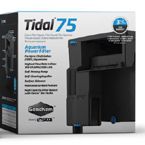
AAP/SeaChem Tidal: This is a newer entry into the premium aquarium HOB power filter niche from a company already known for their quality products & information. The feedback from professionals is so far good. As well, I am currently testing the filter too with it so far being now my first choice for a top notch HOB aquarium filter.
This filter takes many of the concepts from the Aqua Clear as well as the newer Tetra/Whispers and improves on them and provides a top notch 3 year warranty to back these filters up.
What I like is is it uses the concept of multi media use in a larger capacity filter similar to the AquaClear, but then provide a better tray feature, skimming, a maintenance monitor shows when the filter basket needs cleaning, better self priming motor, and simply a more solidly built filter.
However one of the negatives also found in the AquaClear is found in this filter and that is its "flow by" is higher and fine particulate mechanical filtration is not as good as some other HOB filters. This said, the way the basket fits is still better than the AquaClear with lower "flow by"
Time will tell on its durability as while I have used literally 100s of Aqua Clear filters over the years, I do not have this experience of time & numbers with this filter, but based on my experience of using many different HOB Filters over the years, I expect this filter to not only stand up as the premier HOB filter in its class, but also be a durably long lasting filter too with an unsurpassed warranty too!
Product Resource:
• AAP/SeaChem Tidal Aquarium HOB Filters
Beware of clearance Tidal Filters sold via Amazon, Chewy, and other online discounters at prices that are "too good to be true". These are not authorized by SeaChem and have no viable warranty and many are damaged items!
The Penguin & Emperor has good mechanical filtration (little flow-by), but are not as good for bio filtration even with the Bio-Wheel, which is vastly over-rated as per the tests I performed through my aquarium maintenance business. I removed the bio wheel on penguin filters in comparable aquariums with comparable bio loads and fish and found no discernible ammonia spike. Yet when HOB filters that had running Sponge Pre-Filters attached to their intakes were removed, there were discernible ammonia spikes. What this means is that the Bio Wheel was NOT the primary source or even an important source of bio filtration for the tanks with the bio wheels.
For more FULL information about my experiments with Bio Wheels, please read this article:
• Do Bio Wheels really work?
There are NO penguins I recommend, ESPECIALLY the Emperor models as I have had so many impeller problems with these, not to mention they have the problem of becoming "Nitrate factories". In fact as per Emperors Filters in EVERY case where I removed an Emperor Filter and replaced it in one test with a Hydro Sponge #5 and Internal Filter, along with the use of either SeaChem Matrix (SeaChem de-Nitrate in previous years) or Purigen; tank conditions improved considerably.
Why might one ask? The reason is simple, and that is the basket arrangement in the Emperor is similar to many canister filters, with the exception that it does not allow efficient anaerobic de-nitrification with products such as SeaChem Matrix, de-Nitrate, volcanic rock, Purigen, live rock crumbles, etc. and simply becomes a nitrate factory!
Product Resource:
• SeaChem Purigen
While I would not throw away one of these filters if you already own one (as these filters can and do work); the bottom line as to Emperors/ Penguins despite some anecdotal hype around these filters, DO NOT waste your money on one if you are in the market for a new filter. If you already have one, back it up with a Sponge, Internal, Internal Wet/Dry, Fluidized, etc. (which you should with ANY filter anyway).
I will also note that the Aqua-Tech sold by Walmart is simply a stripped down Penguin with no bio capacity at other than the cartridge, which when thrown away destroys all nitrifying bacterial colonies. At least the Bio Wheel maintains some bio colonies, but his filter does not and should be avoided more so than the Penguin if used as the ONLY filter!
From my experience, your money is better spent with an Aqueon, SunSun or Whisper, or especially the premier HOB (when used CORRECTLY with a pre-filter); the Rena Smart Filter.
This filter takes many of the concepts from the Aqua Clear as well as the newer Tetra/Whispers and improves on them and provides a top notch 3 year warranty to back these filters up.
What I like is is it uses the concept of multi media use in a larger capacity filter similar to the AquaClear, but then provide a better tray feature, skimming, a maintenance monitor shows when the filter basket needs cleaning, better self priming motor, and simply a more solidly built filter.
However one of the negatives also found in the AquaClear is found in this filter and that is its "flow by" is higher and fine particulate mechanical filtration is not as good as some other HOB filters. This said, the way the basket fits is still better than the AquaClear with lower "flow by"
Time will tell on its durability as while I have used literally 100s of Aqua Clear filters over the years, I do not have this experience of time & numbers with this filter, but based on my experience of using many different HOB Filters over the years, I expect this filter to not only stand up as the premier HOB filter in its class, but also be a durably long lasting filter too with an unsurpassed warranty too!
Product Resource:
• AAP/SeaChem Tidal Aquarium HOB Filters
Beware of clearance Tidal Filters sold via Amazon, Chewy, and other online discounters at prices that are "too good to be true". These are not authorized by SeaChem and have no viable warranty and many are damaged items!
The Penguin & Emperor has good mechanical filtration (little flow-by), but are not as good for bio filtration even with the Bio-Wheel, which is vastly over-rated as per the tests I performed through my aquarium maintenance business. I removed the bio wheel on penguin filters in comparable aquariums with comparable bio loads and fish and found no discernible ammonia spike. Yet when HOB filters that had running Sponge Pre-Filters attached to their intakes were removed, there were discernible ammonia spikes. What this means is that the Bio Wheel was NOT the primary source or even an important source of bio filtration for the tanks with the bio wheels.
For more FULL information about my experiments with Bio Wheels, please read this article:
• Do Bio Wheels really work?
There are NO penguins I recommend, ESPECIALLY the Emperor models as I have had so many impeller problems with these, not to mention they have the problem of becoming "Nitrate factories". In fact as per Emperors Filters in EVERY case where I removed an Emperor Filter and replaced it in one test with a Hydro Sponge #5 and Internal Filter, along with the use of either SeaChem Matrix (SeaChem de-Nitrate in previous years) or Purigen; tank conditions improved considerably.
Why might one ask? The reason is simple, and that is the basket arrangement in the Emperor is similar to many canister filters, with the exception that it does not allow efficient anaerobic de-nitrification with products such as SeaChem Matrix, de-Nitrate, volcanic rock, Purigen, live rock crumbles, etc. and simply becomes a nitrate factory!
Product Resource:
• SeaChem Purigen
While I would not throw away one of these filters if you already own one (as these filters can and do work); the bottom line as to Emperors/ Penguins despite some anecdotal hype around these filters, DO NOT waste your money on one if you are in the market for a new filter. If you already have one, back it up with a Sponge, Internal, Internal Wet/Dry, Fluidized, etc. (which you should with ANY filter anyway).
I will also note that the Aqua-Tech sold by Walmart is simply a stripped down Penguin with no bio capacity at other than the cartridge, which when thrown away destroys all nitrifying bacterial colonies. At least the Bio Wheel maintains some bio colonies, but his filter does not and should be avoided more so than the Penguin if used as the ONLY filter!
From my experience, your money is better spent with an Aqueon, SunSun or Whisper, or especially the premier HOB (when used CORRECTLY with a pre-filter); the Rena Smart Filter.
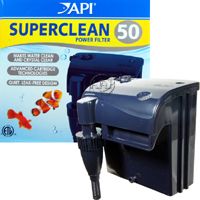
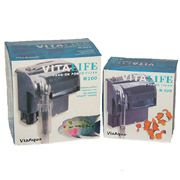
The Rena Superclean and older Via Aqua VitaLife and Millineum are the excellent "Simple" Hang-On filters for freshwater tanks under 60 gallons, with the SuperClean getting the edge due to the surface skimmer feature (not to be confused with a protein Skimmer), lower price (and thus better value), & reliable impeller design.
The SuperClean filters also have a low “flow by rate” and are thus much better for mechanical filtration (these cartridges are easily rinsed and re-used as well).
The SuperClean utilizes a unique plastic "fence" where highly porous ceramic bio media are placed (supplied with filter), that is a simpler and more reliable way to maintain nitrifying bacterial colonies than a bio wheel
Unfortunately, both the ViaAqua VitaLife and Millineum filters have suffered from the down turn in the economy that started in 2008 and are no longer available (except for a few of the M100 models). However a cheap "knock off" off of the VitaLife is now made by by a rather unethical aquarium supply company, avoid this filter that might look like a Vitalife, but is not the same filter in quality.
A useful feature beside the fact that these filters are supplied with the well documented BioChem Zorb which is superior to carbon used in other filters, these filters will have the option of cartridges with NitriZorb (for ammonia/nitrate removal)& Phoszorb (for phosphate removal). Prices are from about $20 for the 20 model and $35 for the 50 model.
The SuperClean filters also have a low “flow by rate” and are thus much better for mechanical filtration (these cartridges are easily rinsed and re-used as well).
The SuperClean utilizes a unique plastic "fence" where highly porous ceramic bio media are placed (supplied with filter), that is a simpler and more reliable way to maintain nitrifying bacterial colonies than a bio wheel
Unfortunately, both the ViaAqua VitaLife and Millineum filters have suffered from the down turn in the economy that started in 2008 and are no longer available (except for a few of the M100 models). However a cheap "knock off" off of the VitaLife is now made by by a rather unethical aquarium supply company, avoid this filter that might look like a Vitalife, but is not the same filter in quality.
A useful feature beside the fact that these filters are supplied with the well documented BioChem Zorb which is superior to carbon used in other filters, these filters will have the option of cartridges with NitriZorb (for ammonia/nitrate removal)& Phoszorb (for phosphate removal). Prices are from about $20 for the 20 model and $35 for the 50 model.
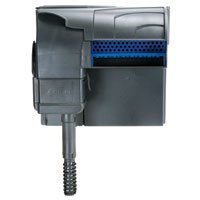
The older Whisper Filters are an industry standard for simple economical Hang-On Aquarium Filters with additional bio filtration. While not the best, these are reliable filters with a popular following for good reasons.
The new Aqueon and Whisper EX series aquarium power filters feature the pump (power unit) outside the aquarium instead of at the bottom of the filter as most Aquarium HOB Filters are configured.
The even newer SunSun HBL 702 series HOB filter also has this new feature.
This has its advantages and disadvantages; the main advantage is there is not a need to prime the filter by adding water to it or the risk of debris such as carbon getting sucked into the impeller well, thus jamming the filter impeller. The later advantage is definitely a selling point. The minor disadvantage is it is possible for the filter minimum water level to be obtained via evaporation, especially if the aquarium owner is out of town. This can and has resulted in filter failure. With normal maintenance, this is problem that should not occur.
The Whisper EX version of this design has a “time strip tab” to indicate the exhaustion of carbon, however my opinion of this is it is a gimmick, as most persons over use carbon in healthy established aquariums and over rate its need.
See this article:
• Aquarium Filter Media, Types and Uses
I would recommend the lower priced Aqueon over the Whisper even though it does not have the “time strip tab” feature. Neither the Aqueon or the Whisper EX offer the bio bag, however the filter cartridges are easily rinsed or purchased in multi packs for better economy.
A note as to Filter Cartridges: Whisper has come out with a new filter cartridge that does not hold up well at all. Even the popular Bio Bag (which I have used for years and have enjoyed its versatility), is made from a weakly “spun” poly fiber that does not hold up as well as many better cartridges, however the price of these bio bag cartridges when bought in bulk boxes generally made up for this.
The new Aqueon and Whisper EX series aquarium power filters feature the pump (power unit) outside the aquarium instead of at the bottom of the filter as most Aquarium HOB Filters are configured.
The even newer SunSun HBL 702 series HOB filter also has this new feature.
This has its advantages and disadvantages; the main advantage is there is not a need to prime the filter by adding water to it or the risk of debris such as carbon getting sucked into the impeller well, thus jamming the filter impeller. The later advantage is definitely a selling point. The minor disadvantage is it is possible for the filter minimum water level to be obtained via evaporation, especially if the aquarium owner is out of town. This can and has resulted in filter failure. With normal maintenance, this is problem that should not occur.
The Whisper EX version of this design has a “time strip tab” to indicate the exhaustion of carbon, however my opinion of this is it is a gimmick, as most persons over use carbon in healthy established aquariums and over rate its need.
See this article:
• Aquarium Filter Media, Types and Uses
I would recommend the lower priced Aqueon over the Whisper even though it does not have the “time strip tab” feature. Neither the Aqueon or the Whisper EX offer the bio bag, however the filter cartridges are easily rinsed or purchased in multi packs for better economy.
A note as to Filter Cartridges: Whisper has come out with a new filter cartridge that does not hold up well at all. Even the popular Bio Bag (which I have used for years and have enjoyed its versatility), is made from a weakly “spun” poly fiber that does not hold up as well as many better cartridges, however the price of these bio bag cartridges when bought in bulk boxes generally made up for this.
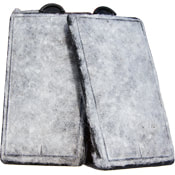
A note as to Filter Cartridges: Whisper has come out with a new filter cartridge that does not hold up well at all. Even the popular Bio Bag (which I have used for years and have enjoyed its versatility), is made from a weakly “spun” poly fiber that does not hold up as well as many better cartridges, however the price of these bio bag cartridges when bought in bulk boxes generally made up for this.
However this new cartridge is not as inexpensive as it once was, and does not even hold up as well as the previous cartridge. Another point that is often missed in this subject of cost, is effectiveness. As the better made cartridges such as those offered for the AAP/SunSun HBL, Via Aqua M100/200 have a much better and tighter weave that traps more and smaller micron debris.
This is a good example where the cost of a product may not truly reflect its value, since I have rinsed many of these VitaLife as well as those for the similar AAP/SunSun HBL series Filter Cartridges over a dozen times before disposing of them, which actually makes them a better price for a vastly better cartridge.
However this new cartridge is not as inexpensive as it once was, and does not even hold up as well as the previous cartridge. Another point that is often missed in this subject of cost, is effectiveness. As the better made cartridges such as those offered for the AAP/SunSun HBL, Via Aqua M100/200 have a much better and tighter weave that traps more and smaller micron debris.
This is a good example where the cost of a product may not truly reflect its value, since I have rinsed many of these VitaLife as well as those for the similar AAP/SunSun HBL series Filter Cartridges over a dozen times before disposing of them, which actually makes them a better price for a vastly better cartridge.
Rena Smart HOB Filters: The Former Rena Smart HOB Filters were an excellent idea for an HOB/Power Filter as they had the lowest flow-by of ANY HOB filter as they operate much like a canister filter by their unique design pulls water through filter columns as well as passing water through a 4-sided filter cartridge which contains Bio Chem Zorb and Bio Chem Stars for excellent chemical and bio filtration.
The only negatives of the "Smart Filter" in my opinion (based on my professional aquarium service partners) are that the cartridges are expensive to replace and can clog quickly due to high filter efficiency. As long as the user is aware of this and checks the cartridge sleeves regularly, especially when the filter is newly installed on a dirty tank, this should not be a problem.
As well, for BEST results, I highly recommend and ONLY use Filter Max Pre-Filters along with the Rena Smart Filter. This can greatly reduce this problem of quick clogging cartridges in the Rena Smart Filter, and in fact adds additional filtration (both bio and mechanical) that combined makes this far and way the best HOB style aquarium filter when correctly configured!!!
See product link:
• Filter Max Pre-Filter
What is unfortunate, is the uninformed anecdotal reviews (such as at Amazon) that permeate the Internet condemning this filter for what is actually a positive. As noted earlier this filter is so efficient, that it can clog easily; this is NOT a flaw, rather users simply should be aware of this and maintain this filter accordingly and add a quality pre-filter as recommended by aquarium professionals!
It is noteworthy that there is NO PROBLEM with the leveling feet, rather it is the lack of use of a pre-filter as previously noted that can cause this filter to leak out the back due to clogging. Unfortunately Amazon has "no skin in the game", provides no service or scientific knowledge to the products they sell and most importantly since they have no knowledge of how the Rena Smart Filter should be properly set up, do NOT sell this product with the correct pre-filter, thus resulting in the irresponsible and incorrect reviews.
The end result has been one of the best HOB filter ideas, is now a discontinued filter line. Remember this next time you shop with Amazon for anything aquarium related, as they provide no real information with their format, nor can one as an Amazon retailer (I know this for a fact as Amazon has courted me several times and my principles have not allowed me to sell under their system). Reading reviews on Amazon and then purchasing many aquarium products there is akin to doing the same for your medical needs then complaining to your Doctor when they do not work correctly!
In summary, the initial filter purchase price is high, but the filter sleeve part of these cartridges can be removed and then rinsed clean with a strong jet of clean water so as to extend the life of cartridge sleeves. That said, for those willing to spend the money, this is otherwise the BEST HOB/Aquarium Power Filter Money can buy, with the highest efficiency, along with one of the more reliable and quiet motors of any HOB aquarium filter.
The only negatives of the "Smart Filter" in my opinion (based on my professional aquarium service partners) are that the cartridges are expensive to replace and can clog quickly due to high filter efficiency. As long as the user is aware of this and checks the cartridge sleeves regularly, especially when the filter is newly installed on a dirty tank, this should not be a problem.
As well, for BEST results, I highly recommend and ONLY use Filter Max Pre-Filters along with the Rena Smart Filter. This can greatly reduce this problem of quick clogging cartridges in the Rena Smart Filter, and in fact adds additional filtration (both bio and mechanical) that combined makes this far and way the best HOB style aquarium filter when correctly configured!!!
See product link:
• Filter Max Pre-Filter
What is unfortunate, is the uninformed anecdotal reviews (such as at Amazon) that permeate the Internet condemning this filter for what is actually a positive. As noted earlier this filter is so efficient, that it can clog easily; this is NOT a flaw, rather users simply should be aware of this and maintain this filter accordingly and add a quality pre-filter as recommended by aquarium professionals!
It is noteworthy that there is NO PROBLEM with the leveling feet, rather it is the lack of use of a pre-filter as previously noted that can cause this filter to leak out the back due to clogging. Unfortunately Amazon has "no skin in the game", provides no service or scientific knowledge to the products they sell and most importantly since they have no knowledge of how the Rena Smart Filter should be properly set up, do NOT sell this product with the correct pre-filter, thus resulting in the irresponsible and incorrect reviews.
The end result has been one of the best HOB filter ideas, is now a discontinued filter line. Remember this next time you shop with Amazon for anything aquarium related, as they provide no real information with their format, nor can one as an Amazon retailer (I know this for a fact as Amazon has courted me several times and my principles have not allowed me to sell under their system). Reading reviews on Amazon and then purchasing many aquarium products there is akin to doing the same for your medical needs then complaining to your Doctor when they do not work correctly!
In summary, the initial filter purchase price is high, but the filter sleeve part of these cartridges can be removed and then rinsed clean with a strong jet of clean water so as to extend the life of cartridge sleeves. That said, for those willing to spend the money, this is otherwise the BEST HOB/Aquarium Power Filter Money can buy, with the highest efficiency, along with one of the more reliable and quiet motors of any HOB aquarium filter.
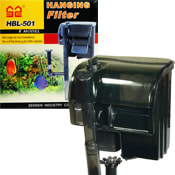
Economy HOB Filters: The AAP/SunSun HBL-501 or AAP/SunSun HBL-702 are very good economy HOB filters (there are several "good" economy HOB Filters), with both cartridge AND Bio Sponges/Grids.
Another plus, while being a top notch economy filter, they are inexpensive.
The 501 model has a small skimmer/aerator feature, while the 702 model has the new and popular feature of an "in tank" motor (similar to the Aqueon & Tetra) that makes for a very easy start up and more importantly lowers the risk of the impeller drawing debris that settles inside the filter impeller well, often from stray carbon. For the price the AAP HBL 702 is definitely a better value than the more pricey Aqueon & Tetra of comparable size as I have found no difference in quality of build or filter efficiency!
As well, these filters come with a cartridge that is actually superior to many more pricey HOB Filters such as the Whisper or Penguin in that it is easily pressure rinsed for re-use in mechanical filtration. Also, these filters have proven to be reasonably reliable and quiet; again at least comparable to the Aqua Clear, Penguin and other filters I have used in the 100s over the years.
With the 'double' SunSun HBL-702, I often recommend removing one of the Bio Grids and replacing with SeaChem Matrix or SeaChem Purigen for Nitrate Control, especially these are to be used and small saltwater aquarium.
Product Resources:
• SeaChem Matrix
• Purigen
The only negative I have found for an otherwise excellent value economy HOB filter, is that the directions are somewhat "sparse", however this is only a very minor flaw as anyone with any familiarity with aquarium HOB power filters should have no problem connecting a SunSun HBL Filter to their aquarium.
The "in-tank" pump feature is both a positive and negative. As a positive it makes staring these filters more simple than eve, however as a negative, if you are one who lets your tank evaporate several inches, this may not be the feature for you as the motor can then run dry and malfunction. Also for tanks used for turtle, frogs, etc where you actually want the water level to be low, this filter along with the Aqueon and Tetra Filters with this feature are not for you.
Another Economy HOB filter is the Top Fin which is actually a mass market version of the Whisper Filter, however it does not include the bio sponge insert that is available with higher end Whispers, as well the Top Fin is prone to some impeller problems. The Top fin is not a bad choice for those on a budget, however I strongly recommend that these filters be improved biologically with a Pre-Filter Sponge or simply be complimented with an additional filter such as a Hydro Sponge Filter since these economy filters do not maintain bio filtration capacities each time the filter cartridge is changed.
Product Resource:
• Filter Max Aquarium Pre-Filters
There are many other Economy Aquarium Power Filters available, too many to mention, but from my use of many, as well as simply knowing from experience which features are important for a healthy aquarium; the SunSun HBL series is certainly the best of the bunch and often outperforms many much more expensive filters including the Penguin.
Further Hang-On Filter Suggestions, Information: I generally prefer/recommend cartridge filters with additional Bio Sponges or grids for a good mix of mechanical, chemical, & bio filtration.
However, you need to look at what you need your filter for. If you have little debris in your aquarium (requiring good mechanical filtration) but a high bio load, the Aqua Clear may be for you (their mechanical problems aside). As I will note elsewhere in this article, a pre-filter will vastly improve bio-filtration in many cartridge style HOB Filters, although many Whispers, SunSun, & similar come with a secondary sponge or bio grid for added bio filtration (the VitaLife & Millennium have a bio-grid).
However with small economy HOB filters often sold at Walmart or PetsMart such as the TopFin or small Whispers without any bio filter capacities, a Pre-Filter Sponge will considerably aid in bio filtration & is strongly suggested (for only about $6).
See product link:
• Filter Max Sponge Pre-Filters
Even though HOB Filters are not first choice for marine aquariums, they can and do work here as well, usually in smaller applications (under 60 gallons). I generally prefer the Aqua Clear, Via Aqua VitaLife M200 (although now discontinued), or even the the SunSun HBL-702 for this application.
For whatever your choice may be, the addition of Live Rock fragments, SeaChem Matrix, SeaChem Purigen, or volcanic rock via a filter bag will improve marine aquarium filtration (I remove the bio grid in the M 200 and substitute the filter bag instead).
Product Resource:
• Volcanic Rock
One more note about the older style (not the new EX series) Whisper HOB filters; one nice thing about these filters is you can buy the “Bio Bag” filter inserts in bulk boxes cheaply at many local fish stores. I like this feature as it gives you options of economy and ease of carbon removal for treatment or established aquariums (which I rarely use carbon in except occasionally).
You can “cut” the carbon out of Penguin, VitaLife, Sunsun, or other filters or simply let it become a bio media by not removing it and only rinsing the fiber part of the cartridge, thus saving money on new cartridges. I often clean my VitaLife & SunSun Cartridges with a strong jet of water and use them over many times, which unfortunately the Bio Bags are too cheaply made to tolerate this “jet” of water or even a simple rinsing without falling apart (this is one of the reasons I like these two filters is the economy of filter cartridge reuse).
Many years back I performed a few tests on “flow by” on Aqua Clears vs. Whisper and a couple other HOB filters (for mechanical filtration and chemical filtration).
• Test [1]: Using a bare tank (20 gallons) and original carbon. I added Methylene Blue and the Whisper removed the Methylene Blue quicker.
Product Resource:
• Kordon Methylene Blue
• Test [2]: I added a washed gravel slurry again to a bare 20 gallon aquarium and again the Whisper removed the debris much quicker this time than the Aqua Clear. I also have used the Penguin and Via Aqua Vita Life; both were also quicker at removing the debris as well (the Via Aqua was the fastest). During this test I used an air stone on the bottom to keep the debris suspended. This experiment included these filers at the time it was conducted: Aqua Clear 150 (now the #30), Whisper 2 (#40), Penguin 170 (replaced by 200), and Via Aqua Vita Life 200.
This brings me to the point that many HOB filters can be equipped with Pre-Filters (the Filter Max is the best due to its patented sponge technology). Pre-Filters vastly increase bio filtration, are inexpensive, prevent baby fish from being sucked into the filter, and provide a measure of bio stability when the cartridge is changed. It should be noted that with Aqua Clears, pre-filters are not as necessary for bio filtration (they still improve it though), although these pre-filters still prevent fry from being sucked into the Aqua Clear.
A complaint with pre-filters I have occasionally heard (not from experienced users) is that they end up performing all the mechanical filtration duties of your HOB filter; HOWEVER this is not true. With cartridge style HOB filters (Penguin, Whisper, Via Aqua, etc.), the pre-filter will remove most of the medium to coarse debris BEFORE passing into the cartridge where the cartridge will then remove the more fine debris. This will have the added benefit will be longer periods between cartridges which will also save you money.
Potential HOB Filter problems (Trouble Shooting):
• Make sure to clean the impeller regularly, also clean the area the impeller “nests” (impeller well) to prevent debris from stopping the impeller. If the impeller stops, check for carbon caught in this area and make sure impeller itself is not broken.
The design of many HOB Power Filters tends to allow carbon, or other grit such as rock, gravel, even particles of volcanic rock or other media to get caught in the impeller well between the impeller magnet and well wall. This is not generally a problem with some of the new models such as the SunSun HBL 702 that have the motor built into the intake and placed inside the aquarium
A “buzzing” noise is a tell tale sign of this problem. All filter media, cartridges, carbon, volcanic rock, etc should always be rinsed to prevent this. Removal of this debris, is generally quite simple, often a back flush with water while turning the filter upside down will clear out the problem debris; if not removal of the motor unit with the impeller and physically removing the impeller and cleaning out the debris will remedy the problem (please note, the Penguin motor is built in, so you have to remove the impeller from the top to service this filter).
The impeller should be to turn 359 degrees before locking, if the impeller spins freely or not at all, it is broken. Clean filter intakes with a foxtail brush to prevent build up that will slow the filter (a sponge pre-filter helps prevent this).
• Improperly seated impeller: This is a very common problem with all HOB filters with bottom fitted motors (which is the majority). The intake tube should securely and 'squarely' fit the area that houses the impeller. The symptoms of this is rattling noises, sometimes very loud and poor flow.
• Water flowing out the over flow: This is by design with most all HOB Aquarium Power filters to prevent overflow out the back. This can be in the middle section with double filters or the intake side with single filters. The cause is generally clogged filter cartridges or other filter material. Sometimes additional material added if improperly paced or crowding the filter can cause the filter to over flow even if other filter material is clean.
• HOB Power Filter not seating properly on the back of aquarium: While almost ALL HOB filters have the same basic design and fit just about equally well, it is often the aquarium trim or lack there of that can make mounting a bit more difficult.
This said, I have never in 100s of HOB mountings with dozens of brands failed to find one that I could not fit. Generally just trimming the lip of the molding/trim is all that is necessary if the trim is too thick.
Sometimes the trim is too thin and allows the HOB filter to move too easily, often resulting in the the filter leaning backwards with disastrous results of water pouring out the back. This is often fixed by adding some duct tape rolled backward with the sticky side out and then wedging this between the tank & filter. I find this more sure than the flimsy spacer plastic pieces that are supplied with most HOB Filters.
• For bio wheels, make sure the Teflon ends on the bio wheel axle are clean and have no build ups of calcium, you can replace these with Teflon tape in a pinch. Also make sure the bio wheel assembly is not to tight, simply remove the bio wheel and gently stretch the assembly apart so the wheel can spin more freely.
Another plus, while being a top notch economy filter, they are inexpensive.
The 501 model has a small skimmer/aerator feature, while the 702 model has the new and popular feature of an "in tank" motor (similar to the Aqueon & Tetra) that makes for a very easy start up and more importantly lowers the risk of the impeller drawing debris that settles inside the filter impeller well, often from stray carbon. For the price the AAP HBL 702 is definitely a better value than the more pricey Aqueon & Tetra of comparable size as I have found no difference in quality of build or filter efficiency!
As well, these filters come with a cartridge that is actually superior to many more pricey HOB Filters such as the Whisper or Penguin in that it is easily pressure rinsed for re-use in mechanical filtration. Also, these filters have proven to be reasonably reliable and quiet; again at least comparable to the Aqua Clear, Penguin and other filters I have used in the 100s over the years.
With the 'double' SunSun HBL-702, I often recommend removing one of the Bio Grids and replacing with SeaChem Matrix or SeaChem Purigen for Nitrate Control, especially these are to be used and small saltwater aquarium.
Product Resources:
• SeaChem Matrix
• Purigen
The only negative I have found for an otherwise excellent value economy HOB filter, is that the directions are somewhat "sparse", however this is only a very minor flaw as anyone with any familiarity with aquarium HOB power filters should have no problem connecting a SunSun HBL Filter to their aquarium.
The "in-tank" pump feature is both a positive and negative. As a positive it makes staring these filters more simple than eve, however as a negative, if you are one who lets your tank evaporate several inches, this may not be the feature for you as the motor can then run dry and malfunction. Also for tanks used for turtle, frogs, etc where you actually want the water level to be low, this filter along with the Aqueon and Tetra Filters with this feature are not for you.
Another Economy HOB filter is the Top Fin which is actually a mass market version of the Whisper Filter, however it does not include the bio sponge insert that is available with higher end Whispers, as well the Top Fin is prone to some impeller problems. The Top fin is not a bad choice for those on a budget, however I strongly recommend that these filters be improved biologically with a Pre-Filter Sponge or simply be complimented with an additional filter such as a Hydro Sponge Filter since these economy filters do not maintain bio filtration capacities each time the filter cartridge is changed.
Product Resource:
• Filter Max Aquarium Pre-Filters
There are many other Economy Aquarium Power Filters available, too many to mention, but from my use of many, as well as simply knowing from experience which features are important for a healthy aquarium; the SunSun HBL series is certainly the best of the bunch and often outperforms many much more expensive filters including the Penguin.
Further Hang-On Filter Suggestions, Information: I generally prefer/recommend cartridge filters with additional Bio Sponges or grids for a good mix of mechanical, chemical, & bio filtration.
However, you need to look at what you need your filter for. If you have little debris in your aquarium (requiring good mechanical filtration) but a high bio load, the Aqua Clear may be for you (their mechanical problems aside). As I will note elsewhere in this article, a pre-filter will vastly improve bio-filtration in many cartridge style HOB Filters, although many Whispers, SunSun, & similar come with a secondary sponge or bio grid for added bio filtration (the VitaLife & Millennium have a bio-grid).
However with small economy HOB filters often sold at Walmart or PetsMart such as the TopFin or small Whispers without any bio filter capacities, a Pre-Filter Sponge will considerably aid in bio filtration & is strongly suggested (for only about $6).
See product link:
• Filter Max Sponge Pre-Filters
Even though HOB Filters are not first choice for marine aquariums, they can and do work here as well, usually in smaller applications (under 60 gallons). I generally prefer the Aqua Clear, Via Aqua VitaLife M200 (although now discontinued), or even the the SunSun HBL-702 for this application.
For whatever your choice may be, the addition of Live Rock fragments, SeaChem Matrix, SeaChem Purigen, or volcanic rock via a filter bag will improve marine aquarium filtration (I remove the bio grid in the M 200 and substitute the filter bag instead).
Product Resource:
• Volcanic Rock
One more note about the older style (not the new EX series) Whisper HOB filters; one nice thing about these filters is you can buy the “Bio Bag” filter inserts in bulk boxes cheaply at many local fish stores. I like this feature as it gives you options of economy and ease of carbon removal for treatment or established aquariums (which I rarely use carbon in except occasionally).
You can “cut” the carbon out of Penguin, VitaLife, Sunsun, or other filters or simply let it become a bio media by not removing it and only rinsing the fiber part of the cartridge, thus saving money on new cartridges. I often clean my VitaLife & SunSun Cartridges with a strong jet of water and use them over many times, which unfortunately the Bio Bags are too cheaply made to tolerate this “jet” of water or even a simple rinsing without falling apart (this is one of the reasons I like these two filters is the economy of filter cartridge reuse).
Many years back I performed a few tests on “flow by” on Aqua Clears vs. Whisper and a couple other HOB filters (for mechanical filtration and chemical filtration).
• Test [1]: Using a bare tank (20 gallons) and original carbon. I added Methylene Blue and the Whisper removed the Methylene Blue quicker.
Product Resource:
• Kordon Methylene Blue
• Test [2]: I added a washed gravel slurry again to a bare 20 gallon aquarium and again the Whisper removed the debris much quicker this time than the Aqua Clear. I also have used the Penguin and Via Aqua Vita Life; both were also quicker at removing the debris as well (the Via Aqua was the fastest). During this test I used an air stone on the bottom to keep the debris suspended. This experiment included these filers at the time it was conducted: Aqua Clear 150 (now the #30), Whisper 2 (#40), Penguin 170 (replaced by 200), and Via Aqua Vita Life 200.
This brings me to the point that many HOB filters can be equipped with Pre-Filters (the Filter Max is the best due to its patented sponge technology). Pre-Filters vastly increase bio filtration, are inexpensive, prevent baby fish from being sucked into the filter, and provide a measure of bio stability when the cartridge is changed. It should be noted that with Aqua Clears, pre-filters are not as necessary for bio filtration (they still improve it though), although these pre-filters still prevent fry from being sucked into the Aqua Clear.
A complaint with pre-filters I have occasionally heard (not from experienced users) is that they end up performing all the mechanical filtration duties of your HOB filter; HOWEVER this is not true. With cartridge style HOB filters (Penguin, Whisper, Via Aqua, etc.), the pre-filter will remove most of the medium to coarse debris BEFORE passing into the cartridge where the cartridge will then remove the more fine debris. This will have the added benefit will be longer periods between cartridges which will also save you money.
Potential HOB Filter problems (Trouble Shooting):
• Make sure to clean the impeller regularly, also clean the area the impeller “nests” (impeller well) to prevent debris from stopping the impeller. If the impeller stops, check for carbon caught in this area and make sure impeller itself is not broken.
The design of many HOB Power Filters tends to allow carbon, or other grit such as rock, gravel, even particles of volcanic rock or other media to get caught in the impeller well between the impeller magnet and well wall. This is not generally a problem with some of the new models such as the SunSun HBL 702 that have the motor built into the intake and placed inside the aquarium
A “buzzing” noise is a tell tale sign of this problem. All filter media, cartridges, carbon, volcanic rock, etc should always be rinsed to prevent this. Removal of this debris, is generally quite simple, often a back flush with water while turning the filter upside down will clear out the problem debris; if not removal of the motor unit with the impeller and physically removing the impeller and cleaning out the debris will remedy the problem (please note, the Penguin motor is built in, so you have to remove the impeller from the top to service this filter).
The impeller should be to turn 359 degrees before locking, if the impeller spins freely or not at all, it is broken. Clean filter intakes with a foxtail brush to prevent build up that will slow the filter (a sponge pre-filter helps prevent this).
• Improperly seated impeller: This is a very common problem with all HOB filters with bottom fitted motors (which is the majority). The intake tube should securely and 'squarely' fit the area that houses the impeller. The symptoms of this is rattling noises, sometimes very loud and poor flow.
• Water flowing out the over flow: This is by design with most all HOB Aquarium Power filters to prevent overflow out the back. This can be in the middle section with double filters or the intake side with single filters. The cause is generally clogged filter cartridges or other filter material. Sometimes additional material added if improperly paced or crowding the filter can cause the filter to over flow even if other filter material is clean.
• HOB Power Filter not seating properly on the back of aquarium: While almost ALL HOB filters have the same basic design and fit just about equally well, it is often the aquarium trim or lack there of that can make mounting a bit more difficult.
This said, I have never in 100s of HOB mountings with dozens of brands failed to find one that I could not fit. Generally just trimming the lip of the molding/trim is all that is necessary if the trim is too thick.
Sometimes the trim is too thin and allows the HOB filter to move too easily, often resulting in the the filter leaning backwards with disastrous results of water pouring out the back. This is often fixed by adding some duct tape rolled backward with the sticky side out and then wedging this between the tank & filter. I find this more sure than the flimsy spacer plastic pieces that are supplied with most HOB Filters.
• For bio wheels, make sure the Teflon ends on the bio wheel axle are clean and have no build ups of calcium, you can replace these with Teflon tape in a pinch. Also make sure the bio wheel assembly is not to tight, simply remove the bio wheel and gently stretch the assembly apart so the wheel can spin more freely.
Sponge
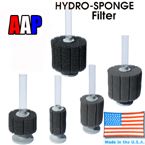
Probably one of the most under rated filters available today! In fact, with the exception of the superior Fluidized Sand Bed Filter when compared "apples to apples" there is no more efficient aerobic bio filtration filter. This superior bio filtration is dependent upon the sponge material used, which sets the American made patented "Hydro Sponge Filters" above the many imports for aerobic bio filtration.
As an example the Hydro Sponge #3 outperformed the AquaClear 50 as well as other Power Filters such as the Marineland Penguin 170 in controlled tests I performed many years back.
These filters are excellent biological filters and reasonable mechanical filters. They are simple and inexpensive. The type of sponge material makes a large difference in the filters bio capacity. One of the sponge filters benefits is their ease in cleaning, which in turn lowers the amount of organic material being broken down in the nitrogen cycle. It takes only minute to clean a sponge filter by rinsing it used aquarium water, while it may take half an hour to clean a canister filter.
Internal filters and HOB small aquariums are good compliments to sponge filters. HOB filters especially benefit from Sponge Pre-Filters.
Product Resource:
• Filter Max Sponge Pre-Filters
Canister filters are good compliments to sponge filters in large aquariums (or vice versa). As noted earlier, the Hydro Sponge #5 PRO will out perform many large HOB filters such as the Aqua Clear 110 and can be part of a large aquariums filter system despite the more common anecdotal beliefs that Sponge Filters are only for small aquariums.
Product Resource:
• Hydro Sponge #5 PRO
As for the brand of sponge filter I would recommend, the Hydro Sponge (by ATI) rises far above the rest as they hold most of the patents for sponge technology.
Recommended Product Resource:
• AAP, Lustar Professional Sponge Filters
Just as important, the ATI Hydro Sponge Filters are one of the few USA made aquarium filters you can buy, and all the knock-offs not only are inferior (& sometimes infringing on USA patents), they are all made elsewhere!
As an example the Hydro Sponge #3 outperformed the AquaClear 50 as well as other Power Filters such as the Marineland Penguin 170 in controlled tests I performed many years back.
These filters are excellent biological filters and reasonable mechanical filters. They are simple and inexpensive. The type of sponge material makes a large difference in the filters bio capacity. One of the sponge filters benefits is their ease in cleaning, which in turn lowers the amount of organic material being broken down in the nitrogen cycle. It takes only minute to clean a sponge filter by rinsing it used aquarium water, while it may take half an hour to clean a canister filter.
Internal filters and HOB small aquariums are good compliments to sponge filters. HOB filters especially benefit from Sponge Pre-Filters.
Product Resource:
• Filter Max Sponge Pre-Filters
Canister filters are good compliments to sponge filters in large aquariums (or vice versa). As noted earlier, the Hydro Sponge #5 PRO will out perform many large HOB filters such as the Aqua Clear 110 and can be part of a large aquariums filter system despite the more common anecdotal beliefs that Sponge Filters are only for small aquariums.
Product Resource:
• Hydro Sponge #5 PRO
As for the brand of sponge filter I would recommend, the Hydro Sponge (by ATI) rises far above the rest as they hold most of the patents for sponge technology.
Recommended Product Resource:
• AAP, Lustar Professional Sponge Filters
Just as important, the ATI Hydro Sponge Filters are one of the few USA made aquarium filters you can buy, and all the knock-offs not only are inferior (& sometimes infringing on USA patents), they are all made elsewhere!
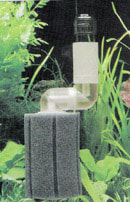
I have a lot more information about sponge filters in this article:
• SPONGE FILTRATION; How sponge Filters Work and the Benefits of using Sponge Filters in Aquariums and Ponds. This is a very in depth article and worth reading!
• SPONGE FILTRATION; How sponge Filters Work and the Benefits of using Sponge Filters in Aquariums and Ponds. This is a very in depth article and worth reading!
Internal & Power Heads
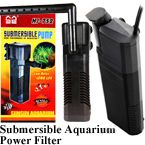
Not as common a filter but a much less costly alternative to expensive and bulky canister filters. Internal filters are basically a power head with a filter of varying capacity attached.
They are useful for improved water circulation, generally are good mechanical and biological filters (although generally they do not have a large capacity). They are a great secondary or even third filter in large aquariums, and a good secondary are even primary filter in small aquariums (under 60 gallons).
Internal filters are a good compliment to almost any filter (especially fluidized), due to the cross circulation they provide.
As well most internal filters (such as the Rio) can be placed horizontally in a small volume of water making these filters excellent choices for frog, turtle or other terrariums or vivariums.
I prefer the Rio Internal Filters for the flow rates, internal sponges and value.
They are useful for improved water circulation, generally are good mechanical and biological filters (although generally they do not have a large capacity). They are a great secondary or even third filter in large aquariums, and a good secondary are even primary filter in small aquariums (under 60 gallons).
Internal filters are a good compliment to almost any filter (especially fluidized), due to the cross circulation they provide.
As well most internal filters (such as the Rio) can be placed horizontally in a small volume of water making these filters excellent choices for frog, turtle or other terrariums or vivariums.
I prefer the Rio Internal Filters for the flow rates, internal sponges and value.
I will briefly mention Power Heads here as well as many internal filters are simply glorified Power Heads (I do not mean that in a bad way either).
Power Heads are an excellent addition as these can add valuable cross currents that are especially useful in Marine Aquariums. Many such as SunSun HJ 1542 (formerly the Via Aqua 1300) have small sponges too and this is a size that fits many saltwater tanks well. Another popular well made brand is the Rio Plus along with the medium/heavy duty Rio HF Pumps with exceptional head pressure due to their sealed Vortex Rotor Blade design.
The SunSun JP-23 is a good value/economy true power head pump that is superior to similar earlier versions of this more basic power head pump design such as the Marineland Penguin. This is an excellent choice for UG Filter lift tubes or sponge filter applications.
The Power Sweep by ZooMed has not had a good track record from my experience; this pump breaks down in short order (the gears are of poor quality) and is under powered (poor head pressure). I am also not real keen on the reliability of Aqua Clear and Marineland Power Heads (I know many have used these later two brands with success, however IMO these are dinosaurs in technology and I have literally used 100s and have seen what they can and cannot do; the Marineland in particular has poor head pressure as well).
Another new segment of the “Aquarium Pump” category are the Propeller Pumps such as the popular Hydor Koralia Pumps, however the Seio Propeller pumps have improved on the Hydor pumps in a slightly better design (as per durability) and a vastly better price (value). What is unique about this style pump is that they can move large volumes of water with small amounts of energy consumption in a VERY small pump; for example, the Seio 320 Pumps uses 4.5 watts to move 320 gph in a small 1.9" x 1.5" x 2.5" pump!
For a more thorough review of some popular power heads, please see this Aquariums Answers Post:
• Review of Popular Aquarium (& Pond) Power Heads
Potential Power Head/Pump & Internal filter Problems:
• Make sure to clean the impeller regularly, also clean the area the impeller “nests” to prevent debris from stopping the impeller. The impeller should be to turn 359 degrees before locking, if the impeller spins freely or not at all, it is broken. Make sure the media is rinsed in used tank water or de-chlorinated tap water regularly (if sponge media, change occasionally if the media is a cartridge or similar). Internal filters do not have the capacity of their larger cousins the Canister Filters, so check the media often.
Cleaning of the impeller & impeller well is especially important if your pump is only used occasionally, such as to pump water out during an aquarium cleaning. What can and DOES happen is calcium and other hard water deposits will harden inside the impeller well, in effect "gluing" the impeller to the inside of the pump, not allowing a start the next time it is used.
• Often Internal Filters or Power Heads are used to run external devices such as a UV Sterilizer or Fluidized Bed Filter. If water is left in the line after cleaning/servicing the pump or internal filter, this can result in an inability to restart properly, especially with smaller pumps/filters. Often the most simple way to correct this is to remove the return line that runs from the external device to the aquarium, then with the pump/filter running, place it into a bucket lower than the bottom of the aquarium so as to allow for a gravity assist to get the flow going again. Once flow is reestablished, replace the return line on the aquarium.
Power Heads are an excellent addition as these can add valuable cross currents that are especially useful in Marine Aquariums. Many such as SunSun HJ 1542 (formerly the Via Aqua 1300) have small sponges too and this is a size that fits many saltwater tanks well. Another popular well made brand is the Rio Plus along with the medium/heavy duty Rio HF Pumps with exceptional head pressure due to their sealed Vortex Rotor Blade design.
The SunSun JP-23 is a good value/economy true power head pump that is superior to similar earlier versions of this more basic power head pump design such as the Marineland Penguin. This is an excellent choice for UG Filter lift tubes or sponge filter applications.
The Power Sweep by ZooMed has not had a good track record from my experience; this pump breaks down in short order (the gears are of poor quality) and is under powered (poor head pressure). I am also not real keen on the reliability of Aqua Clear and Marineland Power Heads (I know many have used these later two brands with success, however IMO these are dinosaurs in technology and I have literally used 100s and have seen what they can and cannot do; the Marineland in particular has poor head pressure as well).
Another new segment of the “Aquarium Pump” category are the Propeller Pumps such as the popular Hydor Koralia Pumps, however the Seio Propeller pumps have improved on the Hydor pumps in a slightly better design (as per durability) and a vastly better price (value). What is unique about this style pump is that they can move large volumes of water with small amounts of energy consumption in a VERY small pump; for example, the Seio 320 Pumps uses 4.5 watts to move 320 gph in a small 1.9" x 1.5" x 2.5" pump!
For a more thorough review of some popular power heads, please see this Aquariums Answers Post:
• Review of Popular Aquarium (& Pond) Power Heads
Potential Power Head/Pump & Internal filter Problems:
• Make sure to clean the impeller regularly, also clean the area the impeller “nests” to prevent debris from stopping the impeller. The impeller should be to turn 359 degrees before locking, if the impeller spins freely or not at all, it is broken. Make sure the media is rinsed in used tank water or de-chlorinated tap water regularly (if sponge media, change occasionally if the media is a cartridge or similar). Internal filters do not have the capacity of their larger cousins the Canister Filters, so check the media often.
Cleaning of the impeller & impeller well is especially important if your pump is only used occasionally, such as to pump water out during an aquarium cleaning. What can and DOES happen is calcium and other hard water deposits will harden inside the impeller well, in effect "gluing" the impeller to the inside of the pump, not allowing a start the next time it is used.
• Often Internal Filters or Power Heads are used to run external devices such as a UV Sterilizer or Fluidized Bed Filter. If water is left in the line after cleaning/servicing the pump or internal filter, this can result in an inability to restart properly, especially with smaller pumps/filters. Often the most simple way to correct this is to remove the return line that runs from the external device to the aquarium, then with the pump/filter running, place it into a bucket lower than the bottom of the aquarium so as to allow for a gravity assist to get the flow going again. Once flow is reestablished, replace the return line on the aquarium.
Canister
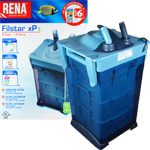
|
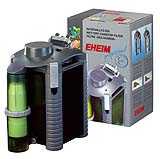
|
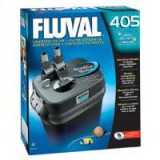
|
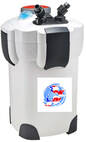
|
INCLUDING:
• Fluval
• Eheim
• Marineland Magnum
• Filstar
• AAP SunSun (Grech, Perfect, AquaTop™), Via Aqua, Hydor & similar
• Canister Filter Troubleshooting
Popular filters for larger aquariums in particular, Canister filters are known for their large capacity (most canister filters with the exception of Magnums are the ‘Kings’ of capacity), which sometimes can be their problem. Many aquarists will not clean canister filters often enough as they are “still running well”, but in reality have a large build up of organic sludge turning them into ‘nitrate factories”.
I GENERALLY recommend them if they are serviced regularly, as their ability to hold large amounts of different filter media and their excellent mechanical filtration set canister filters above many other filters.
However their general use is in freshwater aquariums and even then filters such as the Fluidized Sand Bed Filter generally have considerably more bio capacity and are preferred for planted freshwater aquariums.
But even then a combination of just about any brand AVERAGE canister filter COMBINED with a good high bio load Sponge Filter/Sponge Pre-Filter or FSB Filter/Reactor such as the AAP FSB Filters/Reactors, will far surpass many of the over priced monstrosity canister filters such as the Fluval FX6 in bio capacity with a lot of leftover savings at that.
This is a well known secret among many professional aquarium design persons such as myself, but not as well known among popular forums & Youtube celebrity hobbyists that often go for the splash of the biggest filter such as the FX, often thinking (or unaware) this is automatically the best. HOWEVER, controlled tested by adding copious amounts of organic matter then testing say otherwise to this anecdotal popular thinking - so beware and save your money!!!
Canister filters, despite many improvements in designs and features, seem to be a filter that not only is time consuming in changing for some, they presents many difficulties in initial set up and subsequent cleanings for many basic aquarium keepers based on the many questions and service calls I have had/made (which is why later in this article I provide an extensive troubleshooting guide), for this reason these are often not the best filter for many, and why a high performance sponge filter may be a better choice for less experienced aquarium keepers or those who are simply less "handy".
Reference:
• Sponge Filtration; Often the Better Bio Filter
Canister filters are still one of the best choices for a filter for fresh water aquariums over 100 gallons, especially when well maintained with regular rinses in de-chlorinated water (including foam and ceramic media).
If used in marine aquariums, I recommend the use of cured live rock crumbles, SeaChem Matrix or volcanic rock (better than bio balls or ceramic rings) to keep these filters from becoming nitrate factories.
The use of SeaChem Purigen near the final phase (where carbon and other chemical media is placed) may also help considerably with nitrate production.
For more information about this, please refer to this article:
• Marine Aquarium Information
Product Resources:
• SeaChem Matrix
• SeaChem Purigen
• Volcanic Rock
For MORE about filter media, please see this article:
• AQUARIUM FILTER MEDIA
Most Canister filters have a water flow pattern that flows from the bottom (not in the Magnum though); in these filters I would start with coarse filter media at the bottom of the canister. I would use products such as Nirox Bio Care ceramic media for coarse filtration and bio filtration (rinse this with used tank water- never tap water!), then I would use a Medium Fiber or Ehfi-Fix, then I would use filter fiber or poly filter pads and place any chemical filter media between the fiber or even in a nylon bag. For soft water (Amazon River Aquaria), I recommend Peat, IAL, or Frog (Pillow) Moss.
• Fluval
• Eheim
• Marineland Magnum
• Filstar
• AAP SunSun (Grech, Perfect, AquaTop™), Via Aqua, Hydor & similar
• Canister Filter Troubleshooting
Popular filters for larger aquariums in particular, Canister filters are known for their large capacity (most canister filters with the exception of Magnums are the ‘Kings’ of capacity), which sometimes can be their problem. Many aquarists will not clean canister filters often enough as they are “still running well”, but in reality have a large build up of organic sludge turning them into ‘nitrate factories”.
I GENERALLY recommend them if they are serviced regularly, as their ability to hold large amounts of different filter media and their excellent mechanical filtration set canister filters above many other filters.
However their general use is in freshwater aquariums and even then filters such as the Fluidized Sand Bed Filter generally have considerably more bio capacity and are preferred for planted freshwater aquariums.
But even then a combination of just about any brand AVERAGE canister filter COMBINED with a good high bio load Sponge Filter/Sponge Pre-Filter or FSB Filter/Reactor such as the AAP FSB Filters/Reactors, will far surpass many of the over priced monstrosity canister filters such as the Fluval FX6 in bio capacity with a lot of leftover savings at that.
This is a well known secret among many professional aquarium design persons such as myself, but not as well known among popular forums & Youtube celebrity hobbyists that often go for the splash of the biggest filter such as the FX, often thinking (or unaware) this is automatically the best. HOWEVER, controlled tested by adding copious amounts of organic matter then testing say otherwise to this anecdotal popular thinking - so beware and save your money!!!
Canister filters, despite many improvements in designs and features, seem to be a filter that not only is time consuming in changing for some, they presents many difficulties in initial set up and subsequent cleanings for many basic aquarium keepers based on the many questions and service calls I have had/made (which is why later in this article I provide an extensive troubleshooting guide), for this reason these are often not the best filter for many, and why a high performance sponge filter may be a better choice for less experienced aquarium keepers or those who are simply less "handy".
Reference:
• Sponge Filtration; Often the Better Bio Filter
Canister filters are still one of the best choices for a filter for fresh water aquariums over 100 gallons, especially when well maintained with regular rinses in de-chlorinated water (including foam and ceramic media).
If used in marine aquariums, I recommend the use of cured live rock crumbles, SeaChem Matrix or volcanic rock (better than bio balls or ceramic rings) to keep these filters from becoming nitrate factories.
The use of SeaChem Purigen near the final phase (where carbon and other chemical media is placed) may also help considerably with nitrate production.
For more information about this, please refer to this article:
• Marine Aquarium Information
Product Resources:
• SeaChem Matrix
• SeaChem Purigen
• Volcanic Rock
For MORE about filter media, please see this article:
• AQUARIUM FILTER MEDIA
Most Canister filters have a water flow pattern that flows from the bottom (not in the Magnum though); in these filters I would start with coarse filter media at the bottom of the canister. I would use products such as Nirox Bio Care ceramic media for coarse filtration and bio filtration (rinse this with used tank water- never tap water!), then I would use a Medium Fiber or Ehfi-Fix, then I would use filter fiber or poly filter pads and place any chemical filter media between the fiber or even in a nylon bag. For soft water (Amazon River Aquaria), I recommend Peat, IAL, or Frog (Pillow) Moss.
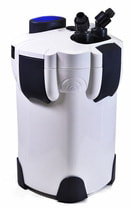
For "ECONOMY/VALUE", I generally suggest the AAP 300 & 400 series (which is also sold under different names, but many including the SunSun VARY CONSIDERABLY in quality especially if purchased via a discounter such as Amazon), although these are not necessarily the best canister filters (& in fact are NOT), these are an reasonable choice when price is a major consideration for high capacity, generally reliable canister filter, just be aware these are economy filters with absolutely NO quality control in manufacture.
SunSun has a newer 700 series canister filter, these are simply an economy-economy filter that are basically a "throw away filter" at the price they sell for. These 700 models (such as the SunSun 704B) are extremely cheaply made and when something breaks you are better off just purchasing another filter.
I would caution potential SunSun, Grech, Perfect, or similar Canister Filter buyers that there are some flaws in return and intake piping as well as there are simply no quality controls resulting in a high number of poorly functioning and/or defective filters making for some poor "out of the box" reviews that would not exist if these persons writing the review had purchased from a source that actually has testing & quality controls in place!!!
Another flaw in the newest 700 series is these simply are more cheaply built, which includes a low output ballast and medium pressure UV lamp (resulting in a UV Clarifier that is not even a Category C UV). All the testing and retrofitting in the world does not fix these flaws, SO AVOID!
Reference:
AAP Canister Filters
High Output UVC Emission from a UV Bulb/Lamp vs low output
The standard 300 & 400 series models come with almost no filter media, while the AAP upgraded/tested models has more filter media including higher bio capacity (both aerobic & anaerobic) Volcanic Rock. It is also noteworthy, that most are sold from the factory are supplied with a low cost, low output medium pressure UV lamp that has 1/4 the output of the better HO low pressure UV lamps that the AAP/SunSun models include. These standard models also include the lower cost low out aquarium ballast too (Reference: Aquarium-Pond UV Sterilizer Review; Discount Clarifiers with Low Output Ballasts).
I strongly suggest avoiding the Amazon, eBay, and other retailers that do not make these albeit corrections & more important full testing and instead sell an inferior version of what is otherwise can be a reasonably good economy aquarium canister filters when you get a working model for the price once testing/quality control is performed and all media is included along with the better UV lamps.
SunSun has a newer 700 series canister filter, these are simply an economy-economy filter that are basically a "throw away filter" at the price they sell for. These 700 models (such as the SunSun 704B) are extremely cheaply made and when something breaks you are better off just purchasing another filter.
I would caution potential SunSun, Grech, Perfect, or similar Canister Filter buyers that there are some flaws in return and intake piping as well as there are simply no quality controls resulting in a high number of poorly functioning and/or defective filters making for some poor "out of the box" reviews that would not exist if these persons writing the review had purchased from a source that actually has testing & quality controls in place!!!
Another flaw in the newest 700 series is these simply are more cheaply built, which includes a low output ballast and medium pressure UV lamp (resulting in a UV Clarifier that is not even a Category C UV). All the testing and retrofitting in the world does not fix these flaws, SO AVOID!
Reference:
AAP Canister Filters
High Output UVC Emission from a UV Bulb/Lamp vs low output
The standard 300 & 400 series models come with almost no filter media, while the AAP upgraded/tested models has more filter media including higher bio capacity (both aerobic & anaerobic) Volcanic Rock. It is also noteworthy, that most are sold from the factory are supplied with a low cost, low output medium pressure UV lamp that has 1/4 the output of the better HO low pressure UV lamps that the AAP/SunSun models include. These standard models also include the lower cost low out aquarium ballast too (Reference: Aquarium-Pond UV Sterilizer Review; Discount Clarifiers with Low Output Ballasts).
I strongly suggest avoiding the Amazon, eBay, and other retailers that do not make these albeit corrections & more important full testing and instead sell an inferior version of what is otherwise can be a reasonably good economy aquarium canister filters when you get a working model for the price once testing/quality control is performed and all media is included along with the better UV lamps.
Suggested place to purchase: AAP Canister Filters at American Aquarium.
Other similar value canister filters include the now discontinued Via Aqua line, and the Hydor PRO series canister filter which has MANY design similarities to the Via Aqua 750 and other models (really almost a carbon copy of the Via Aqua filters). The Hydor PRO is a well constructed but still economy canister filter without any gimmicks (such as built in UV Clarifiers masquerading as a True UV Sterilizer).
It does NOT include more advanced bio media such as is supplied with the API Filstar or even the properly retrofitted AAP Filters (which are only sold at AAP), but it is a solid canister filter that has the same proven disconnect system that Via Aqua employed. The Hydor would be improved if used with Volcanic Rock or Matrix as the AAP 300, 400, 500 filters are provided with.
The negatives with the Hydor PRO is the valves tend to leak (as with the Via Aqua 650/750 that it copies). These should be replaced with better ball valves. As well, the price, as while it is a very well made, it is still an economy canister filter that is priced more like a more complete high end canister filter such as the Filstar. In fact, due to the severe contraction of the Professional Aquarium Industry due to actions by Amazon, this is about the last Canister Filter in its class I can honestly recommend as the better SunSun Filters, Via Aqua, and Filstar are no longer available.
Reference:
• Buying Aquarium Products via Amazon (& Chewy, eBay)
Product Resource:
• Ball Valves to Replace Hydor or Other Canister Filter Ball Valves
Here is a video for the Hydor Pro Filter: YouTube:
• Hydor Professional Aquarium External Filter
Other similar value canister filters include the now discontinued Via Aqua line, and the Hydor PRO series canister filter which has MANY design similarities to the Via Aqua 750 and other models (really almost a carbon copy of the Via Aqua filters). The Hydor PRO is a well constructed but still economy canister filter without any gimmicks (such as built in UV Clarifiers masquerading as a True UV Sterilizer).
It does NOT include more advanced bio media such as is supplied with the API Filstar or even the properly retrofitted AAP Filters (which are only sold at AAP), but it is a solid canister filter that has the same proven disconnect system that Via Aqua employed. The Hydor would be improved if used with Volcanic Rock or Matrix as the AAP 300, 400, 500 filters are provided with.
The negatives with the Hydor PRO is the valves tend to leak (as with the Via Aqua 650/750 that it copies). These should be replaced with better ball valves. As well, the price, as while it is a very well made, it is still an economy canister filter that is priced more like a more complete high end canister filter such as the Filstar. In fact, due to the severe contraction of the Professional Aquarium Industry due to actions by Amazon, this is about the last Canister Filter in its class I can honestly recommend as the better SunSun Filters, Via Aqua, and Filstar are no longer available.
Reference:
• Buying Aquarium Products via Amazon (& Chewy, eBay)
Product Resource:
• Ball Valves to Replace Hydor or Other Canister Filter Ball Valves
Here is a video for the Hydor Pro Filter: YouTube:
• Hydor Professional Aquarium External Filter
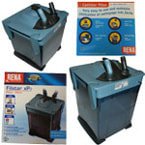
The best standard canister filter (non "pro" model) from my decades aquarium maintenance is the AAP/Rena (API) Filstar XP (although more money than the SunSun & similar economy filter, but often less than the Fluval which are but an economy canister filter with a high price tag).
This canister filter is probably about the best with flow pattern, efficiency, reasonably good construction (although not as good as earlier Filstar models), reliability, ease of use and surpasses the Fluval & many others. Even with the popular and also excellent Eheim Classic Models, the AAP Filstar is the often better choice based on my extensive use of both.
Another advantage is that some sellers of the AAP/Rena Filstar include the super premium filtration media "Bio-Chem Zorb" which is vastly superior to carbon. This product is similar to a high grade carbon and Purigen combined. As well, the Filstar is supplied by some sellers with Bio-Chem Stars which are also a superior bio filtration media to the ceramic rings many filters are supplied with.
In the end, THIS IS MY CHOICE for canister filters when price, quality, & effectiveness are factored in. I will however admit that the newer model Filstar Filters do not include as many parts and is a bit more thin walled in construction, HOWEVER I would still recommend this filter over the SunSun, Eheim, Fluval, & Hydor as well as many others based on my use in 100s of aquariums.
In fact from my experience, the Rena Filstar XP Filter Systems are the best canister filters in their category (when apples to apples models are compared)! The only negative with the Rena Filstar head pressure, as although the head pressure is better than some comparable models of Fluval, it is not as good as the Via Aqua 750, Hydor PRO, SunSun and Magnum.
A few rumors also exist that the Filstar has leaking problems, but in dozens my maintenance company (& colleagues in the service business) have maintained, I have NEVER seen this to be a problem, and I would attribute this to "cut & paste" urban myths that likely got started when someone put their Filstar together incorrectly.
For those reading this article thinking to themselves that I am promoting the API Rena because I sell them should note that I do not have access to the cheapest source for API-Rena Products and therefore in the end sell these at just a little more than cost!!! I sell these because I believe in them and hope that customers might purchase another product that I do make more money on. THE BOTTOM LINE, THE FILSTAR IS THE BEST STANDARD CANISTER FILTER YOU CAN PURCHASE!
For a installation/instruction video for the Filstar, please click here:
• Filstar Installation, Instruction Video
This canister filter is probably about the best with flow pattern, efficiency, reasonably good construction (although not as good as earlier Filstar models), reliability, ease of use and surpasses the Fluval & many others. Even with the popular and also excellent Eheim Classic Models, the AAP Filstar is the often better choice based on my extensive use of both.
Another advantage is that some sellers of the AAP/Rena Filstar include the super premium filtration media "Bio-Chem Zorb" which is vastly superior to carbon. This product is similar to a high grade carbon and Purigen combined. As well, the Filstar is supplied by some sellers with Bio-Chem Stars which are also a superior bio filtration media to the ceramic rings many filters are supplied with.
In the end, THIS IS MY CHOICE for canister filters when price, quality, & effectiveness are factored in. I will however admit that the newer model Filstar Filters do not include as many parts and is a bit more thin walled in construction, HOWEVER I would still recommend this filter over the SunSun, Eheim, Fluval, & Hydor as well as many others based on my use in 100s of aquariums.
In fact from my experience, the Rena Filstar XP Filter Systems are the best canister filters in their category (when apples to apples models are compared)! The only negative with the Rena Filstar head pressure, as although the head pressure is better than some comparable models of Fluval, it is not as good as the Via Aqua 750, Hydor PRO, SunSun and Magnum.
A few rumors also exist that the Filstar has leaking problems, but in dozens my maintenance company (& colleagues in the service business) have maintained, I have NEVER seen this to be a problem, and I would attribute this to "cut & paste" urban myths that likely got started when someone put their Filstar together incorrectly.
For those reading this article thinking to themselves that I am promoting the API Rena because I sell them should note that I do not have access to the cheapest source for API-Rena Products and therefore in the end sell these at just a little more than cost!!! I sell these because I believe in them and hope that customers might purchase another product that I do make more money on. THE BOTTOM LINE, THE FILSTAR IS THE BEST STANDARD CANISTER FILTER YOU CAN PURCHASE!
For a installation/instruction video for the Filstar, please click here:
• Filstar Installation, Instruction Video
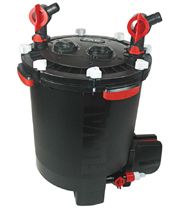
As for the ever popular Fluval, I am often left scratching my head as to its popularity, as I have literally used 100s over the years in my maintenance business and found these to have poor head pressure, poor flow patterns and are unreliable at a higher rate than others, even some economy models such as the SunSun have proven to be equal to or better reliability.
Does this mean those who have had good luck are wrong? No, but when one has used a 1-5 of these filters versus 100s, I get to more fairly compare flaws/defect rates. In the end, the Fluval is simply an economy canister filter masquerading/marketed as a top notch premium filter.
I have had dozens of Fluvals on my maintenance route over the years, and their longevity is less than most others, even in the newer ’04 & '05 models. The Fluvals low head pressure, poor impellers, proprietary hoses in some models (which do not easily lend the filter to accessories such as UVs), and more, lead me to question why these often over rated filters are so popular, and I base this statement on years of use of these filters and other canister filters in REAL world applications.
Even the highly touted Fluval FX5 and FX6 which has some great design ideas (such as the placement of the power supply/pump at the bottom & enclosed impeller), is a flawed filter that often fails or falls short of other filters such as the Filstar XP4 or Eheim 2080. As well, the FX5/FX6 is vastly over rated for bio filtration when compared to Fluidized Filters where you are better off with a lower priced model Fluval or other canister filter mated to a FSB filter!!! The Fluval FX5 also still uses the flawed ribbed/flex tubing that is MUCH more prone to cracking and is very difficult to mate to UV Sterilizers or other equipment in-line.
One more feature of the Fluval FX5/FX6 is the so-called Smart Pump Technology, which continually monitors the pump, constantly measuring impeller speed and force. It also manages the filter’s self-starting feature and evacuates air that may enter or build up within the filtration system during a 12-hour cycle, during which the pump will pause and allow trapped air to escape.
Personally, in the literally 1000s of canister filters I have used, I have never seen a need to monitor impeller speed. Nor have I had an issue with air unless set up incorrectly or with a cracked or similar issue, in which you need to fix this problem before it gets more serious, NOT have a system that lulls you into complacency!!! In my professional experience this is simply a feel good gimmick to take money out of your wallets and a potential part to break down!
This all said, the Fluval FX5/FX6 is certainly in a different league of canister filter than their Fluval predecessors.
However, if you going to spend the amount of money this filter requires, my choice would be for more redundancy with two Rena Filstar, SunSun or similar. OR BETTER, pairing with a Fluidized Filter, which a modern Fluidized Filter (such as the AAP FSB Filter) is more effective for aerobic & even anaerobic bio filtration as per controlled tests than ANY canister filter by themselves, including the Rena, or even a Hydro Sponge #5 PRO Filter. In fact even the small AAP PhosBan 150 Fluidized Sand Bed Filter has a bio capacity of 10 pounds of livestock (fish). With just a power head, the #150 still outperforms the Fluval FX5 per square inch of filter media space.
Product Resource:
• AAP Fluidized Sand Bed Filter
Nevertheless, it is noteworthy that the Fluval also performs mechanical and chemical filtration, hence I recommend a Fluidized filter be paired with another filter type, even a HOB (power filter).
As well all one has to do is type Fluval FX5 Review (such as at discusforums.com/forum) and find that I am not the only user that finds the Fluval flawed, even the high end models.
Does this mean those who have had good luck are wrong? No, but when one has used a 1-5 of these filters versus 100s, I get to more fairly compare flaws/defect rates. In the end, the Fluval is simply an economy canister filter masquerading/marketed as a top notch premium filter.
I have had dozens of Fluvals on my maintenance route over the years, and their longevity is less than most others, even in the newer ’04 & '05 models. The Fluvals low head pressure, poor impellers, proprietary hoses in some models (which do not easily lend the filter to accessories such as UVs), and more, lead me to question why these often over rated filters are so popular, and I base this statement on years of use of these filters and other canister filters in REAL world applications.
Even the highly touted Fluval FX5 and FX6 which has some great design ideas (such as the placement of the power supply/pump at the bottom & enclosed impeller), is a flawed filter that often fails or falls short of other filters such as the Filstar XP4 or Eheim 2080. As well, the FX5/FX6 is vastly over rated for bio filtration when compared to Fluidized Filters where you are better off with a lower priced model Fluval or other canister filter mated to a FSB filter!!! The Fluval FX5 also still uses the flawed ribbed/flex tubing that is MUCH more prone to cracking and is very difficult to mate to UV Sterilizers or other equipment in-line.
One more feature of the Fluval FX5/FX6 is the so-called Smart Pump Technology, which continually monitors the pump, constantly measuring impeller speed and force. It also manages the filter’s self-starting feature and evacuates air that may enter or build up within the filtration system during a 12-hour cycle, during which the pump will pause and allow trapped air to escape.
Personally, in the literally 1000s of canister filters I have used, I have never seen a need to monitor impeller speed. Nor have I had an issue with air unless set up incorrectly or with a cracked or similar issue, in which you need to fix this problem before it gets more serious, NOT have a system that lulls you into complacency!!! In my professional experience this is simply a feel good gimmick to take money out of your wallets and a potential part to break down!
This all said, the Fluval FX5/FX6 is certainly in a different league of canister filter than their Fluval predecessors.
However, if you going to spend the amount of money this filter requires, my choice would be for more redundancy with two Rena Filstar, SunSun or similar. OR BETTER, pairing with a Fluidized Filter, which a modern Fluidized Filter (such as the AAP FSB Filter) is more effective for aerobic & even anaerobic bio filtration as per controlled tests than ANY canister filter by themselves, including the Rena, or even a Hydro Sponge #5 PRO Filter. In fact even the small AAP PhosBan 150 Fluidized Sand Bed Filter has a bio capacity of 10 pounds of livestock (fish). With just a power head, the #150 still outperforms the Fluval FX5 per square inch of filter media space.
Product Resource:
• AAP Fluidized Sand Bed Filter
Nevertheless, it is noteworthy that the Fluval also performs mechanical and chemical filtration, hence I recommend a Fluidized filter be paired with another filter type, even a HOB (power filter).
As well all one has to do is type Fluval FX5 Review (such as at discusforums.com/forum) and find that I am not the only user that finds the Fluval flawed, even the high end models.
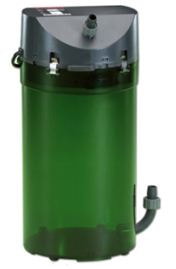
The Eheim is a generally excellent filter with excellent capacity, good solid construction, and an excellent flow pattern with little flow-by. However, the Eheim is sometimes over priced for the questionably better quality than other top filters such as the Filstar. In fact, in my use, reliability is no better than many others (impeller failure rates are no better than many economy canister filters) and head pressure is no better than lower cost models such as the AAP/SunSun, Perfect and others.
Eheim has done an excellent job marketing their filters as they have convinced many in the aquarium community that their filter is second to none which although I still find the Eheim an excellent filter (one of the best), this is simply not correct. I also do not like the return policy of any Eheim product which forces the consumer to send their products back to Eheim instead of the speed and convenience of the retailer. When compared, apples to apples, I and many other aquarium maintenance colleagues still prefer the other European designed canister filter; the Rena Filstar.
The most popular Eheim Filters are the 2213, 2215, & 2217 Classics, and frankly are still the best value in Eheim filters over the over hyped larger Eheims such as the 2080 (the Eheim 2215 Classic is pictured above left).
The newer "Eheim Ecco Pro Easy" models; 2232, 2234,& 2236 are excellent values for those who are sold on the Eheim name. These models have an excellent build, and feature a new pre-filter which gives the user longer intervals between cleanings. The only negative is the poor head pressure, making it a poor choice for running add on devices such as Fluidized Sand Bed Filters (although a separate pump to run a FB Filter is a good idea anyway for redundancy).
Two large (& pricey) Eheim, Filters are the 2262 & 2080 are without equals in capacity and water flow, as well as superior to the Fluval FX filters (the 2062 is my preference). However the head pressure is poor in relation to the water flow, as well I would personally recommend more filter redundancy rather than either of these large filters. I HAVE maintained more healthy water conditions/parameters with multiple quality filters often of different types RATHER than one large filter.
As noted with the Fluval FX5: A vastly more effective filter system (especially when price is considered) would be a pair smaller Eheims, Rena Filstars or SunSuns (or many other canister filters) OR one mated to a Fluidized Sand Bed Filter. The bio capacity of a say an AAP/SunSun HW403 (or similar canister filter) combined with a AAP #150 Fluid Filter would easily exceed either the Eheim 2080 or Fluval FX5/FX6.
Product Resource:
• TMC Premium Fluidized Bed Aquarium Filter
Their Wet/ Dry Model (2229 W/D) is not a true Wet/ Dry rather it purges water in and out of the canister, this produces a poor flow rate for larger aquariums in particular and tends to prone to problems. This is the one Eheim I would consider a flop, with the largest Pet Supply distributor in North America (Central Pet) no longer stocking it due to problems.
In summary, if an Eheim is what you have decided on: I would recommend the 2213, 2215, & 2217 Classics or the Ecco Pro Easy 2232, 2234,& 2236. If your tank is large, rather than a 2062 or 2080, I suggest multiples, OR BETTER; a Fluidized Sand Bed Filter with a separate pump.
The Magnum has unique convertible features (the ability to switch between standard canister filtration and micron, which is a nice feature), as well there is NO easier canister filter for the ease of start up due to their bottom motor which resists "siphon-stopping" air pockets. The Magnum is one of the few canister filters that can be placed at tank level rather than under an aquarium for proper water siphon operation (although no higher as it still utilizes a siphon, it just has a bottom motor that is easier to start and maintain a siphon under marginal siphon conditions).
However their capacity is poor at best when compared to about any other canister filter. Before one dismisses Magnums for their capacity, they have about the best head pressure as compared to other Canister filters which is especially useful for running UV Sterilizers, Fluidized Filter, etc. The Magnums also have an occasional problem with leaking around the O ring, but generally good O ring lubrication maintenance can prevent this.
Eheim has done an excellent job marketing their filters as they have convinced many in the aquarium community that their filter is second to none which although I still find the Eheim an excellent filter (one of the best), this is simply not correct. I also do not like the return policy of any Eheim product which forces the consumer to send their products back to Eheim instead of the speed and convenience of the retailer. When compared, apples to apples, I and many other aquarium maintenance colleagues still prefer the other European designed canister filter; the Rena Filstar.
The most popular Eheim Filters are the 2213, 2215, & 2217 Classics, and frankly are still the best value in Eheim filters over the over hyped larger Eheims such as the 2080 (the Eheim 2215 Classic is pictured above left).
The newer "Eheim Ecco Pro Easy" models; 2232, 2234,& 2236 are excellent values for those who are sold on the Eheim name. These models have an excellent build, and feature a new pre-filter which gives the user longer intervals between cleanings. The only negative is the poor head pressure, making it a poor choice for running add on devices such as Fluidized Sand Bed Filters (although a separate pump to run a FB Filter is a good idea anyway for redundancy).
Two large (& pricey) Eheim, Filters are the 2262 & 2080 are without equals in capacity and water flow, as well as superior to the Fluval FX filters (the 2062 is my preference). However the head pressure is poor in relation to the water flow, as well I would personally recommend more filter redundancy rather than either of these large filters. I HAVE maintained more healthy water conditions/parameters with multiple quality filters often of different types RATHER than one large filter.
As noted with the Fluval FX5: A vastly more effective filter system (especially when price is considered) would be a pair smaller Eheims, Rena Filstars or SunSuns (or many other canister filters) OR one mated to a Fluidized Sand Bed Filter. The bio capacity of a say an AAP/SunSun HW403 (or similar canister filter) combined with a AAP #150 Fluid Filter would easily exceed either the Eheim 2080 or Fluval FX5/FX6.
Product Resource:
• TMC Premium Fluidized Bed Aquarium Filter
Their Wet/ Dry Model (2229 W/D) is not a true Wet/ Dry rather it purges water in and out of the canister, this produces a poor flow rate for larger aquariums in particular and tends to prone to problems. This is the one Eheim I would consider a flop, with the largest Pet Supply distributor in North America (Central Pet) no longer stocking it due to problems.
In summary, if an Eheim is what you have decided on: I would recommend the 2213, 2215, & 2217 Classics or the Ecco Pro Easy 2232, 2234,& 2236. If your tank is large, rather than a 2062 or 2080, I suggest multiples, OR BETTER; a Fluidized Sand Bed Filter with a separate pump.
The Magnum has unique convertible features (the ability to switch between standard canister filtration and micron, which is a nice feature), as well there is NO easier canister filter for the ease of start up due to their bottom motor which resists "siphon-stopping" air pockets. The Magnum is one of the few canister filters that can be placed at tank level rather than under an aquarium for proper water siphon operation (although no higher as it still utilizes a siphon, it just has a bottom motor that is easier to start and maintain a siphon under marginal siphon conditions).
However their capacity is poor at best when compared to about any other canister filter. Before one dismisses Magnums for their capacity, they have about the best head pressure as compared to other Canister filters which is especially useful for running UV Sterilizers, Fluidized Filter, etc. The Magnums also have an occasional problem with leaking around the O ring, but generally good O ring lubrication maintenance can prevent this.
Micron Canister Filters include many canister filters that can be run either as a regular multi-media canister filter such as the Ocean Clear Filter, the Magnum, and others. As well the Vortex and "Aquarium Cleaning Machine" can be considered a micron canister filter in many ways.
As a generalization the term micron filter applies to filters that use cartridges or pads to filter down to 20 -50 microns. Often without other filters or pre-filtration these types of filters can not be run long before the need to change or clean the filter media, this is especially true the smaller the micron size (such as 20 microns or less).
The Ocean Clear Filter has a very large cartridge and can go longer before changes due to the amount of surface area, however even smaller micron filters such as the Magnum can run for longer periods of time if other forms of pre-filtration are used or if the filter is simply used with other filters that will pick up much of the coarse debris before the micron filter can (such as in the diagram below that shows tow plumbed canister filters). It is also noteworthy that many Micron filters require a separate pump such as the Ocean Clear and LifeGuard systems.
Finally, as to Micron Filters: An aquarist can convert an efficient standard canister filter with low flow by (such as the Filstar, Via Aqua 750, & the Eheim) to a somewhat effective micron filter by utilizing fine micron poly pads. This does not usually work in most standard Fluvals (such as the 405) due to their design and high flow-by.
As a generalization the term micron filter applies to filters that use cartridges or pads to filter down to 20 -50 microns. Often without other filters or pre-filtration these types of filters can not be run long before the need to change or clean the filter media, this is especially true the smaller the micron size (such as 20 microns or less).
The Ocean Clear Filter has a very large cartridge and can go longer before changes due to the amount of surface area, however even smaller micron filters such as the Magnum can run for longer periods of time if other forms of pre-filtration are used or if the filter is simply used with other filters that will pick up much of the coarse debris before the micron filter can (such as in the diagram below that shows tow plumbed canister filters). It is also noteworthy that many Micron filters require a separate pump such as the Ocean Clear and LifeGuard systems.
Finally, as to Micron Filters: An aquarist can convert an efficient standard canister filter with low flow by (such as the Filstar, Via Aqua 750, & the Eheim) to a somewhat effective micron filter by utilizing fine micron poly pads. This does not usually work in most standard Fluvals (such as the 405) due to their design and high flow-by.
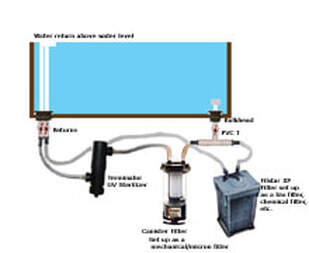
Canister Filter Alternatives
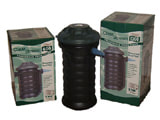
Many aquarists are not aware that many high bio load capacity pond filters make EXCELLENT aquarium filters, often at lower prices to comparable canister filters. However, for Aquarium Keepers who can think “outside the box” a pressurized pond filter has vastly more bio capacity than about 95% of the current offering of canister filters currently available today. As an example, the SunSun CPF 280 Pressurized Pond Filter holds 8 liters of media.
What is also nice besides the price and bio capacity is that by using a pump such as the Rio 1700 inside your aquarium to pump water to your pressurized pond filter, you do not have the problem of starting a siphon (or losing a siphon after you thought it was started). Starting canister filters is the number on complaint with them I have heard over the years from clients.
What is also nice besides the price and bio capacity is that by using a pump such as the Rio 1700 inside your aquarium to pump water to your pressurized pond filter, you do not have the problem of starting a siphon (or losing a siphon after you thought it was started). Starting canister filters is the number on complaint with them I have heard over the years from clients.
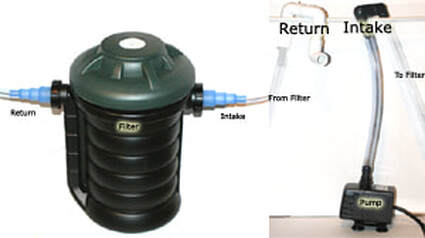
The concept is simple, you place your power head in an appropriate place in your aquarium, then run the correct size of aquarium tubing from the power head out to the Clear Stream Pond Filter and then back into the aquarium. The use of intake and return adapters is suggested.
Product Resource:
• Aquarium Plumbing Parts; Intake & Return Adapter
You may also connect a Pre Filter or similar for additional pre-filtration before sending the water to the main filter or to prevent small fish from getting trapped, although many power heads have small sponges that prevent debris and most medium/small or larger fish from getting caught.
See these product link examples:
• Filter Max; Small Sponge Pre-Filters
• Hydro-Pond 3 & 4; Large Sponge Pre-Filters.
Please note that this concept has worked very well for me over the years, but if your “DIY abilities” are not very good, I would stick with traditional Aquarium Canister Filters such as the second to none Rena Filstar Filter which has in depth instructions as well a demo video.
Supplemental Pumps for Canister Filters: You can also connect a power head to a “dead” canister filter as well so as to continue to use it without buying a new filter.
As well this can be performed to boost a weak canister filter which is especially effective when the canister filter is used to run other applications such as a fluidized filter or UV Sterilizer (some canister filters such as the Fluval and some Eheim models have notoriously weak/poor head pressure for which this can be a very helpful application.
As with the pressurized pond filter application, the pump should be placed in line under the water for best results. When installed this way, your canister filter will fill without all the air bubble and priming issues common to many canister filters.
A Rio 1100 along with the AAP/SunSun JP-065 (for smaller canister filters) or AAP/SunSun JP-066 works well for this application for many canister filters.
Product Resource:
• Small/Medium Flow Pumps
Canister Filter Maintenance to Prevent Problems: Make sure to clean the impeller regularly, also clean the area the impeller “nests” to prevent debris from stopping the impeller. If the impeller stops, check for carbon caught in this area and make sure impeller itself is not broken. The impeller should be able to turn 359 degrees before locking, if the impeller spins freely or not at all, it is broken. Also use a small foxtail brush to clean the intake and exhaust tubes, otherwise these may get clogged.
Canister Filter Trouble Shooting; & Other potential canister filter problems: In my experience using 1000s of canister filters, these troubleshooting tips will either fix or identify 95% of all canister filter issues!
Leaking Around Canister Filter Head:
1. Remove the 'O' Ring, clean and make sure no debris is stuck to it (such as carbon).
2. Then lubricate the 'O' Ring with Petroleum Jelly and re-seat.
3. If this fails, then wrap Teflon Tape around the 'O' Ring a couple of times.
4. If this still fails, then it likely is time to replace the 'O' Ring.
For Coarse Air Bubbles being "burped out" the return/exhaust:
1. Look for bad or cracked pipes/tubing or connections on the intake side of your filter.
2. Test for leaks in the intake side by removing all water from the filter, then plugging the intake pipe where it would normally pickup inside the tank, then "suck" from the exhaust port/connection of your filter. It is important to suck rather than blow since blowing can seal a leak or bad connection whereas sucking can reveal a bad connection that is bringing in air.
3. Finally, make sure your intake is not placed near any air stones or other aeration devices where ANY bubbles might be inadvertently picked up into the filter.
Siphon Issues (similar to above):
1. Make sure your canister filter is at or below the bottom of the aquarium with the exception of the Rena Nexx, Magnum, and a few other canister filters with either bottom motors (most canister filters are top motored) or "In-Tank" motors (Nexx).
2. Make sure you have no air bubbles inside before re-staring it, otherwise purge the filter of all water and re-start your siphon.
3. For difficulties initially starting or re-starting a Canister filter (due to air bubble or other siphon problems).
4. I recommend disconnecting the return tube from the aquarium and placing the end into a bucket BELOW the tank level. Try starting the siphon while in the bucket, first by "sucking water into an empty filter until the water flows into the bucket via gravity. Once water flows naturally into the bucket (via gravity) then turn the pump on for a minute or two (with the return hose still lower than the tank and in the bucket) to force any bubbles out. Then replace the return tube on the aquarium and restart your filter.
5. Make sure your O Ring is properly seated by plugging the exhaust with your thumb and blow into the intake, if air escapes you need to re seat and possibly replace or lubricate your O Ring (Petroleum Jelly of Silicone gel works here).
For Fine Air Bubbles being "kicked out" the return/exhaust:
1. Soak media prior to adding, especially porous filter media such as activated carbon or API Bio Stars.
2. Check for bad connection on the return/exhaust side of your filter; these "bad" connects can draw air as water is pulled past these tiny connection leaks.
3. This can be checked by turning off the filter, closing the valve on the return side and the blowing back toward the filter and listening for small leaks ("sucking" can work even better for the smallest of leaks, just make sure all water is removed from the lines first, then is you cannot keep a strong suction, you have a leak).
Product Resource:
• Aquarium Plumbing Parts; Intake & Return Adapter
You may also connect a Pre Filter or similar for additional pre-filtration before sending the water to the main filter or to prevent small fish from getting trapped, although many power heads have small sponges that prevent debris and most medium/small or larger fish from getting caught.
See these product link examples:
• Filter Max; Small Sponge Pre-Filters
• Hydro-Pond 3 & 4; Large Sponge Pre-Filters.
Please note that this concept has worked very well for me over the years, but if your “DIY abilities” are not very good, I would stick with traditional Aquarium Canister Filters such as the second to none Rena Filstar Filter which has in depth instructions as well a demo video.
Supplemental Pumps for Canister Filters: You can also connect a power head to a “dead” canister filter as well so as to continue to use it without buying a new filter.
As well this can be performed to boost a weak canister filter which is especially effective when the canister filter is used to run other applications such as a fluidized filter or UV Sterilizer (some canister filters such as the Fluval and some Eheim models have notoriously weak/poor head pressure for which this can be a very helpful application.
As with the pressurized pond filter application, the pump should be placed in line under the water for best results. When installed this way, your canister filter will fill without all the air bubble and priming issues common to many canister filters.
A Rio 1100 along with the AAP/SunSun JP-065 (for smaller canister filters) or AAP/SunSun JP-066 works well for this application for many canister filters.
Product Resource:
• Small/Medium Flow Pumps
Canister Filter Maintenance to Prevent Problems: Make sure to clean the impeller regularly, also clean the area the impeller “nests” to prevent debris from stopping the impeller. If the impeller stops, check for carbon caught in this area and make sure impeller itself is not broken. The impeller should be able to turn 359 degrees before locking, if the impeller spins freely or not at all, it is broken. Also use a small foxtail brush to clean the intake and exhaust tubes, otherwise these may get clogged.
Canister Filter Trouble Shooting; & Other potential canister filter problems: In my experience using 1000s of canister filters, these troubleshooting tips will either fix or identify 95% of all canister filter issues!
Leaking Around Canister Filter Head:
1. Remove the 'O' Ring, clean and make sure no debris is stuck to it (such as carbon).
2. Then lubricate the 'O' Ring with Petroleum Jelly and re-seat.
3. If this fails, then wrap Teflon Tape around the 'O' Ring a couple of times.
4. If this still fails, then it likely is time to replace the 'O' Ring.
For Coarse Air Bubbles being "burped out" the return/exhaust:
1. Look for bad or cracked pipes/tubing or connections on the intake side of your filter.
2. Test for leaks in the intake side by removing all water from the filter, then plugging the intake pipe where it would normally pickup inside the tank, then "suck" from the exhaust port/connection of your filter. It is important to suck rather than blow since blowing can seal a leak or bad connection whereas sucking can reveal a bad connection that is bringing in air.
3. Finally, make sure your intake is not placed near any air stones or other aeration devices where ANY bubbles might be inadvertently picked up into the filter.
Siphon Issues (similar to above):
1. Make sure your canister filter is at or below the bottom of the aquarium with the exception of the Rena Nexx, Magnum, and a few other canister filters with either bottom motors (most canister filters are top motored) or "In-Tank" motors (Nexx).
2. Make sure you have no air bubbles inside before re-staring it, otherwise purge the filter of all water and re-start your siphon.
3. For difficulties initially starting or re-starting a Canister filter (due to air bubble or other siphon problems).
4. I recommend disconnecting the return tube from the aquarium and placing the end into a bucket BELOW the tank level. Try starting the siphon while in the bucket, first by "sucking water into an empty filter until the water flows into the bucket via gravity. Once water flows naturally into the bucket (via gravity) then turn the pump on for a minute or two (with the return hose still lower than the tank and in the bucket) to force any bubbles out. Then replace the return tube on the aquarium and restart your filter.
5. Make sure your O Ring is properly seated by plugging the exhaust with your thumb and blow into the intake, if air escapes you need to re seat and possibly replace or lubricate your O Ring (Petroleum Jelly of Silicone gel works here).
For Fine Air Bubbles being "kicked out" the return/exhaust:
1. Soak media prior to adding, especially porous filter media such as activated carbon or API Bio Stars.
2. Check for bad connection on the return/exhaust side of your filter; these "bad" connects can draw air as water is pulled past these tiny connection leaks.
3. This can be checked by turning off the filter, closing the valve on the return side and the blowing back toward the filter and listening for small leaks ("sucking" can work even better for the smallest of leaks, just make sure all water is removed from the lines first, then is you cannot keep a strong suction, you have a leak).
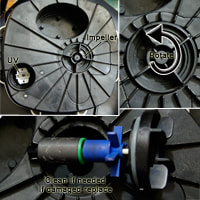
Impeller/Motor will not start or slow motor:
1. Follow the siphon issues suggestions for this problem too, as 9 times out of 10 when I was called out for a weak or dead pump, there was a clog in the intake or output lines. Once the output lines are below the aquarium, a siphon should move water with a strong flow (this often will clear the lines without you knowing it).
2. Next remove water from both lines and blowing through to confirm no clog. Either way if the water flows slowly or it is difficult to blow, you have a clog and NOT a bad motor!!!
3. Check inside the impeller housing with your little finger and feel for deformities, this is generally not repairable if found (Fluvals are notorious for impeller housing warping). Also make sure that the impeller does not free spin and locks before turning more than 360 degrees.
4. Make sure the impeller shaft is lubricated and has Teflon or an O ring on at least one end of the shaft (usually the motor side) I use petroleum Jelly for lubricating the shaft, make sure to lubricate it liberally.
You can check for magnetic current by placing a screwdriver inside the impeller housing with the impeller out and the motor ‘on’ (this test does not work with the pump off), you should feel a magnetic pull from all sides. While few dead spots are normal, there should still be an overall 360 degree pull.
Having a baseline of knowing what your motor magnetic current pull should "feel like" is helpful for telling if the pump is weak (which is rare).
5. Another test of the motor/pump head is to place the pump head in a bucket with just enough water to fill the impeller well, but not fully immerse the pump head. Once you add power (plug in), the pump should exhaust water and your motor is not the problem. If not, then there is a problem with the pump head/motor (assuming it was properly immersed to fill the impeller well).
6. Make sure clean your impeller EVERY time you open the filter for servicing (if at all possible). This includes the impeller itself AND the inside walls of the "impeller well" (the hole the impeller sits inside of).
1. Follow the siphon issues suggestions for this problem too, as 9 times out of 10 when I was called out for a weak or dead pump, there was a clog in the intake or output lines. Once the output lines are below the aquarium, a siphon should move water with a strong flow (this often will clear the lines without you knowing it).
2. Next remove water from both lines and blowing through to confirm no clog. Either way if the water flows slowly or it is difficult to blow, you have a clog and NOT a bad motor!!!
3. Check inside the impeller housing with your little finger and feel for deformities, this is generally not repairable if found (Fluvals are notorious for impeller housing warping). Also make sure that the impeller does not free spin and locks before turning more than 360 degrees.
4. Make sure the impeller shaft is lubricated and has Teflon or an O ring on at least one end of the shaft (usually the motor side) I use petroleum Jelly for lubricating the shaft, make sure to lubricate it liberally.
You can check for magnetic current by placing a screwdriver inside the impeller housing with the impeller out and the motor ‘on’ (this test does not work with the pump off), you should feel a magnetic pull from all sides. While few dead spots are normal, there should still be an overall 360 degree pull.
Having a baseline of knowing what your motor magnetic current pull should "feel like" is helpful for telling if the pump is weak (which is rare).
5. Another test of the motor/pump head is to place the pump head in a bucket with just enough water to fill the impeller well, but not fully immerse the pump head. Once you add power (plug in), the pump should exhaust water and your motor is not the problem. If not, then there is a problem with the pump head/motor (assuming it was properly immersed to fill the impeller well).
6. Make sure clean your impeller EVERY time you open the filter for servicing (if at all possible). This includes the impeller itself AND the inside walls of the "impeller well" (the hole the impeller sits inside of).
For Leaky Valves:
1. Remove the valve and place you finger over one end and blow or better suck as this detects small leaks better due to the fact that your will lose suction shortly after you start thru the valve with the switch open and then listening for leaks, as you may just not have it tightened all the way. Replace any bad O rings or lubricate them with Petroleum Jelly.
2. Sometimes the best solution is replacement with a better valve such as a heavy-duty ball valve as pictured above.
3. The picture of the impeller also displays a heavy-duty compression union (bottom part) which makes a much simpler way to disconnect a canister filter, pump, UV Sterilizer, etc. than many of the connections that might or might not be provided by manufacturers. Better yet, these heavy-duty unions are much more secure, durable, and leak proof.
Product Resource:
• Aquarium & Pond Plumbing Parts; Including Ball Valves & Unions
Noisy Motor:
1. Usually, the problem is with the impeller or impeller well, NOT the motor. Make sure the impeller well is clear of any and all debris such as carbon or sand (common causes). Lubricating the impeller shaft and well with petroleum jelly can help.
2. Make sure your impeller or well has no groves that can cause vibration.
3. Make sure the rubber grommets fit snuggly top and bottom of the shaft and that the shaft is not broken. Adding Teflon Tape around the grommets can make for a snugger fit if needed.
4. Finally, make sure that your impeller has the small washer, usually near the base of the shaft.
Dead Pump Motor/ Head: An actual pump motor failure whether due to a jammed impeller from an overheat or many other reasons (4 out 5 failures over the years have been Fluvals) can still be solved without throwing out your canister filter. Also be aware that plugging a 110-120V motor will result is motor failure (including any aquarium/pond equipment that utilizes electromagnetic current with an impeller). The symptom of over voltage is a grinding noise as an impeller quickly overheats followed by failure.
Simply by replacing your filters intake strainer with a power head such as the Rio Plus 1100 or SunSun JP-066, will immediately bring your canister filter back to life with a filter that no longer requires priming!!!
Product Resource:
• Small/Medium Flow Pumps
Canister Filter WITH UV Clarifier, UV not turning on:
1. Most often this is the result of either the lamp being burned out or the quartz sleeve has filled with water due to an O ring leak. Either way, you want to inspect quartz sleeve for cracks if water is inside the sleeve. Then make sure the O rings are seated properly.
2. Remove the O rings and re-seat and lubricate with petroleum jelly (or replace the O Rings). If no water is found inside the sleeve, then check the lamp and likely replace with a HO UVC lamp for best results (many standard SunSun canister filters are not supplied with a HO UVC lamps to keep the price low).
3. If this is a new canister filter with UV lamp, often shipping can loosen the lamp, so make sure to check that the UV lamp is securely seated. It is also noteworthy that since these canister filters (regardless of brand) are basically only a UV Clarifier, albeit a better one when used with a HO UVC lamp/bulb, this is not an essential part of the filter, and you are better off with a separate true inline UV Sterilizer such as the AAP Compact UVs or the premium Vecton UVs.
Reference:
• UV Sterilization; Facts & Information
Product Resource:
• Premium High Output UVC Lamps/Bulbs and Quartz Sleeves
Crack in Canister Body:
1. This need not always be time to throw away your canister filter or even purchase a new body. I personally have salvaged many canister filters with minor and even moderate cracks by applying PVC cement followed by Teflon Tap along the crack followed by 2-4 or more layers using this method. The fix is generally permanent as I have had canister filters last for years after such repairs.
2. Of course you want to avoid cracks in the first place and other than dropping the filter, the most common cause is improperly clamping the motor down to the filter body placing too much strain on the body. Make sure you lubricate O rings with Petroleum Jelly each time the filter is serviced so that the top motor slips onto the body easily.
3. If the motor does not slip on easily, do not force it and check for problems.
This video demonstrates the repair of a UV Sterilizer body, which is the same exact method we also recommend for the repair of a crack in a canister filter body.
Constant Problems with Leaks & More: Make sure ANY time you service your canister filter that you pressure test it by blow or better, but creating a suction with your mouth, if this suction even slightly decreases, you HAVE at the very least a small leak. From this point you need to narrow down where the leak might be with further suction/blow tests.
1. Remove the valve and place you finger over one end and blow or better suck as this detects small leaks better due to the fact that your will lose suction shortly after you start thru the valve with the switch open and then listening for leaks, as you may just not have it tightened all the way. Replace any bad O rings or lubricate them with Petroleum Jelly.
2. Sometimes the best solution is replacement with a better valve such as a heavy-duty ball valve as pictured above.
3. The picture of the impeller also displays a heavy-duty compression union (bottom part) which makes a much simpler way to disconnect a canister filter, pump, UV Sterilizer, etc. than many of the connections that might or might not be provided by manufacturers. Better yet, these heavy-duty unions are much more secure, durable, and leak proof.
Product Resource:
• Aquarium & Pond Plumbing Parts; Including Ball Valves & Unions
Noisy Motor:
1. Usually, the problem is with the impeller or impeller well, NOT the motor. Make sure the impeller well is clear of any and all debris such as carbon or sand (common causes). Lubricating the impeller shaft and well with petroleum jelly can help.
2. Make sure your impeller or well has no groves that can cause vibration.
3. Make sure the rubber grommets fit snuggly top and bottom of the shaft and that the shaft is not broken. Adding Teflon Tape around the grommets can make for a snugger fit if needed.
4. Finally, make sure that your impeller has the small washer, usually near the base of the shaft.
Dead Pump Motor/ Head: An actual pump motor failure whether due to a jammed impeller from an overheat or many other reasons (4 out 5 failures over the years have been Fluvals) can still be solved without throwing out your canister filter. Also be aware that plugging a 110-120V motor will result is motor failure (including any aquarium/pond equipment that utilizes electromagnetic current with an impeller). The symptom of over voltage is a grinding noise as an impeller quickly overheats followed by failure.
Simply by replacing your filters intake strainer with a power head such as the Rio Plus 1100 or SunSun JP-066, will immediately bring your canister filter back to life with a filter that no longer requires priming!!!
Product Resource:
• Small/Medium Flow Pumps
Canister Filter WITH UV Clarifier, UV not turning on:
1. Most often this is the result of either the lamp being burned out or the quartz sleeve has filled with water due to an O ring leak. Either way, you want to inspect quartz sleeve for cracks if water is inside the sleeve. Then make sure the O rings are seated properly.
2. Remove the O rings and re-seat and lubricate with petroleum jelly (or replace the O Rings). If no water is found inside the sleeve, then check the lamp and likely replace with a HO UVC lamp for best results (many standard SunSun canister filters are not supplied with a HO UVC lamps to keep the price low).
3. If this is a new canister filter with UV lamp, often shipping can loosen the lamp, so make sure to check that the UV lamp is securely seated. It is also noteworthy that since these canister filters (regardless of brand) are basically only a UV Clarifier, albeit a better one when used with a HO UVC lamp/bulb, this is not an essential part of the filter, and you are better off with a separate true inline UV Sterilizer such as the AAP Compact UVs or the premium Vecton UVs.
Reference:
• UV Sterilization; Facts & Information
Product Resource:
• Premium High Output UVC Lamps/Bulbs and Quartz Sleeves
Crack in Canister Body:
1. This need not always be time to throw away your canister filter or even purchase a new body. I personally have salvaged many canister filters with minor and even moderate cracks by applying PVC cement followed by Teflon Tap along the crack followed by 2-4 or more layers using this method. The fix is generally permanent as I have had canister filters last for years after such repairs.
2. Of course you want to avoid cracks in the first place and other than dropping the filter, the most common cause is improperly clamping the motor down to the filter body placing too much strain on the body. Make sure you lubricate O rings with Petroleum Jelly each time the filter is serviced so that the top motor slips onto the body easily.
3. If the motor does not slip on easily, do not force it and check for problems.
This video demonstrates the repair of a UV Sterilizer body, which is the same exact method we also recommend for the repair of a crack in a canister filter body.
Constant Problems with Leaks & More: Make sure ANY time you service your canister filter that you pressure test it by blow or better, but creating a suction with your mouth, if this suction even slightly decreases, you HAVE at the very least a small leak. From this point you need to narrow down where the leak might be with further suction/blow tests.
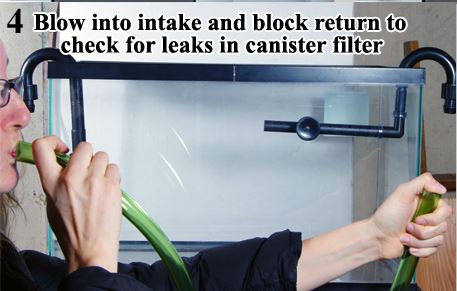
It is noteworthy that even small air leaks can lower flow or completely stop flow. This includes the many canister filters which employ valve assemblies (example pictured to the right), as these can easily have O rings that do not seat properly, and this alone can cause enough of an issue to impede or stop flow once head pressure is added to the filter.
|
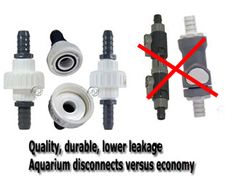
|
Sometimes leaks pop up in the disconnects that come with or are sold with many canister filters. Based on considerable experience, I would be weary of most disconnects sold by aquarium supply manufacturers (even the better brands such as Eheim are still light duty and frankly not that good). While simple, these are usually light duty and are much more prone to leaking than much more durable PVC compression union disconnects which use a surer screw on method and much better O ring. See the picture to the above right.
Product Reference:
• Heavy Duty Quick Disconnect Union
Finally, and I apologize to my readers in advance for this observation which may come across as harsh; I have maintained literally 1000s of canister filters over the years for clients, often these were clients that were hands off, but still many were clients who called me only when there were problems.
When it came to canister filters, and while I myself made mistakes when servicing, there was a certain percentage of "on call" clients that always had problems with canister filters for reasons I am still to this day not sure why. I would get the filter working, then when the customer serviced it alone, it would have issues once more until I came out once again. This cycle seemed to constantly repeat. This did not happen with my contract customers since I was in charge of all care, but when it came to customers calling me out to help with problems, NO FILTER generated more calls than ANY brand of canister filters!
My unfortunately harsh point is that canister filters are not for everyone and if you have a filter that constantly frustrates you, please consider a HOB or Sponge Filter rather than instead blame the filter.
Product Reference:
• Heavy Duty Quick Disconnect Union
Finally, and I apologize to my readers in advance for this observation which may come across as harsh; I have maintained literally 1000s of canister filters over the years for clients, often these were clients that were hands off, but still many were clients who called me only when there were problems.
When it came to canister filters, and while I myself made mistakes when servicing, there was a certain percentage of "on call" clients that always had problems with canister filters for reasons I am still to this day not sure why. I would get the filter working, then when the customer serviced it alone, it would have issues once more until I came out once again. This cycle seemed to constantly repeat. This did not happen with my contract customers since I was in charge of all care, but when it came to customers calling me out to help with problems, NO FILTER generated more calls than ANY brand of canister filters!
My unfortunately harsh point is that canister filters are not for everyone and if you have a filter that constantly frustrates you, please consider a HOB or Sponge Filter rather than instead blame the filter.
Hard Plumbed Canister
Another often forgotten aspect of canister filters is that you can drill and use bulk heads to attach a canister filter. I have installed many canister filters from Magnum, AAP/SunSun 402/403/404, Filstar, to Ehiem, often powering UV Sterilizers and/or Fluidized filters this way in MANY high-end filtration installations I have performed in my custom aquarium design and maintenance business. I also set up a whole fish department this way. I generally replace the valves that come with most Canister filters with PVC ball valves for a more solid fit, more reliability and alleviating the main cause of leaks in most aquarium canister filters.
In larger aquariums (such as 125 gallon plus), I have often plumbed more than one canister filter together with one intake split by a PVC ‘T” or hose barb ‘T”. However, any return should be separate for each canister filter as the motor will not function correctly otherwise. When more than one canister filter is employed on a single aquarium, I will generally set up each canister filter differently, with one containing primarily bio media and chemical nitrate removal products such as Purigen, while the second Canister filter would be set up primarily as a micron/mechanical filter. I generally would connect the UV Sterilizer to the canister filter set up as a micron/mechanical filter as this combination would work better for UV Sterilization.
This next diagram/picture shows how I have plumbed a 250-gallon aquarium (& larger), both fresh and saltwater (reef). This set up includes a high bio-capacity FSB filter (of which these have far more bio capacity over ANY canister filter), along with a top-notch level 1 high dwell time UV Sterilizer.
As with the first picture/diagram, I suggest strainers of any type be attached to the intake bulkheads (I have found the vertical strainers work better for this application than the flat disc type) along with return pipes to the return bulkheads.
In larger aquariums (such as 125 gallon plus), I have often plumbed more than one canister filter together with one intake split by a PVC ‘T” or hose barb ‘T”. However, any return should be separate for each canister filter as the motor will not function correctly otherwise. When more than one canister filter is employed on a single aquarium, I will generally set up each canister filter differently, with one containing primarily bio media and chemical nitrate removal products such as Purigen, while the second Canister filter would be set up primarily as a micron/mechanical filter. I generally would connect the UV Sterilizer to the canister filter set up as a micron/mechanical filter as this combination would work better for UV Sterilization.
This next diagram/picture shows how I have plumbed a 250-gallon aquarium (& larger), both fresh and saltwater (reef). This set up includes a high bio-capacity FSB filter (of which these have far more bio capacity over ANY canister filter), along with a top-notch level 1 high dwell time UV Sterilizer.
As with the first picture/diagram, I suggest strainers of any type be attached to the intake bulkheads (I have found the vertical strainers work better for this application than the flat disc type) along with return pipes to the return bulkheads.
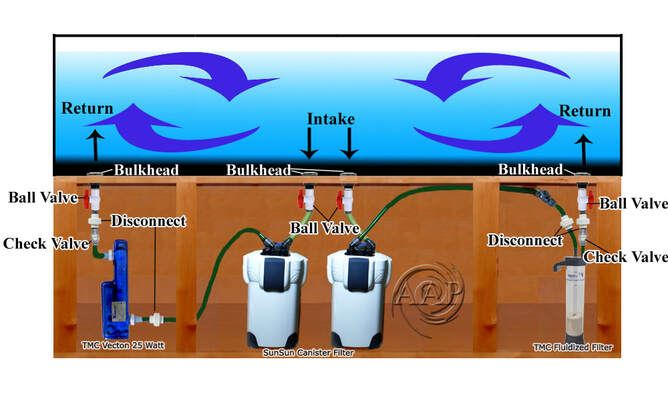
The over-the-top installation is more typical and works fine, however I have achieved better performance, and a MUCH cleaner look when drilled. When used this way your Canister filter is often easier to service (when valves are employed) and can more easily power additional equipment such as a UV Sterilizer, Fluidized filter, or Heater module.
Product Resources:
• Fluidized Sand Bed Aquarium Filters; superior bio capacity
• Aquarium & Pond Plumbing Part (Bulkheads, etc.)
• Aquarium UV Sterilizers; From Good to Better, to Best
• SeaChem Purigen
Product Resources:
• Fluidized Sand Bed Aquarium Filters; superior bio capacity
• Aquarium & Pond Plumbing Part (Bulkheads, etc.)
• Aquarium UV Sterilizers; From Good to Better, to Best
• SeaChem Purigen
Wet/Dry or Sump
Wet/Dry Filter: Popular with fish only marine aquariums in particular (although not so much with pure reef enthusiasts), these filters are great biological filters for control of ammonia and nitrites, but poor mechanical filters. They also can become “nitrate factories” like canister filters if not maintained properly.
In fact, while I have successfully set up canister filters in a way to cut down on nitrate production, this is nearly impossible with a true wet/dry filter. Generally, the common bio ball wet/dry such as in the picture, which also includes the popular eshopps wet/dry filters, while excellent for control of nitrites and ammonia, are also often VERY problematic for creating sometimes very difficult to control nitrate levels over 40 ppm!
These filters became popular in the 1980s and everyone and their brother made these (often home built), although they are still good filters for certain applications, their popularity is based more on principle and hype than on scientifically proven results. The problem is this technology, while excellent for wastewater treatment is not really all that good for many aquarium applications due to high nitrate production.
This high nitrate production is good for a planted freshwater aquarium, but then another negative to these filters emerge, and that is CO2 scrubbing. While it is often possible to have a heavily planted aquarium with say a sponge or FSB filter and need to add little artificial CO2 (such as in the Walstad Method), it is quite rare to maintain such a planted tank without the need to add CO2 via often elaborate CO2 systems.
For the above issues, in almost every instance where I took on a new client with a wet/dry, in particular with marine or planted freshwater aquariums, in the end I REMOVED/REPLACED with a different system (including a pure sump with no "wet/dry" aspect) with much better results. As I noted, sometimes all I changed out was the trickle (wet/dry) part of the filter (removing the bio balls or similar), as the sump was still useful for live rock, volcanic rock, sponges, SeaChem Matrix, etc.
The principle of "wet/dry" is that the air holds more oxygen (which is true), thus by passing water thru bio balls partially exposed to the air you can achieve better bio filtration. A typical wet/dry trickle filter is picture above
What is missed is the fact that an aquarium with proper circulation should have more than adequate dissolved oxygen, not just for the bacteria, but for the fish. Proof of this is the fact I have achieved better bio filtration with comparable fish loads with live rock (marine only) UNDER water as I have with wet-dry filters bio balls. I also have achieved comparable results AND BETTER with large sponge filter (sometimes placed in the sump) and especially with Reactor/Fluidized Sand Bed Filters!
I also like to place live rock in the sump too as this prevents in tank nitrifying bacterial die off during power failures.
The Under Tank (Sump) Wet/Dry: This type (which is the most common, especially for Central Filter systems) uses a siphon or drain to take aquarium water out to the “sump” where the bio balls or other biological media are place in a "trickle" filter prior to reaching the sump, and then uses a pump or powerhead to return the water. With this type of wet/dry you want to make sure that you do not over fill the aquarium past where the sump will overflow with the pump off in case of a power or pump failure.
This type also usually has a pre filter box to add mechanical filtration to the wet/dry.
You can run a variety of bio media in this type of wet/dry. Bio balls and ceramic bio media are popular; live rock, plant Refugium, sponge filters attached to the pump intake, or all of the above are also popular.
As noted earlier, I prefer to remove the "trickle" aspect of these filters and just use the sump where by I also discard the bio balls and use lava rock, Matrix, live rock, live rock crumbles, and/or sponges.
Product Resource:
• Matrix from AAP
Pure Sump: Often a wet/dry is not your best choice, where as a sump that technically has no "wet/dry" aspect. the obvious and proven issues with wet/dry is that these can be nitrate factories.
In fact, while I have successfully set up canister filters in a way to cut down on nitrate production, this is nearly impossible with a true wet/dry filter. Generally, the common bio ball wet/dry such as in the picture, which also includes the popular eshopps wet/dry filters, while excellent for control of nitrites and ammonia, are also often VERY problematic for creating sometimes very difficult to control nitrate levels over 40 ppm!
These filters became popular in the 1980s and everyone and their brother made these (often home built), although they are still good filters for certain applications, their popularity is based more on principle and hype than on scientifically proven results. The problem is this technology, while excellent for wastewater treatment is not really all that good for many aquarium applications due to high nitrate production.
This high nitrate production is good for a planted freshwater aquarium, but then another negative to these filters emerge, and that is CO2 scrubbing. While it is often possible to have a heavily planted aquarium with say a sponge or FSB filter and need to add little artificial CO2 (such as in the Walstad Method), it is quite rare to maintain such a planted tank without the need to add CO2 via often elaborate CO2 systems.
For the above issues, in almost every instance where I took on a new client with a wet/dry, in particular with marine or planted freshwater aquariums, in the end I REMOVED/REPLACED with a different system (including a pure sump with no "wet/dry" aspect) with much better results. As I noted, sometimes all I changed out was the trickle (wet/dry) part of the filter (removing the bio balls or similar), as the sump was still useful for live rock, volcanic rock, sponges, SeaChem Matrix, etc.
The principle of "wet/dry" is that the air holds more oxygen (which is true), thus by passing water thru bio balls partially exposed to the air you can achieve better bio filtration. A typical wet/dry trickle filter is picture above
What is missed is the fact that an aquarium with proper circulation should have more than adequate dissolved oxygen, not just for the bacteria, but for the fish. Proof of this is the fact I have achieved better bio filtration with comparable fish loads with live rock (marine only) UNDER water as I have with wet-dry filters bio balls. I also have achieved comparable results AND BETTER with large sponge filter (sometimes placed in the sump) and especially with Reactor/Fluidized Sand Bed Filters!
I also like to place live rock in the sump too as this prevents in tank nitrifying bacterial die off during power failures.
The Under Tank (Sump) Wet/Dry: This type (which is the most common, especially for Central Filter systems) uses a siphon or drain to take aquarium water out to the “sump” where the bio balls or other biological media are place in a "trickle" filter prior to reaching the sump, and then uses a pump or powerhead to return the water. With this type of wet/dry you want to make sure that you do not over fill the aquarium past where the sump will overflow with the pump off in case of a power or pump failure.
This type also usually has a pre filter box to add mechanical filtration to the wet/dry.
You can run a variety of bio media in this type of wet/dry. Bio balls and ceramic bio media are popular; live rock, plant Refugium, sponge filters attached to the pump intake, or all of the above are also popular.
As noted earlier, I prefer to remove the "trickle" aspect of these filters and just use the sump where by I also discard the bio balls and use lava rock, Matrix, live rock, live rock crumbles, and/or sponges.
Product Resource:
• Matrix from AAP
Pure Sump: Often a wet/dry is not your best choice, where as a sump that technically has no "wet/dry" aspect. the obvious and proven issues with wet/dry is that these can be nitrate factories.
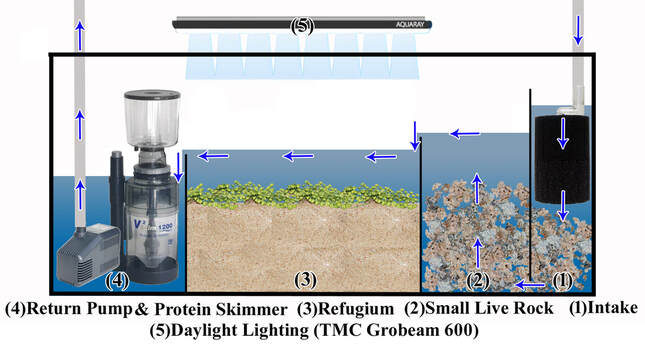
The above diagram displays a more advanced marine aquarium sump that does NOT employ a wet/dry aspect (which IMO/experience is outdated and much less efficient). Please note this can be utilized for freshwater too, simply a freshwater refugium and use of an FSB Filter only in slot 4.
This sump includes:
1. Glass or acrylic plates mounted to provide an optimum flow pattern.
2. An AAP Hydro Pond Pre-Filter in the first chamber.
3. Crushed Coral crumbles for bio filtration, both aerobic and anaerobic (as well as some mechanical filtration).
4. A combination deep sand bed and refugium for further nitrate control. Final chamber with AAP Rio HF Pump for circulation as well as an AAP/TMC Premium V2 Skim marine protein skimmer and/or an FSB Filter Reactor.
5. An AAP/TMC GroBeam or Marine White Premium High efficiency/high output LED light is also employed for refugium.
This sump includes:
1. Glass or acrylic plates mounted to provide an optimum flow pattern.
2. An AAP Hydro Pond Pre-Filter in the first chamber.
3. Crushed Coral crumbles for bio filtration, both aerobic and anaerobic (as well as some mechanical filtration).
4. A combination deep sand bed and refugium for further nitrate control. Final chamber with AAP Rio HF Pump for circulation as well as an AAP/TMC Premium V2 Skim marine protein skimmer and/or an FSB Filter Reactor.
5. An AAP/TMC GroBeam or Marine White Premium High efficiency/high output LED light is also employed for refugium.
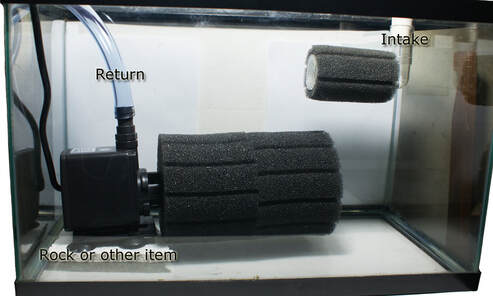
Standard Sump & Central Filter System Sump; DIY: You can easily build your own Sump, Wet/Dry, or Mud-Sump combination. A simple overflow from your tank works well for the pickup (I prefer a bulkhead in the back or bottom of the tank).
For a very effective yet simple filter to power your sump filter (whether for one tank or a central system), the Hydro Pond IV Filter attached to the pump for mechanical copious amounts of nitrifying bio filtration is a proven and hard to beat method, even if not as common.
If you are building a combination filter, I will generally add the live rock crumbles or volcanic rock over/around a Hydro-Pond Sponge connected to the return sump pump. My pump of choice would be a 370 gph to 1200 gph Water Pump such as a Rio HF (Hyper Flow). A Filter Max sponge pre-filter or micron sleeve can be employed on the intake to the sump.
For large multi-aquarium systems with a central sump, this idea can easily be expanded with multiple Hydro Pond Filters (often stacked) along with a high output system pump. For a high output pump, there is simply NO BETTER Pump than the High Efficiency/Output AAP JTP-12000 which puts out 3170 GPH for only 100 watts of energy (with a maximum head pressure 20 ft).
Product Resources:
• Hydro Pond Sponge Filter for Aquarium Sump Applications
• Aquarium Pumps, Sump pumps, power heads, etc.
• AAP SunSun JAP-18000 Amphibious Pump
• Pump Specifications Table (Coming soon!)
For a really simple sump you can simply use a Rubbermaid container filled with live rock crumbles and a pump with a pre filter (although this is not the best, it does work). The diagram below is a simple and effective sump I've used in the past that keeps nitrates low naturally.
For a very effective yet simple filter to power your sump filter (whether for one tank or a central system), the Hydro Pond IV Filter attached to the pump for mechanical copious amounts of nitrifying bio filtration is a proven and hard to beat method, even if not as common.
If you are building a combination filter, I will generally add the live rock crumbles or volcanic rock over/around a Hydro-Pond Sponge connected to the return sump pump. My pump of choice would be a 370 gph to 1200 gph Water Pump such as a Rio HF (Hyper Flow). A Filter Max sponge pre-filter or micron sleeve can be employed on the intake to the sump.
For large multi-aquarium systems with a central sump, this idea can easily be expanded with multiple Hydro Pond Filters (often stacked) along with a high output system pump. For a high output pump, there is simply NO BETTER Pump than the High Efficiency/Output AAP JTP-12000 which puts out 3170 GPH for only 100 watts of energy (with a maximum head pressure 20 ft).
Product Resources:
• Hydro Pond Sponge Filter for Aquarium Sump Applications
• Aquarium Pumps, Sump pumps, power heads, etc.
• AAP SunSun JAP-18000 Amphibious Pump
• Pump Specifications Table (Coming soon!)
For a really simple sump you can simply use a Rubbermaid container filled with live rock crumbles and a pump with a pre filter (although this is not the best, it does work). The diagram below is a simple and effective sump I've used in the past that keeps nitrates low naturally.
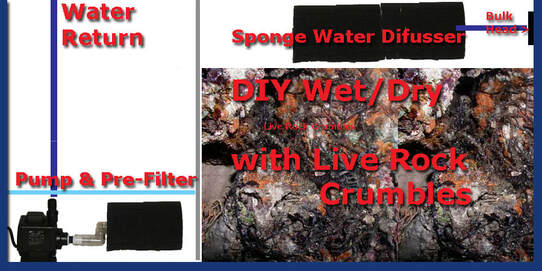
Overflow versus drilled aquarium as a means to get water to your sump: Obviously with a sump below or even beside an aquarium, there must be a means to get the water to the sump. Getting the water back to the display tank is generally easy with using the many pumps available depending upon flow rate and head pressure needed.
Here is a list of many water pump specifications:
• Aquarium/Pond/Sump Pump Specifications (Coming soon!)
My preferred method is with an overflow tube that is attached via a bulkhead drilled in the bottom or side of the aquarium. There is little problem of loss of siphon with this method, whoever these drilled holes are best made prior to setting up the aquarium, especially with glass aquariums. Obviously, this is not always feasible with an already set up aquarium leading to the use of a HOB Overflow that uses a siphon to get water from the aquarium to the sump.
Here is a list of many water pump specifications:
• Aquarium/Pond/Sump Pump Specifications (Coming soon!)
My preferred method is with an overflow tube that is attached via a bulkhead drilled in the bottom or side of the aquarium. There is little problem of loss of siphon with this method, whoever these drilled holes are best made prior to setting up the aquarium, especially with glass aquariums. Obviously, this is not always feasible with an already set up aquarium leading to the use of a HOB Overflow that uses a siphon to get water from the aquarium to the sump.
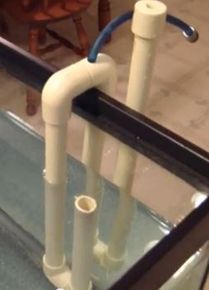
This is where the traditional overflow box is used that allows water to overflow into the box, and then uses a siphon to move the water to the sump. Use of a one-way (out) check valve attached to airline tubing makes it easy to start the water flow by sucking out the air. The same airline can be attached to a power head running in the aquarium that uses an airline to diffuse air into the aquarium, thus helping to prevent loss of siphon from an air bubble forming in the top of the siphon tube.
A newer method employs the use of PVC pumps, generally 3/4 to 1" pvc to act as an overflow with a lower likelihood of loss of siphon than with the traditional methods. See the picture above.
Regardless of what method is used, a caution in case of siphon failure; make sure that your sump holds ANY VOLUME OF WATER that might overflow the aquarium. Example, if the sump holds 8 gallons, the volume your main aquarium holds ABOVE the siphon is NOT LESS THAN 8 GALLONS (for some margin 10 gallons or more would be better).
A newer method employs the use of PVC pumps, generally 3/4 to 1" pvc to act as an overflow with a lower likelihood of loss of siphon than with the traditional methods. See the picture above.
Regardless of what method is used, a caution in case of siphon failure; make sure that your sump holds ANY VOLUME OF WATER that might overflow the aquarium. Example, if the sump holds 8 gallons, the volume your main aquarium holds ABOVE the siphon is NOT LESS THAN 8 GALLONS (for some margin 10 gallons or more would be better).
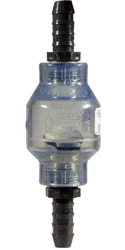
Potential Wet-Dry filter problems:
• Be careful of how your water is delivered to the sump in the event of a power failure or pump failure.
If water is removed via an overflow at the top of the tank, make sure your sump can handle the volume of water that might back up in the even of a pump/power failure by shutting down your pump temporarily.
Otherwise it is highly advisable to place a swing check valve in line where the water enters the sump (see the picture to the left).
Product Resource:
• Swing Check Valve for Wet Dry Filter Sump
• Make sure to clean the bio balls or other bio filter media occasionally by rinsing in USED aquarium water to keep them from slime build up and to keep the water from “channeling”.
• Be careful of how your water is delivered to the sump in the event of a power failure or pump failure.
If water is removed via an overflow at the top of the tank, make sure your sump can handle the volume of water that might back up in the even of a pump/power failure by shutting down your pump temporarily.
Otherwise it is highly advisable to place a swing check valve in line where the water enters the sump (see the picture to the left).
Product Resource:
• Swing Check Valve for Wet Dry Filter Sump
• Make sure to clean the bio balls or other bio filter media occasionally by rinsing in USED aquarium water to keep them from slime build up and to keep the water from “channeling”.
Fluidized Bed High Bio Load
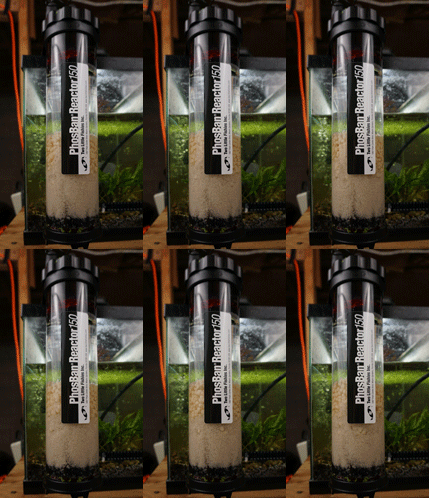
These filters are primarily biological filters only. They work well attached to an internal filter/power head both inside the main aquarium or attached to a sump. As well, many can be easily run off of a canister filer. Fluidized Bed Filters use fine sand kept suspended in a water flow for primarily aerobic biological filtration, but also anaerobic de-nitrifying bio filtration in taller FSB filters as oxygen is used as the water moves through the column of suspended sand. As well the use of products such as NPX BioPlastics placed in the FSB Reaction chamber further enhances nitrate removal capacity.
Product resource:
• NPX BioPlastics Nitrate & Phosphate Reducer 400 ml
• Note: With the exception of the NPX Bioplastics that require a reaction chamber (or Phosphate Removers which do not require a reaction chamber, but work better in one), NO other products should be place in your FSB filter other than the sand (place these products such as Purigen and Marix in a separate filter).
The plus is they are basically self-cleaning as the sand is constantly rubbing against other grains keeping down the organic buildup. The only negatives are these filters do not supply a lot of oxygen for the aerobic bacteria (this is easily remedied with ample water agitation/circulation and/or air stones) and operate best if place AFTER another mechanical filter such as a sponge, filter "sock" (in a sump), or canister filter. I have set up fluidized filters in marine aquariums in place of sumps with excellent results (I set up a whole marine aquarium store department this way).
I fact in lieu of often expensive canister filters such as the Eheim 2080 or the Fluval FX5 & FX6, I would strongly recommend investing in a smaller canister filter (such as the SunSun HW303B or Eheim Classic models 2015-2017) and then place the Fluidized Filter in-line after this Canister Filter.
Using an FSB Filter/Reactor with a canister filter combines the benefits of a canister filter, including good pre-filtration with the benefits of an FSB filter which includes unsurpassed bio filtration that even the largest canister filters cannot match! Generally, this vastly superior bio filtration combination will cost considerably less than the overrated Fluval FX6.
Product resource:
• NPX BioPlastics Nitrate & Phosphate Reducer 400 ml
• Note: With the exception of the NPX Bioplastics that require a reaction chamber (or Phosphate Removers which do not require a reaction chamber, but work better in one), NO other products should be place in your FSB filter other than the sand (place these products such as Purigen and Marix in a separate filter).
The plus is they are basically self-cleaning as the sand is constantly rubbing against other grains keeping down the organic buildup. The only negatives are these filters do not supply a lot of oxygen for the aerobic bacteria (this is easily remedied with ample water agitation/circulation and/or air stones) and operate best if place AFTER another mechanical filter such as a sponge, filter "sock" (in a sump), or canister filter. I have set up fluidized filters in marine aquariums in place of sumps with excellent results (I set up a whole marine aquarium store department this way).
I fact in lieu of often expensive canister filters such as the Eheim 2080 or the Fluval FX5 & FX6, I would strongly recommend investing in a smaller canister filter (such as the SunSun HW303B or Eheim Classic models 2015-2017) and then place the Fluidized Filter in-line after this Canister Filter.
Using an FSB Filter/Reactor with a canister filter combines the benefits of a canister filter, including good pre-filtration with the benefits of an FSB filter which includes unsurpassed bio filtration that even the largest canister filters cannot match! Generally, this vastly superior bio filtration combination will cost considerably less than the overrated Fluval FX6.
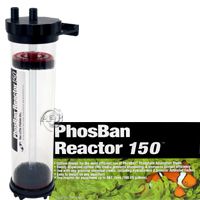
OR simply do away with sometimes cumbersome canister filters completely and place your Fluidized Filter/Reactor in-line to a power head (the addition of a pre-filter sponge is recommended for best results) or Internal Filter (most though do not have the head pressure/flow rate to power FB Filters). Then provide additional aeration/agitation with an air pump or sponge filter driven by an air pump.
The other popular option is running the FSB Filter/Reactor on the side or in a sump. Whatever method you choose, you will get the bio capacity for 10 pounds of fish or other inhabitants (such as turtles) for every 1/2 Kilo of sand used!!! With just 1.5 Kilos of sand, you can maintain a bio load of 30 pounds.
Pictured above right is the newer AAP PhosBan 150 Filter which replaces the older models with simple yet effective design, not to mention more flexibility in use.
The other popular option is running the FSB Filter/Reactor on the side or in a sump. Whatever method you choose, you will get the bio capacity for 10 pounds of fish or other inhabitants (such as turtles) for every 1/2 Kilo of sand used!!! With just 1.5 Kilos of sand, you can maintain a bio load of 30 pounds.
Pictured above right is the newer AAP PhosBan 150 Filter which replaces the older models with simple yet effective design, not to mention more flexibility in use.
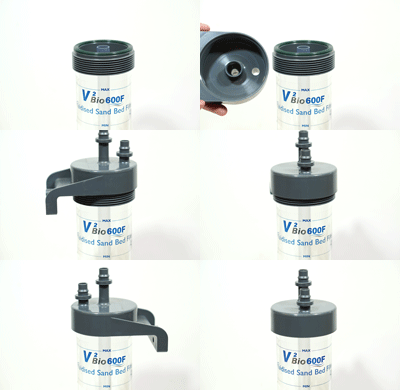
Ease of servicing the AAP FSB filter is another attribute which helped make my decision to move on to these models over previous generation FSB filters. The top easily screws off allowing for easy access to add sand media or other products such as NPX Bioplasitcs. The earlier generation models (which are still widely sold) only allows access via a small opening in the valve assembly.
Product Resource:
• AAP Latest Generation FSB Filters/Reactors
My own extensive use (and this was with the older generation and less efficient LifeGuard/ Pentair Fluidized Filter) showed vastly better bio load capacity with a generic canister filter or power head mated to a fluidized bed filter than with a larger more expensive canister filter (such as the very pricey Fluval FX5).
I should also note that these tests were conducted with a store set up that was fully cycled along with tanks set up with wet/dry, and other tanks with large canister filters. I then added liquefied fish food and noted the spikes in ammonia, nitrites and nitrates. The result was the Fluidized filter systems beat both the large canister filter systems and wet/dry systems with equivalent bio loads!
Product Resource:
• AAP Latest Generation FSB Filters/Reactors
My own extensive use (and this was with the older generation and less efficient LifeGuard/ Pentair Fluidized Filter) showed vastly better bio load capacity with a generic canister filter or power head mated to a fluidized bed filter than with a larger more expensive canister filter (such as the very pricey Fluval FX5).
I should also note that these tests were conducted with a store set up that was fully cycled along with tanks set up with wet/dry, and other tanks with large canister filters. I then added liquefied fish food and noted the spikes in ammonia, nitrites and nitrates. The result was the Fluidized filter systems beat both the large canister filter systems and wet/dry systems with equivalent bio loads!
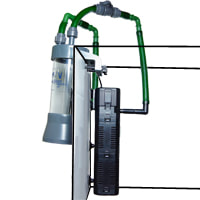
More bluntly the newest generation Fluidized Bed Sand Bed Filters have a Bio Capacity higher than ANY Aquarium Canister Filter per square inch of actual filter chamber, including the Eheim 2080 or Fluval FX5.
When one considers the price of these Reactors/FSB Filters plus a powerhead such as the Rio 1000 mated to the AAP PhosBan 150 along with optional Silica sand and NPX Bioplastics is still MUCH LESS than these large cumbersome canister filters; this becomes a no-brainer IMHO.
Product Resources:
• AAP Professional Fluidized Filters
• Small/Medium Flow Pumps
The Picture above/left displays a SunSun HJ-952 mated to a TMC #600 FB Filter (now replaced by the AAP PhosBan 150). Most Internal Filters do not have the minimum flow rate (& head pressure) to power the larger FB Filters, however this Internal 210 gph has the minimum flow rate to run this Fluidized Bed Filter. The Rio Plus line of pumps (best mated to a Sponge Pre-filter) as the earlier suggested #1000 along with the AAP model #150, & Rio #1100 generally are the pumps of choice for use powering an FSB Filter without a canister filter.
Product Resources:
• SunSun HJ-952; 210 gph Internal Aquarium Filter
• Taam/Rio Water Pump, Power Head
When one considers the price of these Reactors/FSB Filters plus a powerhead such as the Rio 1000 mated to the AAP PhosBan 150 along with optional Silica sand and NPX Bioplastics is still MUCH LESS than these large cumbersome canister filters; this becomes a no-brainer IMHO.
Product Resources:
• AAP Professional Fluidized Filters
• Small/Medium Flow Pumps
The Picture above/left displays a SunSun HJ-952 mated to a TMC #600 FB Filter (now replaced by the AAP PhosBan 150). Most Internal Filters do not have the minimum flow rate (& head pressure) to power the larger FB Filters, however this Internal 210 gph has the minimum flow rate to run this Fluidized Bed Filter. The Rio Plus line of pumps (best mated to a Sponge Pre-filter) as the earlier suggested #1000 along with the AAP model #150, & Rio #1100 generally are the pumps of choice for use powering an FSB Filter without a canister filter.
Product Resources:
• SunSun HJ-952; 210 gph Internal Aquarium Filter
• Taam/Rio Water Pump, Power Head
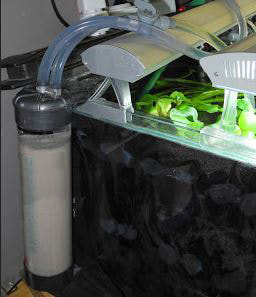
Aquarium fluidized bed filters are the way to go if you have a planted aquarium, because they won't wear off your CO2, as well these adapt better than most bio filters to the cycles of plant respiration and the affects plants have on the aquarium nitrogen cycle. They also make an excellent addition to any large aquarium with a heavy bio-load. Aquarium fluidized bed filters provide the most efficient biological filtration you can get in a large tank, and they are very easy to maintain. The picture above displays an FSB filter mated to the back of a planted aquarium.
Further Reference:
• Planted Freshwater Aquarium Care
I have set up many for clients/stores with drilled thru the bottoms of aquariums, powered by either an Internal Filter/Power Head or a Canister Filter/Micron Filter that then powers a Fluidized Bed Filter. The beauty of this method is that they may move water slower than say a wet-dry, but they are much more efficient, less of a Nitrate factory, and move water at the perfect speed to optimize UV Sterilization (if also utilized). In fact, the goldfish aquariums installed this way were among the healthiest and most trouble free I have maintained.
As for the potential Nitrate Factory issue, the use of a de-nitrifying filter media such as NPX Bio-Plasitcs Media placed inside the Fluidized Filter (especially useful for reef aquariums) OR the use of Purigen and/or Matrix placed in a filter bag near a power head or in a separate filter (usually a canister or HOB) can help to nullify if not eliminate this problem.
Product Resources:
• NPX Bioplastics Nitrate & Phosphate Reducing Polymer Media
• SeaChem Purigen; Removes Nitrogenous Organics from Water
• SeaChem Matrix for Nitrate Removal
The bottom line, if properly installed, their strengths will shine as they are not the nitrate factories that wet/dry filters often become especially if the pre filter used to power the Fluid Filter is rinsed regularly.
As for those who find canister filters messy, cumbersome, and unreliable; a premium Fluidized Filter IS superior in aerobic bio filtration to most canister filters, INCLUDING the over priced and over hyped large capacity Fluval FX and Eheim models.
Be aware that many "cut and paste" web sites such as About.com (whom promote the LifeGuard and do not even mention the AAP Filter), they do little research or update their content and while the LifeGuard may have been the best more than two decades ago (as per my own extensive use), the latest AAP Reactor line is the newest generation with less issues with correct sand fluidation along with the ability!
Tips for Mounting/Installation:
• Besides the control valve supplied with the better FSB filters such as the TMC, purchase and use a second control valve (or swing check valve) for the input side of the filter. This helps prevent sand back up during maintenance. I also suggest the use of a more durable ball valve (generally a 1/2-5/8"). Product Resource: Plumbing Parts; Ball Valves.
• Can be mounted as a HOB (hang on back filter)
• Can be installed under the aquarium in-line.
• Can be placed IN the aquarium!
• Can be placed in a sump, either mounted on the back or placed inside. With this method, I suggest using a separate pump than your main pump moving water out of the sump.
• With the TMC V2 FSB filter, the minimum line is what you want to achieve when first set up, but it will slowly drop as nitrifying bacteria build up. With the Pentair/Lifeguard, I recommend fluidizing closer to the maximum line, but beware that this FSB filter has a bad habit of kicking out sand, especially if not level or if clogged (often due to poor pre-filtration)
Below is an example of a mounting of an older Model #600 FSB filter along with a Rio 1000 Pump, Filter Max #3 pre-filter, & Vecton-2 8 Watt UV Sterilizer:
Further Reference:
• Planted Freshwater Aquarium Care
I have set up many for clients/stores with drilled thru the bottoms of aquariums, powered by either an Internal Filter/Power Head or a Canister Filter/Micron Filter that then powers a Fluidized Bed Filter. The beauty of this method is that they may move water slower than say a wet-dry, but they are much more efficient, less of a Nitrate factory, and move water at the perfect speed to optimize UV Sterilization (if also utilized). In fact, the goldfish aquariums installed this way were among the healthiest and most trouble free I have maintained.
As for the potential Nitrate Factory issue, the use of a de-nitrifying filter media such as NPX Bio-Plasitcs Media placed inside the Fluidized Filter (especially useful for reef aquariums) OR the use of Purigen and/or Matrix placed in a filter bag near a power head or in a separate filter (usually a canister or HOB) can help to nullify if not eliminate this problem.
Product Resources:
• NPX Bioplastics Nitrate & Phosphate Reducing Polymer Media
• SeaChem Purigen; Removes Nitrogenous Organics from Water
• SeaChem Matrix for Nitrate Removal
The bottom line, if properly installed, their strengths will shine as they are not the nitrate factories that wet/dry filters often become especially if the pre filter used to power the Fluid Filter is rinsed regularly.
As for those who find canister filters messy, cumbersome, and unreliable; a premium Fluidized Filter IS superior in aerobic bio filtration to most canister filters, INCLUDING the over priced and over hyped large capacity Fluval FX and Eheim models.
Be aware that many "cut and paste" web sites such as About.com (whom promote the LifeGuard and do not even mention the AAP Filter), they do little research or update their content and while the LifeGuard may have been the best more than two decades ago (as per my own extensive use), the latest AAP Reactor line is the newest generation with less issues with correct sand fluidation along with the ability!
Tips for Mounting/Installation:
• Besides the control valve supplied with the better FSB filters such as the TMC, purchase and use a second control valve (or swing check valve) for the input side of the filter. This helps prevent sand back up during maintenance. I also suggest the use of a more durable ball valve (generally a 1/2-5/8"). Product Resource: Plumbing Parts; Ball Valves.
• Can be mounted as a HOB (hang on back filter)
• Can be installed under the aquarium in-line.
• Can be placed IN the aquarium!
• Can be placed in a sump, either mounted on the back or placed inside. With this method, I suggest using a separate pump than your main pump moving water out of the sump.
• With the TMC V2 FSB filter, the minimum line is what you want to achieve when first set up, but it will slowly drop as nitrifying bacteria build up. With the Pentair/Lifeguard, I recommend fluidizing closer to the maximum line, but beware that this FSB filter has a bad habit of kicking out sand, especially if not level or if clogged (often due to poor pre-filtration)
Below is an example of a mounting of an older Model #600 FSB filter along with a Rio 1000 Pump, Filter Max #3 pre-filter, & Vecton-2 8 Watt UV Sterilizer:
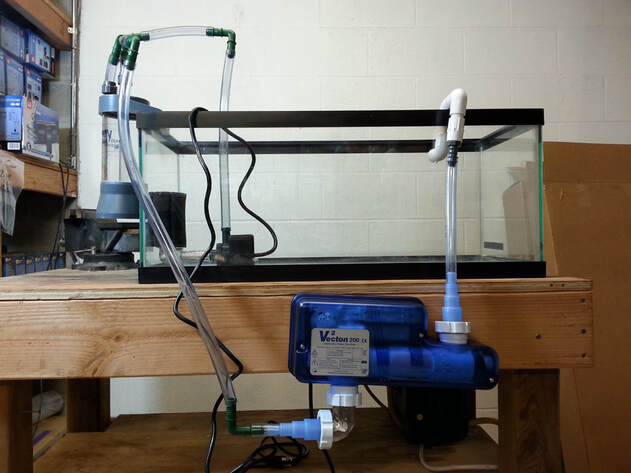
For parts used for the above example and source of these parts, here is a list:
• Rio 1000 Water Pump
• TMC FSB Filter Model #600
• Vecton-2 8-Watt Premium UV Sterilizer
• 5/8 Inch Flexible Tubing
• Filter Max #3 Pre-Filter
• Water Return Adapter
Here is a Diagram of how I installed these with a Canister Filter & UV under the aquarium:
• Rio 1000 Water Pump
• TMC FSB Filter Model #600
• Vecton-2 8-Watt Premium UV Sterilizer
• 5/8 Inch Flexible Tubing
• Filter Max #3 Pre-Filter
• Water Return Adapter
Here is a Diagram of how I installed these with a Canister Filter & UV under the aquarium:
The one possible weakness with Fluidized Filters (when used without a canister filter, HOB, or similar filter present in the aquarium filter system) is the lack of chemical filtration (carbon, Purigen, etc.).
First it is noteworthy that a healthy established aquarium often requires little chemical filtration.
First it is noteworthy that a healthy established aquarium often requires little chemical filtration.
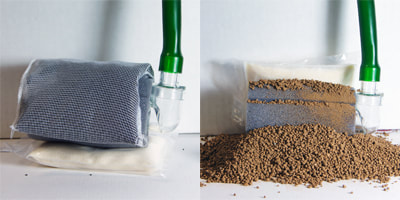
If chemical filtration is necessary (even in low amounts), this however can be overcome by placing a filter bag with carbon draped over or behind a pre-filter sponge (assuming this is used with a water pump/power head). I have placed SeaChem Purigen in a bag just behind a Filter Max Pre-filter with aquarium substrate in front for aesthetics to help hide the sponge and filter bag.
The picture above left displays a Filter Max Sponge Pre-Filter with a carbon bag and Purigen in the left picture. The right picture displays the sponge pre-filter with just Purigen behind the filter and aquarium substrate in front (Please click to enlarge).
Product Resources:
• Filter Max Aquarium Pre-Filter, from AAP
• Nirox Premium Activated Carbon
Another option is to power your FB Filter with an Internal Filter such as the SunSun 952 and then place carbon or other chemical filter media in one of the compartments. The problem with this suggestion is most internal power filters have little room for chemical filter and more importantly most do not have the head pressure to run a FB Filter, especially larger models such as the 1000 or 1500.
The bottom line from my experienced use of FB Filters WITHOUT a canister, HOB, or similar mechanical/chemical filter is that this method of placing a filter bag with chemical media behind the filter works reasonably well for most aquarium needs, albeit not as well as a canister filter for chemical filtration (IF NEEDED!).
• For best results with a Fluidized Sand Bed Filter, a separate aerating power head/propeller pump and/or air stone (or air driven sponge filter) are suggested since Fluidized filter do not aerate water well.
Product Resource:
• Power Head & Circulation Pumps
Potential Fluidized Bed Filter Problems (Troubleshooting): Sometimes pump or power failures can allow sand to back up, however the use of a correctly installed aquarium swing check valve or even just another control valve on the output side of the FSB filter, not just the inlet side can prevent this. As well some, such as the TMC FSB Filter come with valves to prevent this problem, but a second water swing check valve up-line from the FSB Filter can provide more and better redundancy.
Product Resource:
• Swing Check Valve for Fluidized Filter
Also make sure that the outflow/output is above water when servicing, otherwise a back siphon can cause issues with sand back up (unless you have the before mentioned extra valve or check valve).
Sand Ejection: Too 'fast' a pump (high gph) can cause sand to be ejected. Also, if the water pick up for the filter is near a source of aeration or air injection, too much air can be added to the filter and again eject sand. Make sure the FSB filter is level and that the larger gravel is properly placed on the bottom if using a TMC FSB filter.
Generally, the Pentair/Lifeguard FSB filters operate better closer to the maximum line, but one issue with the Pentair is it also often ejects sand. This is not a problem with the TMC V2 FSB filter which also operates more efficiently at the minimum or just below the minimum fluidation line.
Too little flow or more specifically "head pressure" will not allow a Fluidized Filter to properly fluidize the sand and also can allow air pockets to develop. This can get more noticeable as the sand gets "heavier" with bacterial as the filter "matures". Many low end "power head" pumps such as the Hagen and a few basic water pumps may have this issue, especially with larger Fluidized Filters.
Further Reference:
• Aquarium and Pond Pump Head Pressure
Another cause is failure to provide adequate pre-filtration. Good mechanical pre-filtration is a MUST with an FSB filter and often detractors of these filters have failed to set up a pre-filter. Often, all this need be is a good sponge Pre-filter (note "good", as many are not adequate), a canister filter run before the FSB filter, or if placed in a sump, some sort of mechanical filter that removes debris before it enters the Fluid Filter (such as sump filter sock). Of these, often the canister filter is the best pre-filter if only because of volume of mechanical filter material.
These problems are more common to first- and second-generation Fluidized Filters such as the Coralife Sea Storm or Pentair FB300, FB600 filters. Pre-filtration is one of the biggest keys to success with FSB filters, especially in tanks with a lot of organic debris. A telltale sign that your pre-filtration is not adequate is that your pump or canister filter running the FSB gets very "mungy" with organic debris in the impeller well of the pump/filter. If this problem does exist, this indicates and issue with your mode of pre-filtration, NOT an issue with a pump not strong enough (if it worked initially) or your FSB filter itself.
To clear the FSB filter itself, generally simply rinsing sand in de-chlorinated water and then placing back in the filter will take care of a clog or poor fluidation due to organic buildup within the filter. If sand has backed up into the intake pipe, often many lower powered aquarium pumps will not be able to push this out. Sometimes the aquarium keeper can blow this out, but more often I find adding a few drops of de-chlorinator to the intake side of the FSB Filter, then holding a water hose tightly to this intake will quickly blow out the "sand jam".
Some might take the clogging problem as the FSB Filters cannot handle a large bio load, HOWEVER clogging is a problem of large organic debris, and this "clogging" is often in the water pump as well as the FSB Filter, so it should be cleaned as well if a clog occurs. Once pre-filtration is correctly added, the FSB Filter is unsurpassed when it comes to DOC (Dissolved Organic Compounds) in the water column, which is what will cause issues of high ammonia, nitrites, nitrates, and even yellow water.
Poor fluidization where the sand does not lift much or swirls in a circular motion instead if a vertical motion. Some of the other tips also address this, including poor pre-filtration. Clogging of inlet can cause this as well as poor pump head pressure. Another cause is the filter itself; often short FSB filters tend to fluidize horizontally instead of vertically. Even with the TMC V2 line of FSB filters, the small/short model 600 tend to fluidize more horizontally than vertically. I have found taller models over 12 inches such as the TMC model #1000 tend to do a better job of vertical fluidization.
The above said, even horizontal is performing good bio filtration that is generally better than any other filter type per volume of filter media, just not as optimum as when there is a better up and down mixing of the sand
Too much pipe/tubing or an in-line pump MAY also impede flow (head pressure) and allow for "pockets", especially when coupled to a weak pump and even more equipment in line. Reducing pipe/tubing if at all possible and changing pumps may help if this is the problem.
It is normal for ALL properly constructed FSB filters to slowly fluidize at lower level due to the weight of bacteria that will slowly colonize the sand over time. With the TMC V2 this usually means dropping just below the minimum line, while with the Pentair it means dropping to minimum line or just above.
The picture above left displays a Filter Max Sponge Pre-Filter with a carbon bag and Purigen in the left picture. The right picture displays the sponge pre-filter with just Purigen behind the filter and aquarium substrate in front (Please click to enlarge).
Product Resources:
• Filter Max Aquarium Pre-Filter, from AAP
• Nirox Premium Activated Carbon
Another option is to power your FB Filter with an Internal Filter such as the SunSun 952 and then place carbon or other chemical filter media in one of the compartments. The problem with this suggestion is most internal power filters have little room for chemical filter and more importantly most do not have the head pressure to run a FB Filter, especially larger models such as the 1000 or 1500.
The bottom line from my experienced use of FB Filters WITHOUT a canister, HOB, or similar mechanical/chemical filter is that this method of placing a filter bag with chemical media behind the filter works reasonably well for most aquarium needs, albeit not as well as a canister filter for chemical filtration (IF NEEDED!).
• For best results with a Fluidized Sand Bed Filter, a separate aerating power head/propeller pump and/or air stone (or air driven sponge filter) are suggested since Fluidized filter do not aerate water well.
Product Resource:
• Power Head & Circulation Pumps
Potential Fluidized Bed Filter Problems (Troubleshooting): Sometimes pump or power failures can allow sand to back up, however the use of a correctly installed aquarium swing check valve or even just another control valve on the output side of the FSB filter, not just the inlet side can prevent this. As well some, such as the TMC FSB Filter come with valves to prevent this problem, but a second water swing check valve up-line from the FSB Filter can provide more and better redundancy.
Product Resource:
• Swing Check Valve for Fluidized Filter
Also make sure that the outflow/output is above water when servicing, otherwise a back siphon can cause issues with sand back up (unless you have the before mentioned extra valve or check valve).
Sand Ejection: Too 'fast' a pump (high gph) can cause sand to be ejected. Also, if the water pick up for the filter is near a source of aeration or air injection, too much air can be added to the filter and again eject sand. Make sure the FSB filter is level and that the larger gravel is properly placed on the bottom if using a TMC FSB filter.
Generally, the Pentair/Lifeguard FSB filters operate better closer to the maximum line, but one issue with the Pentair is it also often ejects sand. This is not a problem with the TMC V2 FSB filter which also operates more efficiently at the minimum or just below the minimum fluidation line.
Too little flow or more specifically "head pressure" will not allow a Fluidized Filter to properly fluidize the sand and also can allow air pockets to develop. This can get more noticeable as the sand gets "heavier" with bacterial as the filter "matures". Many low end "power head" pumps such as the Hagen and a few basic water pumps may have this issue, especially with larger Fluidized Filters.
Further Reference:
• Aquarium and Pond Pump Head Pressure
Another cause is failure to provide adequate pre-filtration. Good mechanical pre-filtration is a MUST with an FSB filter and often detractors of these filters have failed to set up a pre-filter. Often, all this need be is a good sponge Pre-filter (note "good", as many are not adequate), a canister filter run before the FSB filter, or if placed in a sump, some sort of mechanical filter that removes debris before it enters the Fluid Filter (such as sump filter sock). Of these, often the canister filter is the best pre-filter if only because of volume of mechanical filter material.
These problems are more common to first- and second-generation Fluidized Filters such as the Coralife Sea Storm or Pentair FB300, FB600 filters. Pre-filtration is one of the biggest keys to success with FSB filters, especially in tanks with a lot of organic debris. A telltale sign that your pre-filtration is not adequate is that your pump or canister filter running the FSB gets very "mungy" with organic debris in the impeller well of the pump/filter. If this problem does exist, this indicates and issue with your mode of pre-filtration, NOT an issue with a pump not strong enough (if it worked initially) or your FSB filter itself.
To clear the FSB filter itself, generally simply rinsing sand in de-chlorinated water and then placing back in the filter will take care of a clog or poor fluidation due to organic buildup within the filter. If sand has backed up into the intake pipe, often many lower powered aquarium pumps will not be able to push this out. Sometimes the aquarium keeper can blow this out, but more often I find adding a few drops of de-chlorinator to the intake side of the FSB Filter, then holding a water hose tightly to this intake will quickly blow out the "sand jam".
Some might take the clogging problem as the FSB Filters cannot handle a large bio load, HOWEVER clogging is a problem of large organic debris, and this "clogging" is often in the water pump as well as the FSB Filter, so it should be cleaned as well if a clog occurs. Once pre-filtration is correctly added, the FSB Filter is unsurpassed when it comes to DOC (Dissolved Organic Compounds) in the water column, which is what will cause issues of high ammonia, nitrites, nitrates, and even yellow water.
Poor fluidization where the sand does not lift much or swirls in a circular motion instead if a vertical motion. Some of the other tips also address this, including poor pre-filtration. Clogging of inlet can cause this as well as poor pump head pressure. Another cause is the filter itself; often short FSB filters tend to fluidize horizontally instead of vertically. Even with the TMC V2 line of FSB filters, the small/short model 600 tend to fluidize more horizontally than vertically. I have found taller models over 12 inches such as the TMC model #1000 tend to do a better job of vertical fluidization.
The above said, even horizontal is performing good bio filtration that is generally better than any other filter type per volume of filter media, just not as optimum as when there is a better up and down mixing of the sand
Too much pipe/tubing or an in-line pump MAY also impede flow (head pressure) and allow for "pockets", especially when coupled to a weak pump and even more equipment in line. Reducing pipe/tubing if at all possible and changing pumps may help if this is the problem.
It is normal for ALL properly constructed FSB filters to slowly fluidize at lower level due to the weight of bacteria that will slowly colonize the sand over time. With the TMC V2 this usually means dropping just below the minimum line, while with the Pentair it means dropping to minimum line or just above.
Algae Scrubbers/Refugium
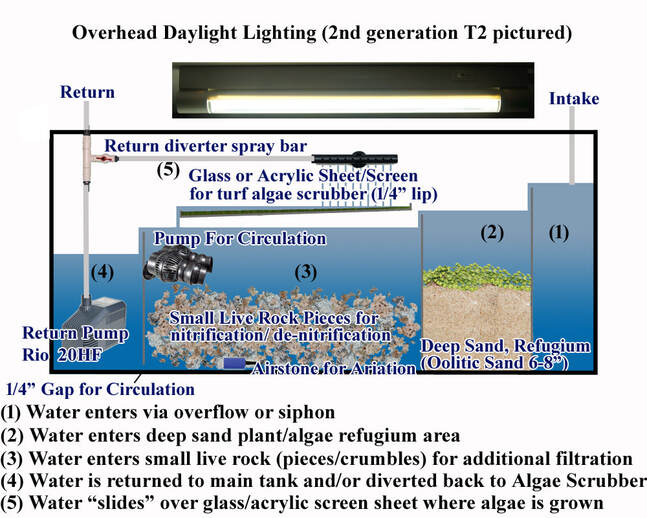
Algae Scrubber: A concept that is growing popularity (that in my view is an improved off shoot from the Refugium, but better) is the Algae Scrubber. The term “Algae Scrubber" refers to this systems use of algae to “scrub” the water of nitrates, phosphates and similar nutrients that often plague many reef tanks. Many claim that with the use of these, protein skimmers can be discarded (I still recommend some mechanical filtration and germicidal filtration).
There are many methods or concepts to this “scrubber” (filter), so please understand this diagram is based on the way a friend in the professional maintenance business has shown me. I have not personally used this method, but the early feedback is certainly very positive and the diagram here is a combined method that also utilizes optional Live Rock Crumbles for further nitrification/ de-nitrification as well a some Refugium concepts and deep sand bed methods too. My colleague suggested a diverter spray bar added to the pump return line to better saturate the algae on the screen or spreader plate.
This picture uses a Rio 20HP, however this was used for a larger (150-gallon tank) and smaller power head such as a Rio 1100 would work fine for most smaller tanks. Good daylight lighting (high PAR/6500K) is essential for success; for a smaller algae scrubber a small CFL, T5 or as pictured here an efficient T2 Daylight fixture works well (or 2-3 of these T2 lights). For larger Algae Scrubbers (or for higher light needs) I would suggest the Super High Output Daylight Lamps (65 watt) or TMC HO GroBeam LEDs for the lighting application.
Product Resources:
• High Flow Pumps
• Small/Medium Flow Pumps
• Super High Output CFL Daylight Aquarium Lights
• AAP GroBeam 600 & 1500 LED Lights
There are many methods or concepts to this “scrubber” (filter), so please understand this diagram is based on the way a friend in the professional maintenance business has shown me. I have not personally used this method, but the early feedback is certainly very positive and the diagram here is a combined method that also utilizes optional Live Rock Crumbles for further nitrification/ de-nitrification as well a some Refugium concepts and deep sand bed methods too. My colleague suggested a diverter spray bar added to the pump return line to better saturate the algae on the screen or spreader plate.
This picture uses a Rio 20HP, however this was used for a larger (150-gallon tank) and smaller power head such as a Rio 1100 would work fine for most smaller tanks. Good daylight lighting (high PAR/6500K) is essential for success; for a smaller algae scrubber a small CFL, T5 or as pictured here an efficient T2 Daylight fixture works well (or 2-3 of these T2 lights). For larger Algae Scrubbers (or for higher light needs) I would suggest the Super High Output Daylight Lamps (65 watt) or TMC HO GroBeam LEDs for the lighting application.
Product Resources:
• High Flow Pumps
• Small/Medium Flow Pumps
• Super High Output CFL Daylight Aquarium Lights
• AAP GroBeam 600 & 1500 LED Lights
Another Algae Scrubber idea is one by Santa Monica Filtration. This concept uses a grow-light LED that attached magnetically to the side or floats on top of the water. The surface where the algae grows is textured to maximize growth.
As with other algae scrubbers, the idea is simple and that is the algae in this "scrubber" removes nitrates, phosphates, and other nutrients from the water column thus lowering in tank algae growth and keeping nitrate levels lower for sensitive aquatic life (in particular marine reef tanks).
I am currently testing this product and if it checks out will recommend and sell this product.
As with other algae scrubbers, the idea is simple and that is the algae in this "scrubber" removes nitrates, phosphates, and other nutrients from the water column thus lowering in tank algae growth and keeping nitrate levels lower for sensitive aquatic life (in particular marine reef tanks).
I am currently testing this product and if it checks out will recommend and sell this product.
Refugium (& deep sand/mud filter): These filters are primarily biological filters. Their advantage is that they work both aerobically and anaerobically (removing nitrates, de-nitrification). These filters are very popular in Germany from what I understand. They work best if they have plants or algae such as Caulerpa Algae (or any other green marine algae/plant that grows quickly) to aid in de-nitrification (You would need to add lighting over this filter if plants are included). I also recommend the use of a micron filter sleeve for pre filtration and/or a sponge media for further filtration before reaching the pump (which should be rinsed regularly so as to not themselves become “nitrate factories”.
The picture above is of a Refugium with a deep sand bed for anaerobic filtration. In the basic picture/diagram above the Refugium is mounted slightly higher than the tank so the pump in the display tank pumps water to the Refugium and the water is redirected by the overflow/outlet to the main display tank. The Refugium/Mud Filter can also be place under the display tank and then the tank has an overflow or siphon to the Refugium and then a pump is placed therein to return the water back to the display tank.
A video below displaying a working Refugium that is also utilizing "state of the art" AquaRay LED lighting for phenomenal growth.
The picture above is of a Refugium with a deep sand bed for anaerobic filtration. In the basic picture/diagram above the Refugium is mounted slightly higher than the tank so the pump in the display tank pumps water to the Refugium and the water is redirected by the overflow/outlet to the main display tank. The Refugium/Mud Filter can also be place under the display tank and then the tank has an overflow or siphon to the Refugium and then a pump is placed therein to return the water back to the display tank.
A video below displaying a working Refugium that is also utilizing "state of the art" AquaRay LED lighting for phenomenal growth.

In my experience these are not good as the "only" filter and do not replace mechanical or especially germicidal filtration in marine tanks. They do make an excellent alternative or combination to sometimes difficult to use protein skimmers and can be awesome filters when used in combination with other filters and live rock, especially when the pure Berlin Method of filtration is employed.
Germical
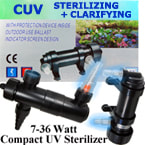
Germicidal filtration is the use of UVC radiation or ozone to kill disease pathogens and improve the Redox Potential in aquariums (only true level 1 or higher UV Sterilization improves Redox).
My extensive experience and research shows that while not essential, the use of Germicidal filtration (UV Sterilization in particular) is something any serious aquarium keeper should not be without. Many articles I have read state that a UV is not that beneficial to an established aquarium as a healthy aquarium depends on beneficial bacteria typically growing on media in your filter which neutralize ammonia.
Unfortunately, the problem with this statement is beneficial bacteria belongs in the filter, not in the open water. Also, this is great for advanced aquarists who are not adding fish and have a healthy Redox Potential, but not in the real world of average and above average aquarists that I have dealt with in the 100s of aquariums I have serviced.
I have a very in-depth article about this subject. I strongly recommend reading this article IN FULL if you plan to move from basic aquarium keeping to advanced:
• Why you should use a UV Sterilizer and how it works
My extensive experience and research shows that while not essential, the use of Germicidal filtration (UV Sterilization in particular) is something any serious aquarium keeper should not be without. Many articles I have read state that a UV is not that beneficial to an established aquarium as a healthy aquarium depends on beneficial bacteria typically growing on media in your filter which neutralize ammonia.
Unfortunately, the problem with this statement is beneficial bacteria belongs in the filter, not in the open water. Also, this is great for advanced aquarists who are not adding fish and have a healthy Redox Potential, but not in the real world of average and above average aquarists that I have dealt with in the 100s of aquariums I have serviced.
I have a very in-depth article about this subject. I strongly recommend reading this article IN FULL if you plan to move from basic aquarium keeping to advanced:
• Why you should use a UV Sterilizer and how it works
Protein Skimmer Filters
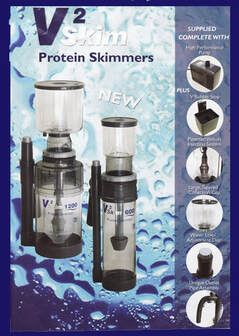
Protein skimmers remove nitrogenous wastes (protein based organic waste) via foam refraction. The protein skimmer collects this waste in a cup, where it is then emptied. There are pump driven and air driven models. Within the pump driven there are different types: Venturi, Aspirating, Downdraft, and Spray Injection; the first two being most common.
For a much more in-depth discussion of Protein Skimmers, please see this Aquarium Answers article: • Aquarium Protein Skimmers
Protein skimmers generally only work in marine aquariums (due to inefficiency of the bubble size in freshwater) where they are very popular in reef aquaria, as they are often needed to keep nitrates below .20 ppm for the delicate marine invertebrates.
Here are some important aspects to consider so as to a purchase a skimmer that performs correctly:
• Contact time of bubbles and water inside the chamber (the longer the reaction chamber, the better in most cases).
• The size and consistency of the bubbles produced (very fine bubbles are best).
• The ratio of air to water.
• Turbulence or friction inside the reaction chamber which may cause poor efficiency in some poorly designed units.
• The use of an Ozone Generator (Ozonizer) can greatly increase the efficiency of a Venturi style skimmer (making an already excellent venturi skimmer such as the TMC V2 Skim, a protein skimmer that is “second to none”). As well an Ozonizer can lower bacterial, viral, and other disease pathogens in the water column.
The advantages of a Protein Skimmer are that they remove nitrogenous waste before they can go thru the nitrogen cycle and become nitrates. The disadvantages are they can be messy, take frequent adjustments (at least on many lower end commercial models), and in my experience, overrated especially for marine fish aquariums. I also have kept many reef aquariums successfully with and without protein skimmers although I do recommend protein skimmers for reef aquariums.
What I personally find interesting is that many of the aquarists that swear by protein skimmers totally trash UV Sterilizers, yet I have found from experience (I had to service what I sell, and if I sold trash, I had to service trash!) that often UV sterilizers had a more positive attributes than protein skimmers.
That said, a good Protein skimmer a useful tool in marine aquariums especially if an Ozonizer is connected to the Skimmer and/or when used in conjunction with the Berlin Filter Method for reef aquaria and should be considered, more so if you are planning on keeping delicate corals such as Acropora or Zoanthids!
The Tropic Marine V2 Skim is one of the better ones with the latest in technology. This skimmer has a venturi injection system which optimizes the perfect mixture of fine air bubbles and water and ensures intensive, efficient skimming and the removal of proteins and other harmful toxins (waste) from the aquarium. For advanced Marine Aquarists (or even beginners looking to step up) this is the Protein skimmer I would strongly recommend. I do not recommend the Sea-Clone.
Potential Protein Skimmer Problems: Protein Skimmers often need regular adjustment to achieve a proper foam collection level and sometimes the cup will also overflow when not checked often (this doesn't usually make a mess, just makes for an ineffective protein skimmer). In my opinion many Protein Skimmers are best for more serious hobbyists do to the sometimes-regular attention they need but does not mean you have to be a professional to own one, just not someone who more just wants to look at his or her pretty aquarium with little “hands on”.
Also, the diffuser in the pump (in pump driven models) can easily get debris such as carbon caught in the pump and make noise and not function properly this is more common in units with filter cartridges. To correct this; remove the carbon insert container, clean everything out, scrub it with a brush to remove all traces of the carbon particles, and then put it back together.
For a much more in-depth discussion of Protein Skimmers, please see this Aquarium Answers article: • Aquarium Protein Skimmers
Protein skimmers generally only work in marine aquariums (due to inefficiency of the bubble size in freshwater) where they are very popular in reef aquaria, as they are often needed to keep nitrates below .20 ppm for the delicate marine invertebrates.
Here are some important aspects to consider so as to a purchase a skimmer that performs correctly:
• Contact time of bubbles and water inside the chamber (the longer the reaction chamber, the better in most cases).
• The size and consistency of the bubbles produced (very fine bubbles are best).
• The ratio of air to water.
• Turbulence or friction inside the reaction chamber which may cause poor efficiency in some poorly designed units.
• The use of an Ozone Generator (Ozonizer) can greatly increase the efficiency of a Venturi style skimmer (making an already excellent venturi skimmer such as the TMC V2 Skim, a protein skimmer that is “second to none”). As well an Ozonizer can lower bacterial, viral, and other disease pathogens in the water column.
The advantages of a Protein Skimmer are that they remove nitrogenous waste before they can go thru the nitrogen cycle and become nitrates. The disadvantages are they can be messy, take frequent adjustments (at least on many lower end commercial models), and in my experience, overrated especially for marine fish aquariums. I also have kept many reef aquariums successfully with and without protein skimmers although I do recommend protein skimmers for reef aquariums.
What I personally find interesting is that many of the aquarists that swear by protein skimmers totally trash UV Sterilizers, yet I have found from experience (I had to service what I sell, and if I sold trash, I had to service trash!) that often UV sterilizers had a more positive attributes than protein skimmers.
That said, a good Protein skimmer a useful tool in marine aquariums especially if an Ozonizer is connected to the Skimmer and/or when used in conjunction with the Berlin Filter Method for reef aquaria and should be considered, more so if you are planning on keeping delicate corals such as Acropora or Zoanthids!
The Tropic Marine V2 Skim is one of the better ones with the latest in technology. This skimmer has a venturi injection system which optimizes the perfect mixture of fine air bubbles and water and ensures intensive, efficient skimming and the removal of proteins and other harmful toxins (waste) from the aquarium. For advanced Marine Aquarists (or even beginners looking to step up) this is the Protein skimmer I would strongly recommend. I do not recommend the Sea-Clone.
Potential Protein Skimmer Problems: Protein Skimmers often need regular adjustment to achieve a proper foam collection level and sometimes the cup will also overflow when not checked often (this doesn't usually make a mess, just makes for an ineffective protein skimmer). In my opinion many Protein Skimmers are best for more serious hobbyists do to the sometimes-regular attention they need but does not mean you have to be a professional to own one, just not someone who more just wants to look at his or her pretty aquarium with little “hands on”.
Also, the diffuser in the pump (in pump driven models) can easily get debris such as carbon caught in the pump and make noise and not function properly this is more common in units with filter cartridges. To correct this; remove the carbon insert container, clean everything out, scrub it with a brush to remove all traces of the carbon particles, and then put it back together.
Berlin Filter Method
This is not a filter per say, rather a method of filtration for Marine Aquaria only that can employ many different filter types to accomplish it. Simply put it is the use of live rock and live sand (or mud) to perform aerobic and anaerobic filtration as well as provide a breeding ground for beneficial copepods and other marine life forms. The general idea is to use from 1-2 lb. (.45 to .9 kg) of live rock per gallon (5 liters) of aquarium water.
This starts by adding ‘Cured’ Live Rock to your aquarium and even to some filters. It is best to purchase this live rock from dealers that have had this in an established aquarium for 2-4 weeks). Besides being placed in the aquarium, this live rock can be placed in filters such as a Mud Filter, in place of bio-balls in a wet/dry of either type (this is accomplished by breaking it into 1-2” pieces), in HOB Filters instead of filter media such as an Aqua Clear 500 (again using broken pieces), or in a sump. I really have had good success with broken live rock in built in wet/dry filters in place of bio-balls. Protein Skimmers can complement this well.
This starts by adding ‘Cured’ Live Rock to your aquarium and even to some filters. It is best to purchase this live rock from dealers that have had this in an established aquarium for 2-4 weeks). Besides being placed in the aquarium, this live rock can be placed in filters such as a Mud Filter, in place of bio-balls in a wet/dry of either type (this is accomplished by breaking it into 1-2” pieces), in HOB Filters instead of filter media such as an Aqua Clear 500 (again using broken pieces), or in a sump. I really have had good success with broken live rock in built in wet/dry filters in place of bio-balls. Protein Skimmers can complement this well.
Cleaning Filters
Cleaning filters of note include the Diatom Filter (Vortex used to be a popular model), Aquarium water changers, Sludge Removers, and Filters such as the Aquarium Cleaning Machine.
The Diatom filters use diatomaceous earth to filter water down to very fine micron size, and even filter out ich tomites. Often these filters were/are used in place of a water change, which they should not be.
Also, in my experience diatomaceous earth tends to strip some electrolytes from the water.
The Diatom filters use diatomaceous earth to filter water down to very fine micron size, and even filter out ich tomites. Often these filters were/are used in place of a water change, which they should not be.
Also, in my experience diatomaceous earth tends to strip some electrolytes from the water.

Another cleaning “filter” is the Eheim Sludge Extractor Battery Vacuum; this is sort of an economy version of the Aquarium Cleaning Machine (although it cannot be used to changes water). This Eheim Battery Vacuum is a vast improvement over the “bag” versions that came before it that let about 90% of organic mulm, through their fine mesh bags.
However as per my use and others that have used this device as well a true Micron Filter such as the Vortex, these are purely for organic sludge, mulm, over feeding removal, etc. This said, the Eheim Battery Vacuum Filter is a good alternative for mulm/sludge removal for those on a budget or with small aquariums where the Cleaning Machine is simply not practical.
Product Resource:
• Eheim Battery Vacuum with Micron Filter
The Aquarium Cleaning Machine which came out around 2005 can first be used as a power vacuum to vacuum and drain water even up to a sink, then set to re-circulate through a micron & carbon cartridge where you can get the rest of the mulm out without changing too much water. The micron cartridges in these can filter very fine particle including some parasites too (down to 20-30 microns).
The advantage of the Aquarium Cleaning Machine over the Vortex Filters is that you do not need to constantly “stir” your substrate/gravel to free up organic debris, which is not only stressful towards the fish, but is simply very inefficient as compared to the vacuum bell of the Cleaning Machine. The Aquarium Cleaning Machine was a good tool for large "Monster Fish" aquariums, FOWLR saltwater tanks, and others. Unfortunately, this product is no longer available due to some poor business decisions by the manufacturer (in my opinion) & abuse by a popular retailer.
As with the Vortex Filters, the Cleaning Machine should not be used in place of water changes, however with the Garden Hose attachment, this machine can be used to drain water out of your aquarium as well (into the yard, sink, toilet, etc.).
However as per my use and others that have used this device as well a true Micron Filter such as the Vortex, these are purely for organic sludge, mulm, over feeding removal, etc. This said, the Eheim Battery Vacuum Filter is a good alternative for mulm/sludge removal for those on a budget or with small aquariums where the Cleaning Machine is simply not practical.
Product Resource:
• Eheim Battery Vacuum with Micron Filter
The Aquarium Cleaning Machine which came out around 2005 can first be used as a power vacuum to vacuum and drain water even up to a sink, then set to re-circulate through a micron & carbon cartridge where you can get the rest of the mulm out without changing too much water. The micron cartridges in these can filter very fine particle including some parasites too (down to 20-30 microns).
The advantage of the Aquarium Cleaning Machine over the Vortex Filters is that you do not need to constantly “stir” your substrate/gravel to free up organic debris, which is not only stressful towards the fish, but is simply very inefficient as compared to the vacuum bell of the Cleaning Machine. The Aquarium Cleaning Machine was a good tool for large "Monster Fish" aquariums, FOWLR saltwater tanks, and others. Unfortunately, this product is no longer available due to some poor business decisions by the manufacturer (in my opinion) & abuse by a popular retailer.
As with the Vortex Filters, the Cleaning Machine should not be used in place of water changes, however with the Garden Hose attachment, this machine can be used to drain water out of your aquarium as well (into the yard, sink, toilet, etc.).
Videos
|
|
|
|
|
|
|
|