

Aquarium & Pond Sponge Filtration
How Sponge Filters Work by AAP
How Sponge Filters Work by AAP
Overview
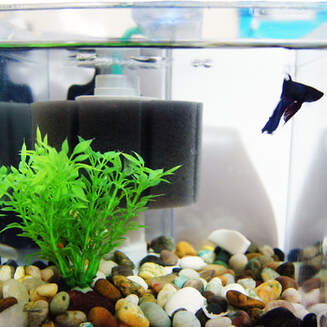
Sponge filtration is an often-overlooked type of filtration for both large and small freshwater tanks and bowls, and even ponds or marine aquariums. Many aquarists look past these filters because of their simplicity, but therein lies their quality. I have professional used these filters for my aquarium maintenance business for 40 plus years with excellent results in freshwater, saltwater and ponds.
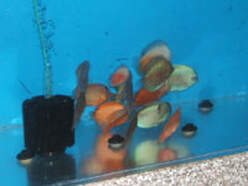
It is also noteworthy that the concept is not new, dating back at least to the early 1960s with the Lustar or Hamburger Mattenfilter Sponges. (The picture above is a Hydro Sponge #1 in a 6 x 6 x 6 Betta tank.)
Unfortunately a large number of lower quality Chinese made sponge filters (many violating USA patents for design too) have flooded the market in part due to snake oil salespersons on YouTube and elsewhere often promoting only the coarse sponge over the fine sponge when in fact professional experience over the decades shows that in 2/3s of aquarium the fine is the better choice or better a combination of the two.
This has led to many otherwise knowledgeable aquarium keepers to point out that a negative is that sponge filters lose their load of trapped particulates upon removal when in fact this is rarely true when the proper quality USA made sponge is mated to the aquarium to the aquarium it will filter.
The truly best sponge filters (such as the USA made Patented AAP Hydro Sponge Filters) can be used to compliment another filter, such as a power "hang on back" (HOB) or canister filter, or even as a standalone filter, as per our extensive controlled tests. We found that only fluidized sand bed filters out perform quality sponge filters for aerobic bio filtration. In fact, I, and many other aquarium professionals, have used sponge filters as the only source of aquarium filtration for decades (with many experiments testing different sponge types & more).
With this in mind, people purchasing one of the many 'Aquarium Kits' sold at Walmart and elsewhere would be much better off with a superior bio-filtration such as the AAP Professional Sponge Filter Kit instead.
As a bio filter, most premium sponge filters (such as the Premium AAP Hydro Sponge Filter) are vastly superior to Under Gravel Filters and even superior to comparably rated HOB filter as per extensive controlled tests performed by us in the 1990s. This is due to the very porous nature of a sponge filter that allows for extensive colonization of nitrifying bacteria, assuming your aquarium or pond is adequately circulated.
A couple of the reasons for better test results when compared to an under gravel filter, is that a well designed sponge filter does not have “dead” spots, nor do sponge filters trap decomposing organic mulm in pockets, such as is the case with under gravel filter plates (which can lower KH/pH, increase nitrates, and even promote Aeromonas or Saprolegnia pathogens!)
In addition, these tests showed that these filters were also superior to most popular power (HOB) filters for bio filtration (such as the Marineland Bio Wheel). Bio Wheels is touted for their ability to host beneficial nitrifying bacteria and yet, this simple sponge filter outperformed them.
Please see this article for more specific information on Bio Wheels:
• Bio Wheels: Do they Work
Please note that many sponge filters and even patent design infringing "knock offs" made by a variety of brands (such as Hagen, SF-XY, XY-380, AquaTop) are NOT made of the same patented sponge material as ATI's patented Hydro sponges. This includes both the coarse and fine sponge material. Thus, these do not perform nitrification at the same level, as my tests confirmed in the 1990s, often by a LARGE margin due to a much more porous design that simply traps more debris and allows more bacterial colonization. As well, these patented sponges have a micro design that does not collapse on itself as readily as other designs. Please read further for a more in-depth explanation of this. These lower end sponge filters (generally Chinse made) also degrade much quicker, as many users can attest to.
In fact, in tests using the Chinese knock offs such as the XY-380 & Hikari commonly sold via Amazon, using very similar bio load aquariums, I found the amount of organic debris during the same time period to be almost double for the patented AAP Hydro Sponge Filter, thus demonstrating a MUCH higher capacity!!!
What is noteworthy is that it is easy to have anything made in China as a knock off of the patent design (I know as I too have done business with China and know full well of the poor ethics they practice in manufacturing), as China does not care about patents and while the design might be very similar (other than changing the color to green as per the newest knock off to hit the market), the fact remains the sponge material is a much less effective material as China will cut corners here.
What is unfortunate of late is so much is based on marketing such as YouTube videos, so you get people believing anything they see in these videos without question, such as that a more coarse material is generally the better choice when in fact in depth tests show that this is not necessarily true and in fact the AAP/ATI standard sponge is often a better choice even in larger aquariums, or better yet a combination or AAP Combo Sponge filter which utilizes the best of both. The bottom line is there is a reason for the patent and why send money to China (even if marketed by an American retailer) when you do not need to since the best is made in the USA?
If you want a better sponge, more options and to support USA made sponge filters over Chinese made, this is the only place you should be shopping:
• AAP USA Made Hydro Sponge Filters; Complete with Combos and more
Commentary/Rebuttle: A member of the group "badmanstropicalfishDOTcom" made a comment about this article: "There is no way any appropriately sized sponge filter has more surface area than a properly set up UGF".
I am not sure why he thinks this, but I can categorically state that in just one large example, the Bahooka Restaurant where one location alone was set up with under gravel filters in well over 100 aquariums. As these aquariums were switched out with appropriately sized AAP/ATI Hydro Sponge Filters, not only was there less organic mulm present during cleanings, but these tanks responded better to spikes in bio load too.
Finally before I go into the main part of this article, a friend pointed out to me that someone wrote an article and in the comments section made attacks upon me partly based on the fact I sell the Hydro Sponge and defend the patent so many times in this article.
Well why should I not sell the one aquarium filter product I've probably tested more than any other in many different forms/brands in my decades and 1000s of aquariums I have professionally maintained??
As for the patent in particular, sorry, but I think it is right to defend a product where a patent has been more abused than any other in my time in this industry dating back to 1977, and often these infringing brands only utilize the "utility" parts of the patent while the sponge material seriously lacks in quality. If you're OK with an inferior patent infringing product over an American made product, I have nothing to say more to you other than WOW!
Often these same infringing products are then sold on Amazon, which is slowly destroying our hobby and industry, with many good products and companies already having called it quits.
Reference:
• Buying Aquarium Products via Amazon (& Chewy, eBay)
Product Resources:
• Patented Hydro Sponge Filters
• Aquarium Sponge Filter Kit
Further References:
• Aquarium, Pond Nitrogen Cycle; Nitrification
• Aquarium Chemistry; Correcting KH/pH
• Saprolegnia; Treatment, Lifecycle in Aquariums
Some Positives & Negatives of Quality Sponge Filters: Quality Sponge filters are a much better choice for bio filtration for planted aquariums over popular canister or HOB filters as they strip less CO2. Only a fluidized sand bed filter exceeds the sponge filter for aerobic bio filtration without as much CO2 stripping for planted aquariums. A lack of CO2 is one of the limiting factors in a planted tank, so it is a huge advantage to have more available for your plants to utilize for photosynthesis!
Quality Sponge filters are the clear choice for shrimp aquariums, especially where shrimp are breeding.
The reason is that you can get a much gentler current, when the filter sponge is mated with an air pump and diffuser. More importantly, there is no way a baby shrimp can get sucked into the filter as they can with most other filters. The only safer option would be an under-gravel filter, but this is a poor choice for other reasons.
Quality Sponge Filters are probably the best choice for Betta bowls or tanks due to their bio efficiency, lack of turbidity, and low risk of fin damage. Sponge Filters are also the filter of choice among breeders (including use in their display aquariums), especially high value discus breeders. In both cases, this is because of the safety they provide to the fish as well as their huge capacity for biological filtration which results in fantastic water quality that is so important for discus as well as other achieving viable fry.
Even for large aquariums, sponge filters, such as the Hydro Sponge #5 PRO (or even Hydro Pond #2 for even larger aquariums/sm. ponds), often provide superior biological filtration when compared to popular HOB filters such as the Aqua Clear 70. This is not to say the AC 70 is a bad filter, either. It is not. Nonetheless, my controlled tests showed that sponge filters were capable of much higher biological filtration than even a good filter like the Aqua Clear.
Product Resources:
• Hydro Sponge #5 PRO
• Hydro Pond #2; For Small Patio Pond or Large Aquarium
With some HOB Filters, such as the Penguin Bio Wheel filter, the results of our controlled biological filtration tests were even more dramatically in favor of sponge filters. (For example, I conducted tests with a Penguin 170 vs. a Hydro Sponge #3 in getting these results.)
Although many aquariums keepers are convinced that many wet/dry and canister filters are the "be-all, end-all" for aerobic bio filtration, this is NOT the case. When we used canister filters in our tests, we found otherwise, especially when compared to larger sponge filters such as the Hydro Pond models (which are often used for large aquariums or aquarium wet/dry systems).
When one considers the simplicity of a sponge filter over most canister filters, this is a "no-brainer" for savvy aquarium keepers that find canister filters too cumbersome! As noted earlier, only a fluidized sand bed filter outperforms a Hydro Sponge Filter for aerobic bio filtration. In fact, some fluidized sand bed filters outperform even the priciest canister filters such as the Fluval FX5 for aerobic bio filtration!
When you consider cost, simplicity of set up, and maintenance with its capacity for filtration, a sponge filter is clearly something to seriously consider in your aquarium build.
Product Reference:
• Fluidized Sand Filter; Latest Generation
It is also noteworthy that the concept is not new, dating back at least to the early 1960s with the Lustar or Hamburger Mattenfilter Sponges. (The picture above is a Hydro Sponge #1 in a 6 x 6 x 6 Betta tank.)
Unfortunately a large number of lower quality Chinese made sponge filters (many violating USA patents for design too) have flooded the market in part due to snake oil salespersons on YouTube and elsewhere often promoting only the coarse sponge over the fine sponge when in fact professional experience over the decades shows that in 2/3s of aquarium the fine is the better choice or better a combination of the two.
This has led to many otherwise knowledgeable aquarium keepers to point out that a negative is that sponge filters lose their load of trapped particulates upon removal when in fact this is rarely true when the proper quality USA made sponge is mated to the aquarium to the aquarium it will filter.
The truly best sponge filters (such as the USA made Patented AAP Hydro Sponge Filters) can be used to compliment another filter, such as a power "hang on back" (HOB) or canister filter, or even as a standalone filter, as per our extensive controlled tests. We found that only fluidized sand bed filters out perform quality sponge filters for aerobic bio filtration. In fact, I, and many other aquarium professionals, have used sponge filters as the only source of aquarium filtration for decades (with many experiments testing different sponge types & more).
With this in mind, people purchasing one of the many 'Aquarium Kits' sold at Walmart and elsewhere would be much better off with a superior bio-filtration such as the AAP Professional Sponge Filter Kit instead.
As a bio filter, most premium sponge filters (such as the Premium AAP Hydro Sponge Filter) are vastly superior to Under Gravel Filters and even superior to comparably rated HOB filter as per extensive controlled tests performed by us in the 1990s. This is due to the very porous nature of a sponge filter that allows for extensive colonization of nitrifying bacteria, assuming your aquarium or pond is adequately circulated.
A couple of the reasons for better test results when compared to an under gravel filter, is that a well designed sponge filter does not have “dead” spots, nor do sponge filters trap decomposing organic mulm in pockets, such as is the case with under gravel filter plates (which can lower KH/pH, increase nitrates, and even promote Aeromonas or Saprolegnia pathogens!)
In addition, these tests showed that these filters were also superior to most popular power (HOB) filters for bio filtration (such as the Marineland Bio Wheel). Bio Wheels is touted for their ability to host beneficial nitrifying bacteria and yet, this simple sponge filter outperformed them.
Please see this article for more specific information on Bio Wheels:
• Bio Wheels: Do they Work
Please note that many sponge filters and even patent design infringing "knock offs" made by a variety of brands (such as Hagen, SF-XY, XY-380, AquaTop) are NOT made of the same patented sponge material as ATI's patented Hydro sponges. This includes both the coarse and fine sponge material. Thus, these do not perform nitrification at the same level, as my tests confirmed in the 1990s, often by a LARGE margin due to a much more porous design that simply traps more debris and allows more bacterial colonization. As well, these patented sponges have a micro design that does not collapse on itself as readily as other designs. Please read further for a more in-depth explanation of this. These lower end sponge filters (generally Chinse made) also degrade much quicker, as many users can attest to.
In fact, in tests using the Chinese knock offs such as the XY-380 & Hikari commonly sold via Amazon, using very similar bio load aquariums, I found the amount of organic debris during the same time period to be almost double for the patented AAP Hydro Sponge Filter, thus demonstrating a MUCH higher capacity!!!
What is noteworthy is that it is easy to have anything made in China as a knock off of the patent design (I know as I too have done business with China and know full well of the poor ethics they practice in manufacturing), as China does not care about patents and while the design might be very similar (other than changing the color to green as per the newest knock off to hit the market), the fact remains the sponge material is a much less effective material as China will cut corners here.
What is unfortunate of late is so much is based on marketing such as YouTube videos, so you get people believing anything they see in these videos without question, such as that a more coarse material is generally the better choice when in fact in depth tests show that this is not necessarily true and in fact the AAP/ATI standard sponge is often a better choice even in larger aquariums, or better yet a combination or AAP Combo Sponge filter which utilizes the best of both. The bottom line is there is a reason for the patent and why send money to China (even if marketed by an American retailer) when you do not need to since the best is made in the USA?
If you want a better sponge, more options and to support USA made sponge filters over Chinese made, this is the only place you should be shopping:
• AAP USA Made Hydro Sponge Filters; Complete with Combos and more
Commentary/Rebuttle: A member of the group "badmanstropicalfishDOTcom" made a comment about this article: "There is no way any appropriately sized sponge filter has more surface area than a properly set up UGF".
I am not sure why he thinks this, but I can categorically state that in just one large example, the Bahooka Restaurant where one location alone was set up with under gravel filters in well over 100 aquariums. As these aquariums were switched out with appropriately sized AAP/ATI Hydro Sponge Filters, not only was there less organic mulm present during cleanings, but these tanks responded better to spikes in bio load too.
Finally before I go into the main part of this article, a friend pointed out to me that someone wrote an article and in the comments section made attacks upon me partly based on the fact I sell the Hydro Sponge and defend the patent so many times in this article.
Well why should I not sell the one aquarium filter product I've probably tested more than any other in many different forms/brands in my decades and 1000s of aquariums I have professionally maintained??
As for the patent in particular, sorry, but I think it is right to defend a product where a patent has been more abused than any other in my time in this industry dating back to 1977, and often these infringing brands only utilize the "utility" parts of the patent while the sponge material seriously lacks in quality. If you're OK with an inferior patent infringing product over an American made product, I have nothing to say more to you other than WOW!
Often these same infringing products are then sold on Amazon, which is slowly destroying our hobby and industry, with many good products and companies already having called it quits.
Reference:
• Buying Aquarium Products via Amazon (& Chewy, eBay)
Product Resources:
• Patented Hydro Sponge Filters
• Aquarium Sponge Filter Kit
Further References:
• Aquarium, Pond Nitrogen Cycle; Nitrification
• Aquarium Chemistry; Correcting KH/pH
• Saprolegnia; Treatment, Lifecycle in Aquariums
Some Positives & Negatives of Quality Sponge Filters: Quality Sponge filters are a much better choice for bio filtration for planted aquariums over popular canister or HOB filters as they strip less CO2. Only a fluidized sand bed filter exceeds the sponge filter for aerobic bio filtration without as much CO2 stripping for planted aquariums. A lack of CO2 is one of the limiting factors in a planted tank, so it is a huge advantage to have more available for your plants to utilize for photosynthesis!
Quality Sponge filters are the clear choice for shrimp aquariums, especially where shrimp are breeding.
The reason is that you can get a much gentler current, when the filter sponge is mated with an air pump and diffuser. More importantly, there is no way a baby shrimp can get sucked into the filter as they can with most other filters. The only safer option would be an under-gravel filter, but this is a poor choice for other reasons.
Quality Sponge Filters are probably the best choice for Betta bowls or tanks due to their bio efficiency, lack of turbidity, and low risk of fin damage. Sponge Filters are also the filter of choice among breeders (including use in their display aquariums), especially high value discus breeders. In both cases, this is because of the safety they provide to the fish as well as their huge capacity for biological filtration which results in fantastic water quality that is so important for discus as well as other achieving viable fry.
Even for large aquariums, sponge filters, such as the Hydro Sponge #5 PRO (or even Hydro Pond #2 for even larger aquariums/sm. ponds), often provide superior biological filtration when compared to popular HOB filters such as the Aqua Clear 70. This is not to say the AC 70 is a bad filter, either. It is not. Nonetheless, my controlled tests showed that sponge filters were capable of much higher biological filtration than even a good filter like the Aqua Clear.
Product Resources:
• Hydro Sponge #5 PRO
• Hydro Pond #2; For Small Patio Pond or Large Aquarium
With some HOB Filters, such as the Penguin Bio Wheel filter, the results of our controlled biological filtration tests were even more dramatically in favor of sponge filters. (For example, I conducted tests with a Penguin 170 vs. a Hydro Sponge #3 in getting these results.)
Although many aquariums keepers are convinced that many wet/dry and canister filters are the "be-all, end-all" for aerobic bio filtration, this is NOT the case. When we used canister filters in our tests, we found otherwise, especially when compared to larger sponge filters such as the Hydro Pond models (which are often used for large aquariums or aquarium wet/dry systems).
When one considers the simplicity of a sponge filter over most canister filters, this is a "no-brainer" for savvy aquarium keepers that find canister filters too cumbersome! As noted earlier, only a fluidized sand bed filter outperforms a Hydro Sponge Filter for aerobic bio filtration. In fact, some fluidized sand bed filters outperform even the priciest canister filters such as the Fluval FX5 for aerobic bio filtration!
When you consider cost, simplicity of set up, and maintenance with its capacity for filtration, a sponge filter is clearly something to seriously consider in your aquarium build.
Product Reference:
• Fluidized Sand Filter; Latest Generation
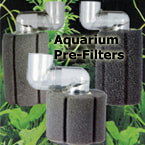
Sponge filters are also available as pre-filters.
Using a sponge pre-filter extends the time between cartridge changes in power (HOB) filters, slows the accumulation of organic debris buildup inside a canister filter, and prevents fish fry from being sucked up the intake tubes of the filters. More importantly, a sponge pre-filter can add some very essential bio filtration redundancy to often woefully inadequate HOB filters that frequently lose much of their bio capacity with each filter change.
For more about Sponge PreFilters, see this section later in this article:
• Sponge Filters as Pre-Filters
Product Reference:
• Filter Max Sponge Pre Filters
Sponge filters do perform mechanical filtration (removal of debris from the water column), however this is not where they excel (although certain brands definitely perform much better than others). Biological filtration is their strength, which is why the best filtration would be a combination of a sponge filter and a HOB (power filter) such as the more premium Rena Smart or SuperClean Filter or SunSun Value HOB Filters. These would provide a great combination, a one-two punch! When a separate sponge filter is employed with an aquarium power filter, canister filter, etc., this improves redundancy of filtration in the case of one filter failing or accidentally being "over-cleaned" (where beneficial bio filtering bacteria are destroyed).
Back to mechanical filtration, this is where the use of patented sponge filters can make a difference. I have run Lees, Tetra, as well as many of the cheap Chinese brand Sponge Filters (such as the poor-quality Jardin) and found poor "pick-up" of organic debris even next to the sponge filter, then switched to the AAP Hydro Sponge Filter with the same exact air pump and this was no longer a problem. Even with the Hydro-Sponge Filter, placement of the filter, air or water pumps size and even simple extension of the airline deeper into the filter can improve pick up of larger organic debris. See the "Use (Air Pump or Power Head Methods)" Section of this article for more.
The only aspect of aquarium/pond filtration where the sponge filter falls short is in chemical filtration.
This can be added with the use of activated charcoal, or other adsorbent. However, even if the sponge filter is the only means of filtration, it should be noted that most established/healthy aquariums do not need constant chemical filtration. This is especially true in the case of planted tanks.
As well, the aquarium keeper could place a nylon bag with Nirox Superior Grade Carbon, SeaChem Purigen, or other chemical filter media at the base of the sponge filter and the movement of water around/through the sponge filter will allow for some chemical filtration.
Using a sponge pre-filter extends the time between cartridge changes in power (HOB) filters, slows the accumulation of organic debris buildup inside a canister filter, and prevents fish fry from being sucked up the intake tubes of the filters. More importantly, a sponge pre-filter can add some very essential bio filtration redundancy to often woefully inadequate HOB filters that frequently lose much of their bio capacity with each filter change.
For more about Sponge PreFilters, see this section later in this article:
• Sponge Filters as Pre-Filters
Product Reference:
• Filter Max Sponge Pre Filters
Sponge filters do perform mechanical filtration (removal of debris from the water column), however this is not where they excel (although certain brands definitely perform much better than others). Biological filtration is their strength, which is why the best filtration would be a combination of a sponge filter and a HOB (power filter) such as the more premium Rena Smart or SuperClean Filter or SunSun Value HOB Filters. These would provide a great combination, a one-two punch! When a separate sponge filter is employed with an aquarium power filter, canister filter, etc., this improves redundancy of filtration in the case of one filter failing or accidentally being "over-cleaned" (where beneficial bio filtering bacteria are destroyed).
Back to mechanical filtration, this is where the use of patented sponge filters can make a difference. I have run Lees, Tetra, as well as many of the cheap Chinese brand Sponge Filters (such as the poor-quality Jardin) and found poor "pick-up" of organic debris even next to the sponge filter, then switched to the AAP Hydro Sponge Filter with the same exact air pump and this was no longer a problem. Even with the Hydro-Sponge Filter, placement of the filter, air or water pumps size and even simple extension of the airline deeper into the filter can improve pick up of larger organic debris. See the "Use (Air Pump or Power Head Methods)" Section of this article for more.
The only aspect of aquarium/pond filtration where the sponge filter falls short is in chemical filtration.
This can be added with the use of activated charcoal, or other adsorbent. However, even if the sponge filter is the only means of filtration, it should be noted that most established/healthy aquariums do not need constant chemical filtration. This is especially true in the case of planted tanks.
As well, the aquarium keeper could place a nylon bag with Nirox Superior Grade Carbon, SeaChem Purigen, or other chemical filter media at the base of the sponge filter and the movement of water around/through the sponge filter will allow for some chemical filtration.
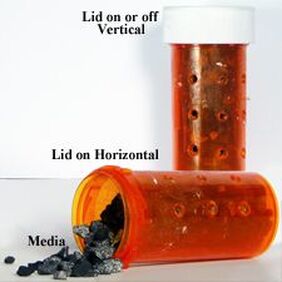
The picture above demonstrates the use of a prescription bottle for a DIY carbon filter. This can be placed under or behind a sponge filter where the water current is stronger. I have found this to be very useful in tanks where the sponge filter is the primary filter in a small aquarium such as a Betta tank.
In this picture API's AmmoCarb is being used.
There are a couple other options for aquarium keepers that can negate the need for chemical filtration. One is the good old-fashioned method of simply performing regular water changes. Or the addition of a power (HOB) filter such as the AAP/SunSun HBL-501/702 or AAP/SeaChem Tidal Filter. Either of these filters would allow you to use chemical filtration and would provide a good compliment to your sponge filter. Even though water changes will likely still be necessary, power (HOB) filters could lengthen the time period between them.
Product References:
• Nirox Superior Grade Carbon
• SeaChem Purigen
• API/SeaChem Tidal HOB Filters
• AAP Hydro Sponge Filters
Another more obvious negative reason against the use of sponge filters is a question of pure aesthetics.
While the ATI Sponge Filters are, pound for pound, just about the best aerobic nitrifying bio filters you can buy, many people do not like the looks of them.
Despite the clear benefits to these filters, there is still a sponge in your aquarium. Rather than seeing this as an obstacle, some consider it a creative challenge. For me placing it in the corner, with rocks nearby, along with the cylindrical shape of many these are not all that difficult to hide. The Hamburger Mattenfilter (HMF) are also often employed as DIY corner filters similar to my use of the AAP/ATI Hydro Sponge filter (albeit a bit more cumbersome with some problems of the HMF sponge itself changing shape as it it picks up debris and then not working as effectively)
Many aquarium keepers simply use rocks, plants and/or other décor to hide these sponge filters or pre-filters. Or, a black/dark background on your tank can also help the sponge be less noticeable. For many breeders, fish farms, and the like, the negative aesthetic aspect of the sponge filter is easily overridden by their inexpensive high biological filtration capacities.
In this picture API's AmmoCarb is being used.
There are a couple other options for aquarium keepers that can negate the need for chemical filtration. One is the good old-fashioned method of simply performing regular water changes. Or the addition of a power (HOB) filter such as the AAP/SunSun HBL-501/702 or AAP/SeaChem Tidal Filter. Either of these filters would allow you to use chemical filtration and would provide a good compliment to your sponge filter. Even though water changes will likely still be necessary, power (HOB) filters could lengthen the time period between them.
Product References:
• Nirox Superior Grade Carbon
• SeaChem Purigen
• API/SeaChem Tidal HOB Filters
• AAP Hydro Sponge Filters
Another more obvious negative reason against the use of sponge filters is a question of pure aesthetics.
While the ATI Sponge Filters are, pound for pound, just about the best aerobic nitrifying bio filters you can buy, many people do not like the looks of them.
Despite the clear benefits to these filters, there is still a sponge in your aquarium. Rather than seeing this as an obstacle, some consider it a creative challenge. For me placing it in the corner, with rocks nearby, along with the cylindrical shape of many these are not all that difficult to hide. The Hamburger Mattenfilter (HMF) are also often employed as DIY corner filters similar to my use of the AAP/ATI Hydro Sponge filter (albeit a bit more cumbersome with some problems of the HMF sponge itself changing shape as it it picks up debris and then not working as effectively)
Many aquarium keepers simply use rocks, plants and/or other décor to hide these sponge filters or pre-filters. Or, a black/dark background on your tank can also help the sponge be less noticeable. For many breeders, fish farms, and the like, the negative aesthetic aspect of the sponge filter is easily overridden by their inexpensive high biological filtration capacities.
Let's get back to the positive attributes of sponge filters and their applications.
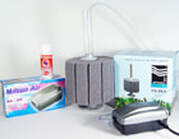
Often, aquarium filter kits that are made up of quality sponge filters along with air pumps or power heads are superior to many of the aquarium kits that are sold in the bigger pet stores. These are the "starter kits" that come with a small tank and are often very basic aquarium power filters, or even basic corner filters (or similar) with little bio filtration capacity. Beginning aquarists would be better served to consider a simple power head and sponge filter in their first tanks! This is especially true of big box department store or chain pet store kits that rarely have the bio capacity of a sponge filter kit such as one that utilizes an ATI Hydro Sponge. Simplified maintenance along with superior bio filtration capabilities would equal greater chances of success for beginning fish keepers.
Product Reference:
• Aquarium Filter Kits, utilizing Premium Sponge Filters
See also this article where "lowly" sponge filters beat out HOB filters with bio wheels:
• Aquarium Answers: Do Bio Wheels live up to the hype?
Testimonial to the facts of Sponge Filtration (from a Hobbyist): "The sponge filtration was inspired by Carl more than 2 years ago when I started into the hobby. Since then, I have progressed to using sponge filtration as the only filtration in my 210-gallon planted freshwater tank. The seeded sponges were used when combining 5 fish tanks into one tank. Two weeks later, I am enjoying my aquarium. My fish include a 2 yr old scat fish (was in fresh water at lfs), 8 Bolivian rams (just laid eggs again), 2 German rams (new male in the pair), 5 angels (have laid eggs, no fry), 7 adult dollar fish (2 yrs old) and 5 juveniles, a 2yr old dinosaur bischer, 30 cardinals and assorted neon tetras, 1 cory (left), 1 curviceps, 4 platys (had fry). I discarded the canister filter, biowheel filter, and use sponge filtration exclusively. Thank you for diligent, intelligent, and thoughtful sharing of your knowledge." - Jacqueline A., Florida
Often, aquarium filter kits that are made up of quality sponge filters along with air pumps or power heads are superior to many of the aquarium kits that are sold in the bigger pet stores. These are the "starter kits" that come with a small tank and are often very basic aquarium power filters, or even basic corner filters (or similar) with little bio filtration capacity. Beginning aquarists would be better served to consider a simple power head and sponge filter in their first tanks! This is especially true of big box department store or chain pet store kits that rarely have the bio capacity of a sponge filter kit such as one that utilizes an ATI Hydro Sponge. Simplified maintenance along with superior bio filtration capabilities would equal greater chances of success for beginning fish keepers.
Product Reference:
• Aquarium Filter Kits, utilizing Premium Sponge Filters
See also this article where "lowly" sponge filters beat out HOB filters with bio wheels:
• Aquarium Answers: Do Bio Wheels live up to the hype?
Testimonial to the facts of Sponge Filtration (from a Hobbyist): "The sponge filtration was inspired by Carl more than 2 years ago when I started into the hobby. Since then, I have progressed to using sponge filtration as the only filtration in my 210-gallon planted freshwater tank. The seeded sponges were used when combining 5 fish tanks into one tank. Two weeks later, I am enjoying my aquarium. My fish include a 2 yr old scat fish (was in fresh water at lfs), 8 Bolivian rams (just laid eggs again), 2 German rams (new male in the pair), 5 angels (have laid eggs, no fry), 7 adult dollar fish (2 yrs old) and 5 juveniles, a 2yr old dinosaur bischer, 30 cardinals and assorted neon tetras, 1 cory (left), 1 curviceps, 4 platys (had fry). I discarded the canister filter, biowheel filter, and use sponge filtration exclusively. Thank you for diligent, intelligent, and thoughtful sharing of your knowledge." - Jacqueline A., Florida
Basics- How Sponge Filters Work
Sponge filters work by having aquarium water drawn through the porous sponge material in which debris from the water column is trapped mechanically. At this time, aerobic bacteria living in the pores feed on nitrogenous wastes such as ammonia and nitrites that are suspended in the water.
Water is pulled through the sponge media via a lift/vacuum caused by air bubbles from an air pump attached to the filter via airline tubing or by a power head attached to the top of the lift tube. Simply put, a sponge filter uses a water pump to pull, or push, water through the pores in the sponge or an air pump to create a suction that does similar.
As the water passes through the pores of the sponge, they trap debris of varying sizes. It can then be rinsed or squeezed out (see more on this in the maintenance section) during cleaning. These pores have a considerable amount of surface area where aerobic bacteria can propagate and exist.
The size and quality of the pores will determine flow rate, how much debris can be trapped, and how large the bacterial colonies will be that can exist within the filter. This means that knock off sponge filters that are of poor design will have very little internal space, collapse quickly, and allow poor internal flow.
You might save money, but you will get less for your money and be replacing the sponge and/or filter sooner.
With sponge pre-filters, the concept is similar. Water is drawn through the sponge media by the suction of the filter such as a HOB, power head, water pump, or canister's motor unit. The same actions take place. Debris is trapped and nitrogenous wastes are consumed by aerobic bacteria.
Water is pulled through the sponge media via a lift/vacuum caused by air bubbles from an air pump attached to the filter via airline tubing or by a power head attached to the top of the lift tube. Simply put, a sponge filter uses a water pump to pull, or push, water through the pores in the sponge or an air pump to create a suction that does similar.
As the water passes through the pores of the sponge, they trap debris of varying sizes. It can then be rinsed or squeezed out (see more on this in the maintenance section) during cleaning. These pores have a considerable amount of surface area where aerobic bacteria can propagate and exist.
The size and quality of the pores will determine flow rate, how much debris can be trapped, and how large the bacterial colonies will be that can exist within the filter. This means that knock off sponge filters that are of poor design will have very little internal space, collapse quickly, and allow poor internal flow.
You might save money, but you will get less for your money and be replacing the sponge and/or filter sooner.
With sponge pre-filters, the concept is similar. Water is drawn through the sponge media by the suction of the filter such as a HOB, power head, water pump, or canister's motor unit. The same actions take place. Debris is trapped and nitrogenous wastes are consumed by aerobic bacteria.
Sponge Material Used
The type of sponge material can affect both mechanical and biological filtration. This is where many of the cheap knock offs, or even name brand sponge filters such as the Lees sponge filter, do not perform as well.
Not all sponge materials are created equal! These utilize pores that are too fine and are made with a foam material that is too dense or simply of poor quality that collapse resulting in poor flow, clogging, and a far less than desirable biological function. In fact, sometimes pore size is over-rated in judging quality (a better test is how much "gunk" it will hold with how many rinsing's will often tell the true story. The quality of the material used to make the sponge will more often than not determine this more than sponge pore size.
Unfortunately, with the flood of low-quality sponge filters now dominating the hobby, along with the "cut & paste nature of the Internet including YouTube Videos/Facebook, many otherwise knowledgeable aquarium keepers do not understand this and the fact a good sponge filter such as the AAP Hydro sponge (both regular & PRO) or DIY filters using HMF (Hamburger Mattenfilter) can in fact outperform any comparably sized HOB filter in both mechanical and in particular bio filtration. This said, the same cannot often be said about the many "look alike" knock offs from China sold under many different names such as AquaTop, XY, Aquarium Co-op, or Hikari.
Recently a popular YouTuber who is selling supposedly upgraded Chinese knock offs claims the regular sponges are not as good as the coarse. This is patently false as a generalization and anyone with real-world long-time experience knows this.
The facts are the coarse often are a better choice in applications with larger fish and more coarse debris, HOWEVER in applications with smaller fish such as Tetra, guppies, etc. the small actually outperforms and in fact generally has a higher bio load. In reality, in MOST applications you are better off with one of each type or the unique AAP Combo Sponge Filters, so do not be fooled by popular YouTubers with little long term professional experience promoting Chinese knock offs!
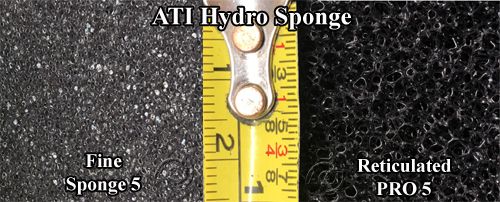
The picture above shows the two types of patented sponges made by ATI/AAP HydroSponge where the pore density is obvious and quite different from just about any other sponge filter available (approximately 30 ppi for the Regular Hydro Sponge).
The patented reticulated "PRO" sponges (approximately 10 ppi) are for higher flow and more coarse particulates. While the standard patented sponges are for lower flow, but smaller particulates. I would also not be too concerned with PPI, as I have used similar PPI sponges in my decades of experience and have seen wide variances in performance within the same ppi sponges of different manufacturers. The reason is simple in that the quality of the sponge material makes a bigger difference in the ppi as most Chinese sponges degrade and collapse, thus lowering ability to collect debris and maintain bacterial surface area.
A good test of the quality of the sponge material is when you go to rinse/clean the sponge. Upon removal, the patented AAP Hydro Sponge filter along with all others will likely drip some of the trapped "yuk" from your aquarium while removing if you are not careful due to material trapped just at the surface. However, upon rinsing in a bowl or small bucket of used aquarium water, one will often find it does not take nearly as much squeezing's to clear most every sponge made as when compared to the Hydro sponges which will often take 2 or 3 buckets of clean rinse water to clear since these sponges trap/hold so much more!!! Similarly, when new, the original AAP/ATI Hydro Sponge Filters often need to be squeezed several times under water to keep from floating or releasing trapped air bubbles due to high capacity.
As well, the cheap Chinese knock offs may look like the Hydro Sponge regular in particular (regardless of what "brand" they are sold under), but besides trapping much less as per the rinsing, it is also noteworthy that these cheap knocks will sometimes shed bits & pieces of the sponge with each rinsing. This is a HUGE difference, as I have in particular a couple #2 Regular AAP Hydro Sponge Filter sponges that while not in perfect condition, are still holding together after nearly a decade!!! Be careful to no judge all sponge filters by these look alike cheap knock offs!
Another controlled test that involved many aquariums (some with equal bio loads along with controls), where regular high-capacity Hydro Sponges, PRO Sponges, and a mixture of other sponges & filters were used; I would then add a measured amount of pureed fish food and then tracked ammonia & nitrite spikes. The aquariums of a MIX of both types of Hydro Sponges performed best, while others responded differently depending upon the original bio load. The low-quality sponge material as well as many HOB filters responded worse.
As noted, this material as per my tests, has far more bio/mechanical capacity than any of the cheap foam sponge material used in most common and Chinese knock offs. As even the DIY or similar products using poret foam (such as used by SwissTropicals) still does not match capacity as per my use/tests. In fact, as per the Swiss Tropical Sponge Filters that are pushed in small circles, these are not as versatile, but more importantly this square design has been known and demonstrated for years by aquarium professionals to be less efficient.
It is also noteworthy that while these knock offs have not gotten the sponges right, they have copied the patented modular design. So when you purchase these knock offs such as the Deep Blue or Aquarium Solutions, and many others now flooding the market, you are infringing on a patent.
Back to flow and a more in-depth explanation of the above information, the reverse situation can be a problem with certain reticulated/coarse sponges when used in the wrong flow environment. Although the AAP/ATI Hydro Sponge is the best in sponge filters, their patented reticulated sponge material is best used in higher flow rate environments instead of their patented standard sponges. Examples of ATI Reticulated sponges are the Filter Max #3, PRO, and Pond sponges. While the basic design of the filters remains the same, the design of the sponge differs allowing for higher flow environments, as well as coarser filtration.
As an example, I do NOT recommend the Hydro Sponge PRO Filters in small sizes such as the #2. While the #5 PRO is an excellent filter for the environment and flow rates for which they were designed, we have found that the Hydro Sponge #2 PRO does not work as well in both the flow rates, typical particulates in the water column, and the bacterial loads found in the smaller tanks that for which a #2 is designed. Thus, in the end, the #2 Standard sponge outperformed the #2 PRO in a smaller tank (10-20 gallons). So, it is critical that the sponge material be suited to the flow called for by the tank size, fish size, and bio load.
As another example, I have run aquariums with just one Hydro Sponge #2 using the PRO (Filter Max #3) sponge (making this a #2 PRO Sponge Filter) with a common mixed community tank. While this is an excellent sponge for higher flow rates, especially mated to a Filter Max #3 Pre-filter, it performed poorly in clearing debris and murky water. HOWEVER, within hours of changing out with a seeded standard Hydro Sponge #2 filter, the tank was clear.
The key to understand is that while the standard fine sponge actually has more pore capacity per square centimeter than the reticulated, in a high bio load environment with larger debris in the water column, it can clog the outer pores not allowing bio capacity in the inner part of the sponge, thus in essence lowering the bio capacity when compared to the reticulated sponge. This is less likely with the smaller sponge which are generally used in smaller, lower bio load aquariums.
So, if "fine" filtration is needed, the standard patented sponge from ATI is best & actually has a higher capacity (assuming it does not clog quickly due to high amounts of more coarse debris in the water column). Whereas if higher flow rates are needed along with higher bio loads that includes more debris in the water column, and fine filtration is not as important, the patented reticulated sponge filter is best.
In the end, you need to judge your aquarium environment since the answer to which one is "best" is not "black & white". IN FACT, my uses/tests show that even in high bio load aquariums (such as large cichlids) a combination of coarse/reticulated and regular sponges actually will achieve the best results!
You could also combine filtration types (coarse & fine) by using a Hydro Sponge #5 PRO with a #5 Stackable attached (which is a standard sponge). Using a Hydro Pond #2 or #4 and replacing one of the reticulated sponges provided with a standard #5 would also work. It is noteworthy that water will always flow in the path of least resistance, so this combination method with not draw nearly as much water through the fine sponge as the coarse reticulated sponge.
Not all sponge materials are created equal! These utilize pores that are too fine and are made with a foam material that is too dense or simply of poor quality that collapse resulting in poor flow, clogging, and a far less than desirable biological function. In fact, sometimes pore size is over-rated in judging quality (a better test is how much "gunk" it will hold with how many rinsing's will often tell the true story. The quality of the material used to make the sponge will more often than not determine this more than sponge pore size.
Unfortunately, with the flood of low-quality sponge filters now dominating the hobby, along with the "cut & paste nature of the Internet including YouTube Videos/Facebook, many otherwise knowledgeable aquarium keepers do not understand this and the fact a good sponge filter such as the AAP Hydro sponge (both regular & PRO) or DIY filters using HMF (Hamburger Mattenfilter) can in fact outperform any comparably sized HOB filter in both mechanical and in particular bio filtration. This said, the same cannot often be said about the many "look alike" knock offs from China sold under many different names such as AquaTop, XY, Aquarium Co-op, or Hikari.
Recently a popular YouTuber who is selling supposedly upgraded Chinese knock offs claims the regular sponges are not as good as the coarse. This is patently false as a generalization and anyone with real-world long-time experience knows this.
The facts are the coarse often are a better choice in applications with larger fish and more coarse debris, HOWEVER in applications with smaller fish such as Tetra, guppies, etc. the small actually outperforms and in fact generally has a higher bio load. In reality, in MOST applications you are better off with one of each type or the unique AAP Combo Sponge Filters, so do not be fooled by popular YouTubers with little long term professional experience promoting Chinese knock offs!
The picture above shows the two types of patented sponges made by ATI/AAP HydroSponge where the pore density is obvious and quite different from just about any other sponge filter available (approximately 30 ppi for the Regular Hydro Sponge).
The patented reticulated "PRO" sponges (approximately 10 ppi) are for higher flow and more coarse particulates. While the standard patented sponges are for lower flow, but smaller particulates. I would also not be too concerned with PPI, as I have used similar PPI sponges in my decades of experience and have seen wide variances in performance within the same ppi sponges of different manufacturers. The reason is simple in that the quality of the sponge material makes a bigger difference in the ppi as most Chinese sponges degrade and collapse, thus lowering ability to collect debris and maintain bacterial surface area.
A good test of the quality of the sponge material is when you go to rinse/clean the sponge. Upon removal, the patented AAP Hydro Sponge filter along with all others will likely drip some of the trapped "yuk" from your aquarium while removing if you are not careful due to material trapped just at the surface. However, upon rinsing in a bowl or small bucket of used aquarium water, one will often find it does not take nearly as much squeezing's to clear most every sponge made as when compared to the Hydro sponges which will often take 2 or 3 buckets of clean rinse water to clear since these sponges trap/hold so much more!!! Similarly, when new, the original AAP/ATI Hydro Sponge Filters often need to be squeezed several times under water to keep from floating or releasing trapped air bubbles due to high capacity.
As well, the cheap Chinese knock offs may look like the Hydro Sponge regular in particular (regardless of what "brand" they are sold under), but besides trapping much less as per the rinsing, it is also noteworthy that these cheap knocks will sometimes shed bits & pieces of the sponge with each rinsing. This is a HUGE difference, as I have in particular a couple #2 Regular AAP Hydro Sponge Filter sponges that while not in perfect condition, are still holding together after nearly a decade!!! Be careful to no judge all sponge filters by these look alike cheap knock offs!
Another controlled test that involved many aquariums (some with equal bio loads along with controls), where regular high-capacity Hydro Sponges, PRO Sponges, and a mixture of other sponges & filters were used; I would then add a measured amount of pureed fish food and then tracked ammonia & nitrite spikes. The aquariums of a MIX of both types of Hydro Sponges performed best, while others responded differently depending upon the original bio load. The low-quality sponge material as well as many HOB filters responded worse.
As noted, this material as per my tests, has far more bio/mechanical capacity than any of the cheap foam sponge material used in most common and Chinese knock offs. As even the DIY or similar products using poret foam (such as used by SwissTropicals) still does not match capacity as per my use/tests. In fact, as per the Swiss Tropical Sponge Filters that are pushed in small circles, these are not as versatile, but more importantly this square design has been known and demonstrated for years by aquarium professionals to be less efficient.
It is also noteworthy that while these knock offs have not gotten the sponges right, they have copied the patented modular design. So when you purchase these knock offs such as the Deep Blue or Aquarium Solutions, and many others now flooding the market, you are infringing on a patent.
Back to flow and a more in-depth explanation of the above information, the reverse situation can be a problem with certain reticulated/coarse sponges when used in the wrong flow environment. Although the AAP/ATI Hydro Sponge is the best in sponge filters, their patented reticulated sponge material is best used in higher flow rate environments instead of their patented standard sponges. Examples of ATI Reticulated sponges are the Filter Max #3, PRO, and Pond sponges. While the basic design of the filters remains the same, the design of the sponge differs allowing for higher flow environments, as well as coarser filtration.
As an example, I do NOT recommend the Hydro Sponge PRO Filters in small sizes such as the #2. While the #5 PRO is an excellent filter for the environment and flow rates for which they were designed, we have found that the Hydro Sponge #2 PRO does not work as well in both the flow rates, typical particulates in the water column, and the bacterial loads found in the smaller tanks that for which a #2 is designed. Thus, in the end, the #2 Standard sponge outperformed the #2 PRO in a smaller tank (10-20 gallons). So, it is critical that the sponge material be suited to the flow called for by the tank size, fish size, and bio load.
As another example, I have run aquariums with just one Hydro Sponge #2 using the PRO (Filter Max #3) sponge (making this a #2 PRO Sponge Filter) with a common mixed community tank. While this is an excellent sponge for higher flow rates, especially mated to a Filter Max #3 Pre-filter, it performed poorly in clearing debris and murky water. HOWEVER, within hours of changing out with a seeded standard Hydro Sponge #2 filter, the tank was clear.
The key to understand is that while the standard fine sponge actually has more pore capacity per square centimeter than the reticulated, in a high bio load environment with larger debris in the water column, it can clog the outer pores not allowing bio capacity in the inner part of the sponge, thus in essence lowering the bio capacity when compared to the reticulated sponge. This is less likely with the smaller sponge which are generally used in smaller, lower bio load aquariums.
So, if "fine" filtration is needed, the standard patented sponge from ATI is best & actually has a higher capacity (assuming it does not clog quickly due to high amounts of more coarse debris in the water column). Whereas if higher flow rates are needed along with higher bio loads that includes more debris in the water column, and fine filtration is not as important, the patented reticulated sponge filter is best.
In the end, you need to judge your aquarium environment since the answer to which one is "best" is not "black & white". IN FACT, my uses/tests show that even in high bio load aquariums (such as large cichlids) a combination of coarse/reticulated and regular sponges actually will achieve the best results!
You could also combine filtration types (coarse & fine) by using a Hydro Sponge #5 PRO with a #5 Stackable attached (which is a standard sponge). Using a Hydro Pond #2 or #4 and replacing one of the reticulated sponges provided with a standard #5 would also work. It is noteworthy that water will always flow in the path of least resistance, so this combination method with not draw nearly as much water through the fine sponge as the coarse reticulated sponge.
|
|
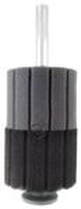
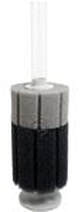
The pictures above to the left and right shows a solution for high bio-load and larger aquariums in need of higher flow filters, but still desiring good fine mechanical filtration that will not impede overall flow.
The unique AAP Hydro Sponge 5 Combo (left) as well as the unique AAP 1-3 PRO Combo (right) combines the patented ATI 5 Pro and 5 Standard (#3 PRO & Hydro Sponge #1 in the 1-3 PRO Combo). These can be used with either a power head or air pump and will easily work in aquariums 60 gallons or larger for the 5 combo (or smaller if need be) or 50 or less for the 1-3 Combo (or larger if multiple used).
Our large professional aquarium maintenance company's experience suggests redundancy is usually best, so even where the larger size of the #5 Combo might be called for, I suggest considering TWO of the #3/1 Pro Combos instead (which are also easier to hide and could be split to opposite sides of the aquarium for better circulation).
These filters will also easily outperform both mechanically more importantly, biologically most all "Hang on the Back" filters including the larger Aqua Clears. Make sure when rinsing, that the fine standard sponge is always on the top for optimum effectiveness since water will always follow the path of least resistance and using the PRO reticulated sponge on top will not allow much water flow through the fine sponge.
Exclusive Product Resources:
• Hydro Sponge #5 Combo
• Hydro Sponge #1-3 PRO Combo
The unique AAP Hydro Sponge 5 Combo (left) as well as the unique AAP 1-3 PRO Combo (right) combines the patented ATI 5 Pro and 5 Standard (#3 PRO & Hydro Sponge #1 in the 1-3 PRO Combo). These can be used with either a power head or air pump and will easily work in aquariums 60 gallons or larger for the 5 combo (or smaller if need be) or 50 or less for the 1-3 Combo (or larger if multiple used).
Our large professional aquarium maintenance company's experience suggests redundancy is usually best, so even where the larger size of the #5 Combo might be called for, I suggest considering TWO of the #3/1 Pro Combos instead (which are also easier to hide and could be split to opposite sides of the aquarium for better circulation).
These filters will also easily outperform both mechanically more importantly, biologically most all "Hang on the Back" filters including the larger Aqua Clears. Make sure when rinsing, that the fine standard sponge is always on the top for optimum effectiveness since water will always follow the path of least resistance and using the PRO reticulated sponge on top will not allow much water flow through the fine sponge.
Exclusive Product Resources:
• Hydro Sponge #5 Combo
• Hydro Sponge #1-3 PRO Combo
Seeding
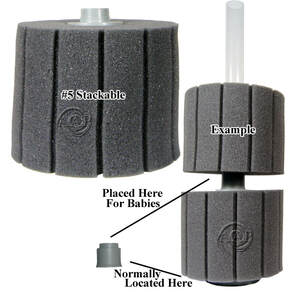
You can also "seed" a new aquarium for a faster more efficient cycling period.
Seeding the sponge media biologically: To “seed” the sponge media you can use the sponge from an established aquarium or leave a sponge in the water column of an established aquarium. This can be sped up by placing the Sponge Filter directly in contact with other established filter media or moving gravel around the Sponge Filter. The reason is that nitrifying bacteria are not found in high numbers in the water column (open water), however gravel and even more so other filter media are like to have these bacteria in VASTLY higher numbers.
The use a of a Stackable Sponge Filter (pictured above) in an established aquarium can then provide a second (or 3rd if 3 are "stacked") sponge for seeding another aquarium you may be starting (or exchanging with a friend or local aquarium store). Another un-related advantage of a stackable sponge filter is that these create a space for fry to hide in breeding tanks and also allow for expanding your filter to fit expanded bio loads, especially for larger aquariums or breeding tank systems.
You also can simply place the filter in your aquarium and allow the sponge filter media to establish itself biologically. There are many other methods that work well, some are discussed here:
• The Aquarium Nitrogen Cycle
Product resource:
• Stackable Sponge Filter
If you would like more information on sponge material, please see the following article:
• Sponge Media Material
Seeding the sponge media biologically: To “seed” the sponge media you can use the sponge from an established aquarium or leave a sponge in the water column of an established aquarium. This can be sped up by placing the Sponge Filter directly in contact with other established filter media or moving gravel around the Sponge Filter. The reason is that nitrifying bacteria are not found in high numbers in the water column (open water), however gravel and even more so other filter media are like to have these bacteria in VASTLY higher numbers.
The use a of a Stackable Sponge Filter (pictured above) in an established aquarium can then provide a second (or 3rd if 3 are "stacked") sponge for seeding another aquarium you may be starting (or exchanging with a friend or local aquarium store). Another un-related advantage of a stackable sponge filter is that these create a space for fry to hide in breeding tanks and also allow for expanding your filter to fit expanded bio loads, especially for larger aquariums or breeding tank systems.
You also can simply place the filter in your aquarium and allow the sponge filter media to establish itself biologically. There are many other methods that work well, some are discussed here:
• The Aquarium Nitrogen Cycle
Product resource:
• Stackable Sponge Filter
If you would like more information on sponge material, please see the following article:
• Sponge Media Material
Use Air Pump or Power Head
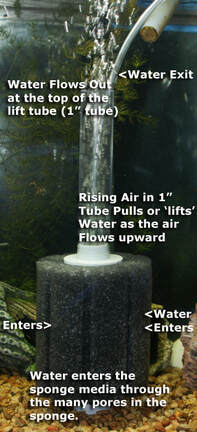
When your Sponge Filter is attached to an air pump, the rising column of air bubbles in the tube pulls water with it. The bubbles rise because they are buoyant, and the water is pulled along behind them. A larger diameter lift tube allows for a higher flow rate (this is where Hydro Sponge filters excel).
You can measure the water flow (which can be useful to know) by slightly tilting the filter with the top of the outflow just above the aquarium water line and timing the fill rate into a pitcher or gallon jug. If it fills the jug in 30 seconds, you multiply 2 times per minute times 60 or 120 gallons per hour.
You can also add an air stone or air diffuser to the end of your tubing in the outflow tube to produce more bubbles and more lift.
How to Determine Water Flow when an Air Pump is Used to Power your Sponge Filter: Most air pumps are rated in liters per minute (or cc) of air volume. In experiments we have carried out, with no added head pressure via lifting above the water level, you can achieve an equal amount of water moved.
By adding an air diffuser such as those sold by Hydro Sponge (separately), the surface area of the bubbles increases greatly and actually doubles the water volume moved!
Example: If you employ a 3 liter per minute air pump along with an air diffuser, you will achieve 6 liters of water per minute, which divided by 3.785 (liters in a gallon), you get 1.59 gallons per minute or 95 gallons per hour.
As per "Freshwater Aquarium Basics: Filters", it is best to have between 3-5x the water volume of the aquarium in turnover (depending upon the type of fish/aquarium kept). So, for a 50 gallon aquarium, the filter in this example moving 95 gallons per hour would fall slightly short of the ideal. This means another sponge filter, power head, or even a simple air bar is required for proper water movement and filtration in this example.
Reference:
• Freshwater Aquarium Basics; Filters
The air pump method is generally the better choice for these reasons:
• For use in a hospital tank.
• For a breeder tank or fry rearing tank.
• Any tank where the fish prefer a quieter flow such as Discus or Bettas.
• For simplicity of set up for the aquarium keeper (e.g., beginners).
Sponge Filter/Air Pump Combinations Suggestions: Please note that these suggestions are far from an exhaustive list, so matching similar sponge filters and similar air pumps should yield similar results (although it is noteworthy that there are no equals to the patented Hydro sponge filter, even though most air pumps are quite similar in quality and design).
• Hydro Sponge #1 or #2: SunSun YT-301 or Million Air 80. For a bit more power, the Million Air 200 or Fusion 300.
• Hydro Sponge #3, #4, or #5: Million Air 200, Fusion 300 which have more depth abilities than the MA80 and other smaller single outlet pumps. The Million Air 400 or 600 and the Fusion 600 or 700 can be used with an airline 'T' to combine each outlet for extra deep tanks such as over 24 inches.
• TWO Sponge Filters: Million Air 300/400, Fusion 600 or Fusion 700 for deep tanks.
• FOUR to SIX Sponge Filters: Fusion 700, (an airline control kit is suggested for more than 2 per air pump outlet).
Product Resources:
• Million Air 80
• Million Air 200
• Million Air 300/400
• Air Line Control Kit
• Standard Airline Tubing
As a note for those employing an air pump to power their Sponge Filter: Almost all air pumps use some variation of vibration technology whereby a magnet is moved back and forth via the alternating electrical current to then operate a diaphragm and thus produce air. This inherently is not quiet, no matter what someone might otherwise try to tell you. Some air pumps such as the Fusion have a baffle system that helps, but it still does not get rid of all noise (the Fusion would be your best choice if you are very noise sensitive, but it still is not perfect).
A bigger difference between some of the cheaper Walmart brands and even the SunSun YT versus the Million Air, Fusion and some other better models is the rubber armature and other parts such as the diaphragm are not thick enough or of poor-quality rubber. This results in a pump that get much noisier over time and much more quickly than the better-quality pumps due to the rubber stretching/degrading/tearing. However as per initial noise, often the cheapest air pumps are no noisier out of the box.
If noise is an issue, make sure your pump is not on a hard surface where it can vibrate, also for better "noise protection", placing your pump in a small box wrapped in old socks or similar has worked for me with my clients who are sensitive to noise. In the end though, even a power head makes a slight rattling noise. As well you will have the sound of splashing or gurgling water, so as I have told some of my aquarium maintenance clients over the years, if you cannot handle certain noises, do NOT place ANY aquarium where this may bother you or someone else that is noise sensitive!!!
When attached to a power head, the pump pulls the water thru the sponge. With this method I recommend using an air diffuser that generally comes with most power heads to improve dissolved oxygen levels (unless used in a planted freshwater aquarium). Even if you cannot, or choose not, to use an air diffuser (not all power heads have this feature), you can still aerate the aquarium through breaking the water's “surface tension” using either any directional control that your power head has, or by placing the Power head (pump) outlet near the surface so as to cause ripples on the surface.
With a power head, you will not see any bubbles flowing up the lift tube as with an air pump. However, with both methods there is a rising column of water through this tube that in turn is pulling water through the sponge filter material.
The Hydro Sponge #5 can handle flows up to 400 gph (depending on bio load), if a higher flow is required, the Hydro Pond Filter #2 or #4 can also be used in an aquarium (I have often used the Hydro Pond #4 as a pre-filter for high gph pumps in wet dry sumps). The Hydro Pond #4 is pump driven and can handle flows up to 1500 gph. Hydro Pond #2 is air driven and can handle flows up to 1000 gph. And of course, the Hydro Pond Filters can be used in ponds where they are excellent complimentary filters or even standalone filters (usually in low bio load ponds).
Product Resources:
• Hydro Sponge Filter #5
• Hydro Pond Filters
The power head method is generally the better choice for these reasons:
• Higher flow rates are desired.
• Cross current is necessary, especially for long tanks.
• Generally larger fish that are more “destructive”, Although I still recommend protecting the sponge filter/power head set up from these fish (such as many Cichlids) by leaning large rocks next to the sponge filter and power head to keep them in place.
• Marine Reef applications.
The picture below shows a simple suggested large aquarium set up using a Hydro Pond #4 Filter (a Hydro Sponge #5 would work well too) and the differences in flow using either air pump or a power head. In addition, please note the suggested rock placement you can use to keep the filters from being knocked over if large fish, such as Oscars, are present.
You can measure the water flow (which can be useful to know) by slightly tilting the filter with the top of the outflow just above the aquarium water line and timing the fill rate into a pitcher or gallon jug. If it fills the jug in 30 seconds, you multiply 2 times per minute times 60 or 120 gallons per hour.
You can also add an air stone or air diffuser to the end of your tubing in the outflow tube to produce more bubbles and more lift.
How to Determine Water Flow when an Air Pump is Used to Power your Sponge Filter: Most air pumps are rated in liters per minute (or cc) of air volume. In experiments we have carried out, with no added head pressure via lifting above the water level, you can achieve an equal amount of water moved.
By adding an air diffuser such as those sold by Hydro Sponge (separately), the surface area of the bubbles increases greatly and actually doubles the water volume moved!
Example: If you employ a 3 liter per minute air pump along with an air diffuser, you will achieve 6 liters of water per minute, which divided by 3.785 (liters in a gallon), you get 1.59 gallons per minute or 95 gallons per hour.
As per "Freshwater Aquarium Basics: Filters", it is best to have between 3-5x the water volume of the aquarium in turnover (depending upon the type of fish/aquarium kept). So, for a 50 gallon aquarium, the filter in this example moving 95 gallons per hour would fall slightly short of the ideal. This means another sponge filter, power head, or even a simple air bar is required for proper water movement and filtration in this example.
Reference:
• Freshwater Aquarium Basics; Filters
The air pump method is generally the better choice for these reasons:
• For use in a hospital tank.
• For a breeder tank or fry rearing tank.
• Any tank where the fish prefer a quieter flow such as Discus or Bettas.
• For simplicity of set up for the aquarium keeper (e.g., beginners).
Sponge Filter/Air Pump Combinations Suggestions: Please note that these suggestions are far from an exhaustive list, so matching similar sponge filters and similar air pumps should yield similar results (although it is noteworthy that there are no equals to the patented Hydro sponge filter, even though most air pumps are quite similar in quality and design).
• Hydro Sponge #1 or #2: SunSun YT-301 or Million Air 80. For a bit more power, the Million Air 200 or Fusion 300.
• Hydro Sponge #3, #4, or #5: Million Air 200, Fusion 300 which have more depth abilities than the MA80 and other smaller single outlet pumps. The Million Air 400 or 600 and the Fusion 600 or 700 can be used with an airline 'T' to combine each outlet for extra deep tanks such as over 24 inches.
• TWO Sponge Filters: Million Air 300/400, Fusion 600 or Fusion 700 for deep tanks.
• FOUR to SIX Sponge Filters: Fusion 700, (an airline control kit is suggested for more than 2 per air pump outlet).
Product Resources:
• Million Air 80
• Million Air 200
• Million Air 300/400
• Air Line Control Kit
• Standard Airline Tubing
As a note for those employing an air pump to power their Sponge Filter: Almost all air pumps use some variation of vibration technology whereby a magnet is moved back and forth via the alternating electrical current to then operate a diaphragm and thus produce air. This inherently is not quiet, no matter what someone might otherwise try to tell you. Some air pumps such as the Fusion have a baffle system that helps, but it still does not get rid of all noise (the Fusion would be your best choice if you are very noise sensitive, but it still is not perfect).
A bigger difference between some of the cheaper Walmart brands and even the SunSun YT versus the Million Air, Fusion and some other better models is the rubber armature and other parts such as the diaphragm are not thick enough or of poor-quality rubber. This results in a pump that get much noisier over time and much more quickly than the better-quality pumps due to the rubber stretching/degrading/tearing. However as per initial noise, often the cheapest air pumps are no noisier out of the box.
If noise is an issue, make sure your pump is not on a hard surface where it can vibrate, also for better "noise protection", placing your pump in a small box wrapped in old socks or similar has worked for me with my clients who are sensitive to noise. In the end though, even a power head makes a slight rattling noise. As well you will have the sound of splashing or gurgling water, so as I have told some of my aquarium maintenance clients over the years, if you cannot handle certain noises, do NOT place ANY aquarium where this may bother you or someone else that is noise sensitive!!!
When attached to a power head, the pump pulls the water thru the sponge. With this method I recommend using an air diffuser that generally comes with most power heads to improve dissolved oxygen levels (unless used in a planted freshwater aquarium). Even if you cannot, or choose not, to use an air diffuser (not all power heads have this feature), you can still aerate the aquarium through breaking the water's “surface tension” using either any directional control that your power head has, or by placing the Power head (pump) outlet near the surface so as to cause ripples on the surface.
With a power head, you will not see any bubbles flowing up the lift tube as with an air pump. However, with both methods there is a rising column of water through this tube that in turn is pulling water through the sponge filter material.
The Hydro Sponge #5 can handle flows up to 400 gph (depending on bio load), if a higher flow is required, the Hydro Pond Filter #2 or #4 can also be used in an aquarium (I have often used the Hydro Pond #4 as a pre-filter for high gph pumps in wet dry sumps). The Hydro Pond #4 is pump driven and can handle flows up to 1500 gph. Hydro Pond #2 is air driven and can handle flows up to 1000 gph. And of course, the Hydro Pond Filters can be used in ponds where they are excellent complimentary filters or even standalone filters (usually in low bio load ponds).
Product Resources:
• Hydro Sponge Filter #5
• Hydro Pond Filters
The power head method is generally the better choice for these reasons:
• Higher flow rates are desired.
• Cross current is necessary, especially for long tanks.
• Generally larger fish that are more “destructive”, Although I still recommend protecting the sponge filter/power head set up from these fish (such as many Cichlids) by leaning large rocks next to the sponge filter and power head to keep them in place.
• Marine Reef applications.
The picture below shows a simple suggested large aquarium set up using a Hydro Pond #4 Filter (a Hydro Sponge #5 would work well too) and the differences in flow using either air pump or a power head. In addition, please note the suggested rock placement you can use to keep the filters from being knocked over if large fish, such as Oscars, are present.
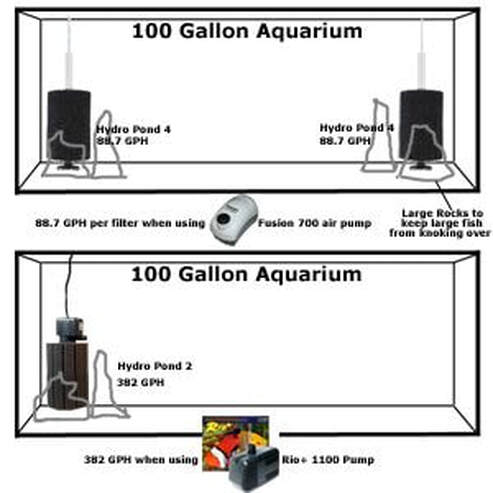
With both air pump or power head methods, the water is pulled through the sponge filter media where debris is mechanically trapped, and aerobic bacteria remove nitrogenous waste such as ammonia and nitrites.
For ponds, a more porous sponge media is better to allow a better flow rate and less accumulation of small debris from mechanical filtration that might easily clog a more 'fine to medium' sponge.
For aquariums with internal, pre-filter, or standard sponge filters, a medium porous sponge material with many tiny pores to trap bacteria is best (again this is where the Hydro Sponge Filter excels with its patented design).
Product Resources:
• Power Head
• Hydro Pond #4 Filter
• Hydro Sponge Filter
With a new sponge filter, your filter primarily operates mechanically (trapping debris in the sponge which can be rinsed/squeezed out in de-chlorinated water), while the more important bio feature of utilizing nitrifying bacteria to remove toxic ammonia & nitrites takes 4-8 weeks to be fully functional. This can vary due to the age of the aquarium or new tank cycling methods.
Please see this excellent article for further information on this subject:
• Aquarium Nitrogen Cycle; Cycling Methods
• I should note: From my experience, even though a power head may move more water, I prefer connecting sponge filters to air pumps over water pumps as I find this application to be more simple, less messy, and having less problems with fish knocking power heads off the lift tubes. Your experience may vary but this is what I have found.
When deciding on how high the lift tube should go (whether air driven or pump driven), consider the flow pattern you would like to achieve in your aquarium. I recommend as large a pattern as possible. Therefore, I cut the lift tubes (easily done with a hacksaw) as close to the water surface as will allow for evaporation and other minor changes in tank level and remain submerged.
For ponds, a more porous sponge media is better to allow a better flow rate and less accumulation of small debris from mechanical filtration that might easily clog a more 'fine to medium' sponge.
For aquariums with internal, pre-filter, or standard sponge filters, a medium porous sponge material with many tiny pores to trap bacteria is best (again this is where the Hydro Sponge Filter excels with its patented design).
Product Resources:
• Power Head
• Hydro Pond #4 Filter
• Hydro Sponge Filter
With a new sponge filter, your filter primarily operates mechanically (trapping debris in the sponge which can be rinsed/squeezed out in de-chlorinated water), while the more important bio feature of utilizing nitrifying bacteria to remove toxic ammonia & nitrites takes 4-8 weeks to be fully functional. This can vary due to the age of the aquarium or new tank cycling methods.
Please see this excellent article for further information on this subject:
• Aquarium Nitrogen Cycle; Cycling Methods
• I should note: From my experience, even though a power head may move more water, I prefer connecting sponge filters to air pumps over water pumps as I find this application to be more simple, less messy, and having less problems with fish knocking power heads off the lift tubes. Your experience may vary but this is what I have found.
When deciding on how high the lift tube should go (whether air driven or pump driven), consider the flow pattern you would like to achieve in your aquarium. I recommend as large a pattern as possible. Therefore, I cut the lift tubes (easily done with a hacksaw) as close to the water surface as will allow for evaporation and other minor changes in tank level and remain submerged.
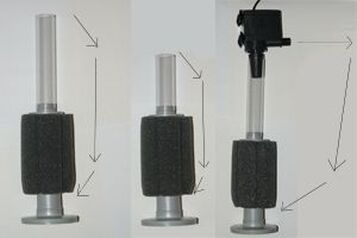
With some very small tanks (such as Betta tanks), I run these sponge filters on air power, and I do not use the clear lift tube at all. Instead, I only attach the air diffuser to the bullseye of the sponge filter.
Even when air powered, the air lifts the water through the filter to the top of the lift tube where the water then exits, however, the air bubbles will continue to the surface. The picture above shows these differences.
Even when air powered, the air lifts the water through the filter to the top of the lift tube where the water then exits, however, the air bubbles will continue to the surface. The picture above shows these differences.
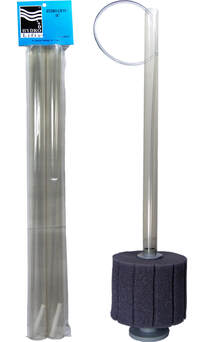
For tall/deep aquariums: The use of lift tube extensions can be used to provide a better flow pattern.
The Hydro-Lift can be used with the 1-inch-high flow outlets found on the Hydro Sponge Filter. In addition, these lifts work for both air-driven and water-driven applications.
Generally, the use of lift tube extensions can be an advantage for flow patterns, but not always, especially if upper-level HOB filters are used. A deep aquarium would be just fine with short lift tube combined with a "hang-on-the-back" power filter providing upper circulation. However, if the sponge filters are your primary source of filtration, I would suggest the use of lift tube extensions for deep aquariums.
Product Resources:
• Hydro-Lift; Sponge Filter Extension
• Power Head (water pump)
• AAP/SeaChem Tidal High Capacity Aquarium HOB Power Filter
Use with Other Filters: If other filters are present, such as a "hang-on power filter," then, generally your best results will be achieved by placing the sponge filter on one side and the hang-on power filter, or other filter, on the other side (such as the return from a canister filter). Since hang-on power filters have a water fall effect, these have less horizontal water movement, so in tanks over 36 inches in length the use of a power head on your sponge filter is suggested for better horizontal circulation. For tanks under 24 inches in length, generally the air pump method will achieve a good circulation pattern.
If power heads or related circulation pumps are already present (such as those on many internal filters too), the use of a air pump driven sponge filter with its superior vertical circulation would generally be most complementary.
The Hydro-Lift can be used with the 1-inch-high flow outlets found on the Hydro Sponge Filter. In addition, these lifts work for both air-driven and water-driven applications.
Generally, the use of lift tube extensions can be an advantage for flow patterns, but not always, especially if upper-level HOB filters are used. A deep aquarium would be just fine with short lift tube combined with a "hang-on-the-back" power filter providing upper circulation. However, if the sponge filters are your primary source of filtration, I would suggest the use of lift tube extensions for deep aquariums.
Product Resources:
• Hydro-Lift; Sponge Filter Extension
• Power Head (water pump)
• AAP/SeaChem Tidal High Capacity Aquarium HOB Power Filter
Use with Other Filters: If other filters are present, such as a "hang-on power filter," then, generally your best results will be achieved by placing the sponge filter on one side and the hang-on power filter, or other filter, on the other side (such as the return from a canister filter). Since hang-on power filters have a water fall effect, these have less horizontal water movement, so in tanks over 36 inches in length the use of a power head on your sponge filter is suggested for better horizontal circulation. For tanks under 24 inches in length, generally the air pump method will achieve a good circulation pattern.
If power heads or related circulation pumps are already present (such as those on many internal filters too), the use of a air pump driven sponge filter with its superior vertical circulation would generally be most complementary.
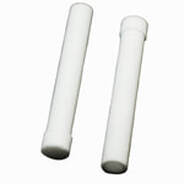
If you desire less agitation when using an air pump to power your sponge filter, I recommend cutting the top of the lift tube as close to the surface as possible. I also recommend using an optional air diffuser with your sponge filter which will produce a smaller bubble than a sponge filter used without a diffuser, thus resulting in less agitation of the water. Please note that air diffusers are sold separately with most brands of Sponge Filters.
If further agitation reduction is desired/required (especially with small fishbowls), the use of air line control valves of valve kits can be used (a valve kit can be used to bleed off excess air pressure).
Air Pump Attachment: Note that even without the use of the optional diffuser (best used instead of standard air stones), I have attached a small piece of tubing to the underside of the bullseye (frame #4).
This is IMPORTANT as it allows the column of air to draw water upward deeper into the sponge filter, thus providing better more thorough filtration and better uptake of debris from the water column in the aquarium.
Air Pump Attachment: Note that even without the use of the optional diffuser (best used instead of standard air stones), I have attached a small piece of tubing to the underside of the bullseye (frame #4).
This is IMPORTANT as it allows the column of air to draw water upward deeper into the sponge filter, thus providing better more thorough filtration and better uptake of debris from the water column in the aquarium.
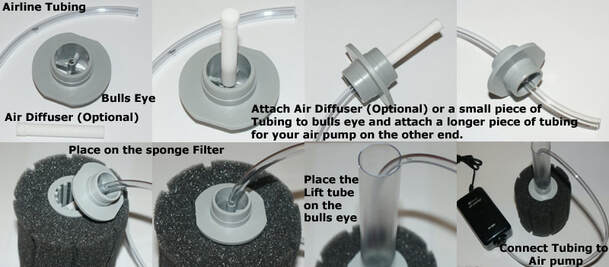
This next picture displays a cut away view of a Hydro Pond #2 Filter, showing connection to an airline for use with an air pump. Outside of this being a double sponge with two bullseyes instead of one as per standard Hydro Sponge Filters, the internal design is the same for all sponge filters when used with air driven power. This filter is excellent for both large aquarium use or patio pond use (such as container ponds).
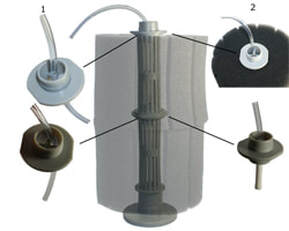
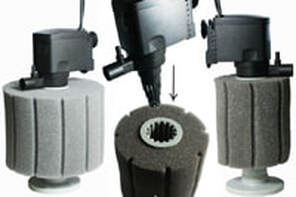
Power Head Water Pump Attachment: These two pictures show sponge filters set up with basic power head pumps such as the AAP JT-132, Maxi-Jet, Rio 600, or SunSun JP-23 pictured here. The nipple simply slides into the tube or strainer. Pressure from the water current will hold the power head pump in place (although when using the lift tubes, the use suction cups supplied with power head makes for a better "hold"). To snug the fit even more, often the use of Teflon Tape around the nipple or even a thin ribbon of Duct/Gorilla Tape wrapped around the top of the power head intake strainer will make for an even more snug fit.
I should also note that, while these diagrams show a secure fitting for many aquariums from my experience, for large fish (such as adult South American Cichlids), I would suggest using heavy rocks to brace the sponge filter & power head as these fish will often knock the power head off the lift tube.
As the reader can see, the power head can be mounted directly on the Sponge Filter or on the lift tube and each have their advantages:
• Lift Tube Mounting Advantages include better overall circulation, especially in taller tanks.
• Direct Sponge Filter Mounting advantages include better stability and less chance of fish disrupting the pump from the filter. As well generally a better fit for aquariums under 12 inches in height.
Readers should note that many power heads including the one pictured include a nipple on the outlet nozzle: This is for attaching an air intake diffuser tube which is little more than an airline tube that draws in air for further aeration of the aquarium via the water current exiting the power head water pump. In most instances these will not work if the pump is much more than a few inches below the water surface. It is also noteworthy that these small air line rubes often get build ups of hard water that need to be rodded out with a paper clip or similar DIY tool so as to allow free flow of air.
Product Resources:
• Hydro Sponge #5
• Hydro Pond #2
• AAP JT-132 & Maxi-Jet PowerHead Water/Circulation Pumps
Further Resources:
• Marineland Power Head Pump Review
• Maxi-Jet Power Head Review
• Hagen AquaClear Power Head Pump Review
I should also note that, while these diagrams show a secure fitting for many aquariums from my experience, for large fish (such as adult South American Cichlids), I would suggest using heavy rocks to brace the sponge filter & power head as these fish will often knock the power head off the lift tube.
As the reader can see, the power head can be mounted directly on the Sponge Filter or on the lift tube and each have their advantages:
• Lift Tube Mounting Advantages include better overall circulation, especially in taller tanks.
• Direct Sponge Filter Mounting advantages include better stability and less chance of fish disrupting the pump from the filter. As well generally a better fit for aquariums under 12 inches in height.
Readers should note that many power heads including the one pictured include a nipple on the outlet nozzle: This is for attaching an air intake diffuser tube which is little more than an airline tube that draws in air for further aeration of the aquarium via the water current exiting the power head water pump. In most instances these will not work if the pump is much more than a few inches below the water surface. It is also noteworthy that these small air line rubes often get build ups of hard water that need to be rodded out with a paper clip or similar DIY tool so as to allow free flow of air.
Product Resources:
• Hydro Sponge #5
• Hydro Pond #2
• AAP JT-132 & Maxi-Jet PowerHead Water/Circulation Pumps
Further Resources:
• Marineland Power Head Pump Review
• Maxi-Jet Power Head Review
• Hagen AquaClear Power Head Pump Review
Additional Sponge Filter Small Bowls
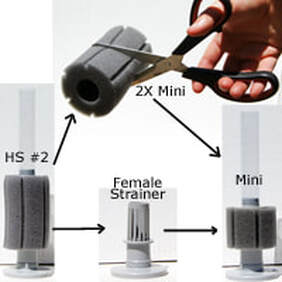
The picture above displays how to utilize a Hydro Sponge #2 to make a Mini Hydro Sponge for use in small bowls (such as 1 quart, 1 liter) or small 1–2-gallon aquariums where the Hydro Sponge 1 is not desired.
The beauty of this idea is that, not only do you get a nice compact Sponge Filter, but you get a spare sponge too at no extra cost.
The beauty of this idea is that, not only do you get a nice compact Sponge Filter, but you get a spare sponge too at no extra cost.
Additional Sponge Filters Lg Aquarium or Breeding
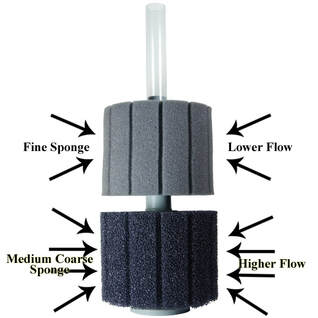
As already noted earlier, Hydro Sponge Stackables can be used to add additional filtration in breeding tanks and also to provide safe areas to hide for fish babies (fry).
The use of these sponges, especially the Hydro Sponge 5 Stackable also allows for expansion with larger tanks, often with surpassed bio efficiency and ease of maintenance over frequently over-touted canister or wet-dry filters. As well, when a #5 stackable is added to a #5 PRO filter, this will provide different levels of mechanical filtration (as well as flow rates), which further increases the viability of the sponge filters to be the primary aquarium filter.
Product Resources:
• Hydro Sponge #2
• Hydro Sponge 5 Stackable
• #5 PRO filter
The use of these sponges, especially the Hydro Sponge 5 Stackable also allows for expansion with larger tanks, often with surpassed bio efficiency and ease of maintenance over frequently over-touted canister or wet-dry filters. As well, when a #5 stackable is added to a #5 PRO filter, this will provide different levels of mechanical filtration (as well as flow rates), which further increases the viability of the sponge filters to be the primary aquarium filter.
Product Resources:
• Hydro Sponge #2
• Hydro Sponge 5 Stackable
• #5 PRO filter
Troubleshooting
Flow: Although mechanical filtration is not the main strength of a sponge filter, it can still remove copious amounts of debris from the water column when properly connected using the optimum grade of sponge material for the bio load. If not properly connected, you will see little, if any, mechanical filtration and even biological filtration will suffer.
As well (as already noted earlier in this article), using low grade sponge material WILL RESULT in poor mechanical filtration. Unfortunately, this low-quality sponge material makes up 100% of the sponge filters coming out of China sold commonly via discounters. In fact, these Chinese sponges sold under a a variety of brands (often via Amazon, but by Aquarium Co-op too) are using the wrong sponge material for the job, often too coarse, but sometimes too fine as well.
Even with the AAP Hydro Sponges, using a PRO reticulated sponge in a smaller aquarium with low flow rates, and fine particulates in the water column will NOT achieve optimum results. Ditto using the regular AAP Hydro Sponge in a high flow rate, high bio capacity with large water column particulates will NOT achieve optimum results as per mechanical filtration. Sometimes a combination of both types will achieve your best results which is where some of the popular Chinese knock offs fail as they are sold either as coarse or fine (& of much poorer quality too).
As well (as already noted earlier in this article), using low grade sponge material WILL RESULT in poor mechanical filtration. Unfortunately, this low-quality sponge material makes up 100% of the sponge filters coming out of China sold commonly via discounters. In fact, these Chinese sponges sold under a a variety of brands (often via Amazon, but by Aquarium Co-op too) are using the wrong sponge material for the job, often too coarse, but sometimes too fine as well.
Even with the AAP Hydro Sponges, using a PRO reticulated sponge in a smaller aquarium with low flow rates, and fine particulates in the water column will NOT achieve optimum results. Ditto using the regular AAP Hydro Sponge in a high flow rate, high bio capacity with large water column particulates will NOT achieve optimum results as per mechanical filtration. Sometimes a combination of both types will achieve your best results which is where some of the popular Chinese knock offs fail as they are sold either as coarse or fine (& of much poorer quality too).
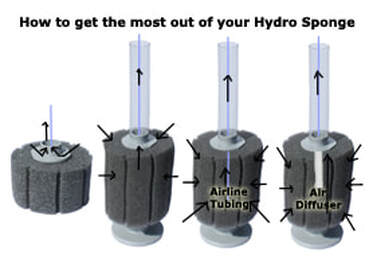
The picture above shows water flow through a sponge filter depending upon air diffuser, airline tubing, and lift tube placement.
As you can see, a sponge filter with no lift tube and with no extension of tubing (or air diffuser) has a poor flow through the sponge material (if any flow at all). The reason is that the air bubbles rising in the column will create a vacuum. However, if there is no lift tube (or very little), no vacuum is produced and the water will simply flow upward with the current of water, mostly avoiding the sponge (which will have more resistance).
The point is to overcome the resistance of the sponge material with a stronger vacuum produced in the lift tube. Additionally, an extension of airline tubing into the sponge filter and/or the use of an air diffuser or air stone can extend this vacuum deeper into the sponge filter, thus providing a better flow. You can test your flow by adding Methylene blue into your aquarium near the Sponge Filter; if the blue gets pulled quickly towards and into the filter, that means your filter is set up optimally, if not, adjust your airline tubing deeper into the filter
Floating: When new, sponge filters have a tendency to float. Air will remain trapped inside the sponge pores. You can correct this with several squeezes of the sponge. You should be able to clear most of the fine air bubbles that can cause floating. Sometimes placing a rock or similar weight on top of the sponge filter until all the air escapes will help too. Over time, nitrifying aerobic bacteria (& other organics) will add weight to the sponge that will make it much heavier. Thus, sponge filter floating will be less of an issue.
It is noteworthy that a sponge with more capacity will trap more air and thus be more prone to floating (especially with larger sponges such as the AAP Hydro Sponge 5 Regular), but over time, this higher capacity is worth any effort. In the end it is simply a symptom of an excellent high porous sponge, not the base, as decades of professional use bears out.
Not Trapping Debris: This is likely caused by incorrect installation so that air or water flow is not properly pulling debris into the sponge, please review the pictures throughout this article for correct set-up/installation. Clogged or full sponge filter material will also not allow proper flow. An aged sponge filter or poor-quality sponge material (which is common) will also clog much more quickly, especially as it ages. See also the Media Care Section.
Sponge media that is also not cleaned often enough, is set up incorrectly, or is of low quality will also have a chance of releasing debris back into the aquarium when cleaning. If this is a problem, I would suggest vacuuming around the filter prior to the removal/disconnection of the sponge filter from the air pump or water pump. Then I suggest changing the sponge, checking installation, and/or improving/upgrading your sponge filter.
Finally with many cheap Sponge filters that have become common of late, these are simply not that porous and simply cannot trap much when compared to the patented AAP/Hydro Sponge Filters.
Sponge Falling Apart: A true AAP Hydro Sponge Filter should last for years, however rinsing in tap water will degrade your sponge much more quickly. As well, if used outdoors, direct sunlight will also degrade sponge material more quickly due to UV rays that penetrate water readily, so it is advisable to place the filter in a shady area if used outdoors (such as Hydro Pond Filters). Also please note that some fish will actually eat the sponge material, which will make the sponge material fall apart more quickly. Fish I have observed eating the sponge material includes Plecostomus and Koi.
As you can see, a sponge filter with no lift tube and with no extension of tubing (or air diffuser) has a poor flow through the sponge material (if any flow at all). The reason is that the air bubbles rising in the column will create a vacuum. However, if there is no lift tube (or very little), no vacuum is produced and the water will simply flow upward with the current of water, mostly avoiding the sponge (which will have more resistance).
The point is to overcome the resistance of the sponge material with a stronger vacuum produced in the lift tube. Additionally, an extension of airline tubing into the sponge filter and/or the use of an air diffuser or air stone can extend this vacuum deeper into the sponge filter, thus providing a better flow. You can test your flow by adding Methylene blue into your aquarium near the Sponge Filter; if the blue gets pulled quickly towards and into the filter, that means your filter is set up optimally, if not, adjust your airline tubing deeper into the filter
Floating: When new, sponge filters have a tendency to float. Air will remain trapped inside the sponge pores. You can correct this with several squeezes of the sponge. You should be able to clear most of the fine air bubbles that can cause floating. Sometimes placing a rock or similar weight on top of the sponge filter until all the air escapes will help too. Over time, nitrifying aerobic bacteria (& other organics) will add weight to the sponge that will make it much heavier. Thus, sponge filter floating will be less of an issue.
It is noteworthy that a sponge with more capacity will trap more air and thus be more prone to floating (especially with larger sponges such as the AAP Hydro Sponge 5 Regular), but over time, this higher capacity is worth any effort. In the end it is simply a symptom of an excellent high porous sponge, not the base, as decades of professional use bears out.
Not Trapping Debris: This is likely caused by incorrect installation so that air or water flow is not properly pulling debris into the sponge, please review the pictures throughout this article for correct set-up/installation. Clogged or full sponge filter material will also not allow proper flow. An aged sponge filter or poor-quality sponge material (which is common) will also clog much more quickly, especially as it ages. See also the Media Care Section.
Sponge media that is also not cleaned often enough, is set up incorrectly, or is of low quality will also have a chance of releasing debris back into the aquarium when cleaning. If this is a problem, I would suggest vacuuming around the filter prior to the removal/disconnection of the sponge filter from the air pump or water pump. Then I suggest changing the sponge, checking installation, and/or improving/upgrading your sponge filter.
Finally with many cheap Sponge filters that have become common of late, these are simply not that porous and simply cannot trap much when compared to the patented AAP/Hydro Sponge Filters.
Sponge Falling Apart: A true AAP Hydro Sponge Filter should last for years, however rinsing in tap water will degrade your sponge much more quickly. As well, if used outdoors, direct sunlight will also degrade sponge material more quickly due to UV rays that penetrate water readily, so it is advisable to place the filter in a shady area if used outdoors (such as Hydro Pond Filters). Also please note that some fish will actually eat the sponge material, which will make the sponge material fall apart more quickly. Fish I have observed eating the sponge material includes Plecostomus and Koi.
Uv Sterilizer-Sponge Filter Combo
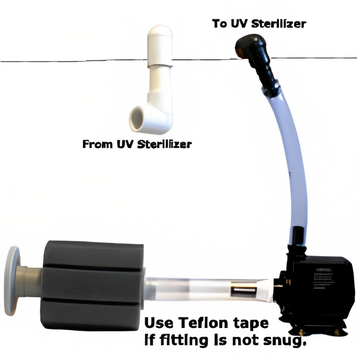
Although not a common application, it is possible to connect a sponge filter to a UV sterilizer (unlike a hang on the back aquarium power filter). In fact, this makes a relatively easy way to utilize the benefits of UV Sterilization in an aquarium that either has a sponge filter or a HOB filter and do you not want to spend more money for a filter that connects easily to UV sterilizers. The addition of a sponge filter with a UV sterilizer to an aquarium with an existing filter (such as an Aqua Clear, Penguin, etc.) will also improve bio filtration, mechanical filtration and ensure redundancy that insures against the failure of the primary filter.
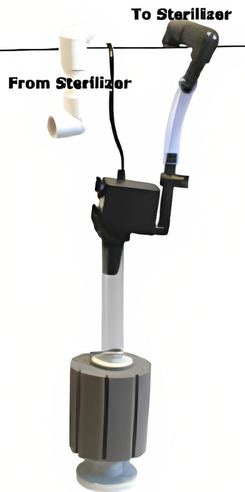
The first image shows an AAP JT-132 connected horizontally to an AAP Hydro Sponge #3 Filter. You will note the use of Teflon tape or vinyl tape to make a more solid connection. One inch vinyl tubing can also be used between the pump and lift tubing. The Rio 1000 or many other pumps can work. You could also use the Via Aqua 480 with the slimmer Hydro Sponge #2 filter).
The second image shows a Marineland Maxi-Jet 600 Pro PowerHead or AAP JT-132 Power Head also connected to a Hydro Sponge #3 Filter mounted vertically.
Other ideas would include a larger AAP Hydro Pond #4 connected to a higher flow pump, such as a Rio 1700 Pump for a larger tank such as a 100-gallon aquarium.
With the first two examples, a Terminator 5 Watt UV or the TMC Vecton Premium 8-Watt UV sterilizer will work.
With a higher flow rate (such as a Rio 1700 or similar pump), consider a Terminator 18 watt, TMC 15 Watt Vecton, or a 25 Watt Vecton UV Sterilizer.
The second image shows a Marineland Maxi-Jet 600 Pro PowerHead or AAP JT-132 Power Head also connected to a Hydro Sponge #3 Filter mounted vertically.
Other ideas would include a larger AAP Hydro Pond #4 connected to a higher flow pump, such as a Rio 1700 Pump for a larger tank such as a 100-gallon aquarium.
With the first two examples, a Terminator 5 Watt UV or the TMC Vecton Premium 8-Watt UV sterilizer will work.
With a higher flow rate (such as a Rio 1700 or similar pump), consider a Terminator 18 watt, TMC 15 Watt Vecton, or a 25 Watt Vecton UV Sterilizer.
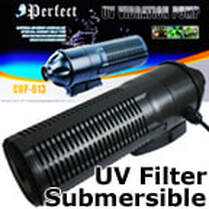
Finally, another alternative is a UV sterilizer that has a large, reticulated sponge filter built in. From my testing and use of many UV sterilizers, the best of the bunch in terms of filter capacity and, more importantly one of only a handful that can actually perform level one sterilization, is the SunSun CUP Series UV/Filter.
Product Resources:
• Marineland Maxi-Jet 600 Pro PowerHead
• Hydro Sponge #3 Filter
• AAP JT-132
• TMC 8, 15, & 25 Watt Vecton UV Sterilizer
• SunSun CUP Series UV/Filter
Product Resources:
• Marineland Maxi-Jet 600 Pro PowerHead
• Hydro Sponge #3 Filter
• AAP JT-132
• TMC 8, 15, & 25 Watt Vecton UV Sterilizer
• SunSun CUP Series UV/Filter
Sponge Pre-Filters
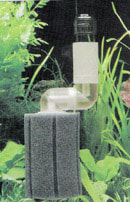
Besides the more common standalone sponge filter, the sponge pre-filter is also a viable sponge filtration option. These are especially useful in preserving viable nitrifying bacterial colonies in HOB filters during changes of filter media, especially with cartridge filters that don't have other means of maintaining bacteria, as many of these filters lack bio media chambers. This is especially true with economy HOB power filters sold at Walmart, PetSmart, etc. such as the Top Fin & Aqua-Tech HOB Filter. This is a common problem with beginner aquarium keepers that have single cartridge filters, in that every time they dispose of a filter cartridge, they throw away the majority of their viable aerobic nitrifying bacterial colonies, resulting in toxic ammonia spikes!
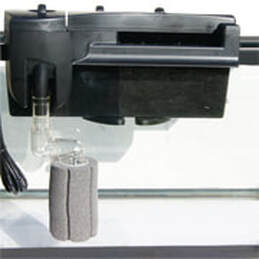
Sponge pre-filters such as the Filter Max can be attached to the intake of most canister or aquarium power (HOB) filters. In fact, the use of premium sponge pre-filters such as the AAP Filter Max can cut down on the need to change filter cartridges in power HOB filters by 200-300%, saving money, and time.
This is especially effective for high efficiency power filters such as the Rena Smart Filter which tend to clog faster than some aquarium HOB filters.
It is also important to utilize the full patented Filter Max Sponge Filter, using just the sponge instead of the patented strainers allows the sponge to collapse quickly and not utilize the full sponge. My own experience attaching just a sponge to the strainer/manifold of a power head, pump, or filter intake resulted in considerably less debris being collected before the sponge would be "exhausted". This is why misguided advice in forums/videos to just use the sponge falls way short of proper and complete use of these patented sponge filters.
There is NOT one round intake that I personally have not been able to connect a Filter Max together with, although sometimes with some Teflon Tape was used for a snugger fit. I even have (with much modification using silicone to fill the gap, and Teflon tape), connected a Filter Max to a square intake on an Emperor filter.
Besides extending the length of time between filter cartridge changing in an HOB power Filter, as with other good sponge filters, these pre-filters will increase bio capacity of your overall aquarium filtration.
As well these pre-filters, whether connected to a HOB filter or canister filter will also prevent young fish fry from being sucked into an intake as is often the case with canister filters and many HOB filters as well.
The only drawbacks are that your filter must have a cylindrical intake tube (which rules out some Marineland filters) and that you do not achieve the filter redundancy in the same way as having a separate Sponge Filter. However, these Sponge Pre Filters also add protection for fish getting trapped against the intake strainer or literally “sucked up” as with fish fry (babies).
The type of sponge material also affects the flow rate, as the AAP Filter Max #3 uses a patented reticulated sponge material that only traps larger debris and clogs much slower, while the Filter Max #1 and #2 have the original ATI Sponge material that traps smaller debris, but also does not allow as much current and clogs more quickly.
This is especially effective for high efficiency power filters such as the Rena Smart Filter which tend to clog faster than some aquarium HOB filters.
It is also important to utilize the full patented Filter Max Sponge Filter, using just the sponge instead of the patented strainers allows the sponge to collapse quickly and not utilize the full sponge. My own experience attaching just a sponge to the strainer/manifold of a power head, pump, or filter intake resulted in considerably less debris being collected before the sponge would be "exhausted". This is why misguided advice in forums/videos to just use the sponge falls way short of proper and complete use of these patented sponge filters.
There is NOT one round intake that I personally have not been able to connect a Filter Max together with, although sometimes with some Teflon Tape was used for a snugger fit. I even have (with much modification using silicone to fill the gap, and Teflon tape), connected a Filter Max to a square intake on an Emperor filter.
Besides extending the length of time between filter cartridge changing in an HOB power Filter, as with other good sponge filters, these pre-filters will increase bio capacity of your overall aquarium filtration.
As well these pre-filters, whether connected to a HOB filter or canister filter will also prevent young fish fry from being sucked into an intake as is often the case with canister filters and many HOB filters as well.
The only drawbacks are that your filter must have a cylindrical intake tube (which rules out some Marineland filters) and that you do not achieve the filter redundancy in the same way as having a separate Sponge Filter. However, these Sponge Pre Filters also add protection for fish getting trapped against the intake strainer or literally “sucked up” as with fish fry (babies).
The type of sponge material also affects the flow rate, as the AAP Filter Max #3 uses a patented reticulated sponge material that only traps larger debris and clogs much slower, while the Filter Max #1 and #2 have the original ATI Sponge material that traps smaller debris, but also does not allow as much current and clogs more quickly.
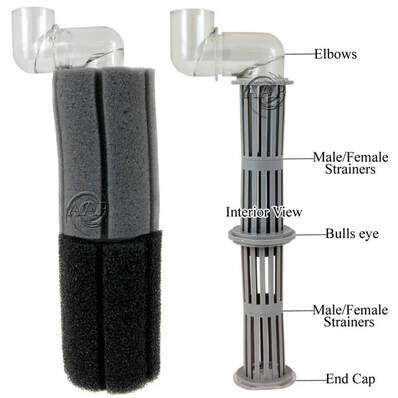
The Filter Max II/III combination provides both aspects of these patented aquarium sponge filers. This filter combination is provided with a lower flow, but higher fine debris mechanical #2 sponge along with
the higher flow rate reticulated #3 sponge. This is a great idea for higher flow filters where finer mechanical filtration is desired but would clog up too fast under normal use with the standard Filter Max II.
the higher flow rate reticulated #3 sponge. This is a great idea for higher flow filters where finer mechanical filtration is desired but would clog up too fast under normal use with the standard Filter Max II.
Other Uses of Sponge Filter
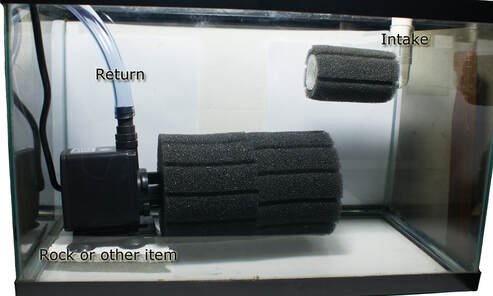
Another use of Sponge Filters is as a basic Pond Filter or using a Hydro Pond Sponge Filter as an excellent and efficient large flow pre-filters in aquarium sumps for both salt and freshwater aquarium systems.
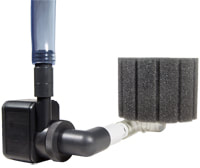
|
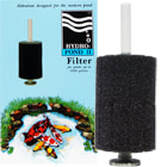
|
These same Hydro Sponge Filter that are designed for small pond use also make excellent high-capacity bio filters for large aquariums. Whether it be the double reticulated air driven #2 Hydro Pond or the water driven #3 (single) or #4 (double), these high-capacity sponge filter can be the PRIMARY filters for aquariums as large as 250 or even larger in multiples or as the secondary filter!
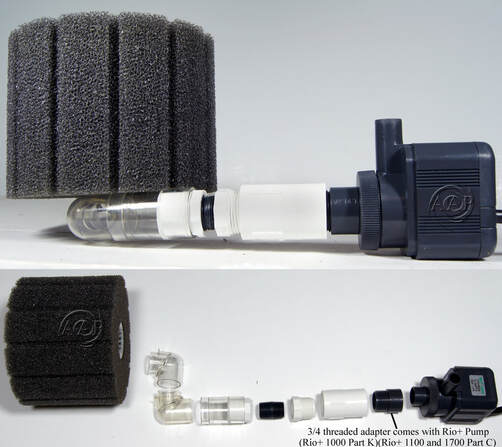
Product Resources:
• AAP Hydro Pond Filters For Large Aquariums, Sumps
Hydro Pond sponge filters are excellent in smaller ponds or as a pre-filter for pond pumps. They can go longer between rinsings if covered with volcanic rock. However be careful not to bury in sand or use in a veggie filter where plant roots which can make rinsing a more difficult task and also quickly degrade the sponge material.
Further Reading:
• Pond Care Information
• AAP Hydro Pond Filters For Large Aquariums, Sumps
Hydro Pond sponge filters are excellent in smaller ponds or as a pre-filter for pond pumps. They can go longer between rinsings if covered with volcanic rock. However be careful not to bury in sand or use in a veggie filter where plant roots which can make rinsing a more difficult task and also quickly degrade the sponge material.
Further Reading:
• Pond Care Information
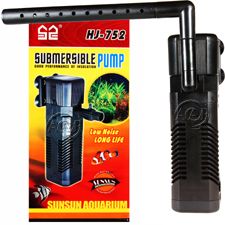
Many, if not most, internal/submersible filters are essentially sponge filters that are self-powered sponge filters.
These have the advantage of being easy to tuck up high in an aquarium corner more out of the way than a standard sponge filter. Also, with the SunSun HJ-752 Filter pictured here you can cut the sponge in half to allow more room, and then add other filter media such as carbon or Matrix. However, a small bag, or other means of blocking the carbon from being ingested into the motor, should be used. Some of these filters also have multiple chambers where other filter media can be placed (example the SunSun HJ-952 (210 gph)).
The disadvantage, especially when compared to the patented Hydro Sponge filter line is their sponge bio capacity is much lower based on the size and efficiency of the sponge material.
Product Resources:
• Rio Internal/Submersible Filters
These have the advantage of being easy to tuck up high in an aquarium corner more out of the way than a standard sponge filter. Also, with the SunSun HJ-752 Filter pictured here you can cut the sponge in half to allow more room, and then add other filter media such as carbon or Matrix. However, a small bag, or other means of blocking the carbon from being ingested into the motor, should be used. Some of these filters also have multiple chambers where other filter media can be placed (example the SunSun HJ-952 (210 gph)).
The disadvantage, especially when compared to the patented Hydro Sponge filter line is their sponge bio capacity is much lower based on the size and efficiency of the sponge material.
Product Resources:
• Rio Internal/Submersible Filters
Sponge Media Care & Cleaning
The main problem with sponge filter media of any type is clogging due to mechanical filtration. The better designed sponge filter medium is one that maximizes the amount of time between cleanings. These sponge media will not clog under normal use. This, of course, will vary even by the same manufacturer due to what the sponge filter media was designed for. For instance, a Filter Max #2 is a fine sponge media that traps smaller debris and will thus clog more quickly in a tank with a high bio-load than a Filter Max #3, often requiring more frequent rinses in de-chlorinated water.
Unfortunately, the many cheap sponge filters flooding the market via eBay, Amazon, & other discounters has but a fraction of the capacity, both bio and mechanical.
Further information:
• Filter Media; Types, Information, Review
When the flow slows or water begins to flow around the sponge media (such as in many Aqua Clear Filters), you need to rinse/clean your sponge filter media.
The best method is to collect used aquarium water in a bucket from a water change and squeeze the sponge several times until nothing more is expelled from the sponge. This water is then disposed of, and new water can be added to the aquarium to replace the water used for sponge cleaning. You also may use de-chlorinated tap water or well water (without added chemicals) for rinsing your sponge media. I often will use both methods and I will use the de-chlorinated tap water for the final rinses until the rinse water is no longer dirty.
The reason to rinse with used tank water or de-chlorinated tap or well water is so you DON'T destroy beneficial aerobic bacterial colonies that form in the pores of the sponge media over time. The chlorine in the water would kill the bacteria and cause an ammonia spike.
To prevent too much dirty water returning to the aquarium when removing a sponge filter, sponge pre-filter, etc., I suggest having a small container to catch the water that might pour back as soon as the sponge is removed above the water line. If a large amount of "gunk" returning to the water still is a problem when disconnecting for maintenance; my suggestion is to change your sponge more often and/or move up to a larger size sponge.
This said, based on considerable experience using many different sponge filters over the years in literally 1000s of aquarium applications, with the best designed & patented sponges, what little "gunk" does fall back into the aquarium is but a very small fraction of what you will often rinse out. Often the AAP Hydro sponge will require multiple rinses before the water is mostly clear due to the high bio and mechanical filter capacity.
With ATI/AAP sponge Filters and Filter Max, all sponges are interchangeable, so as an example you can easily add a Hydro Sponge #3 sponge to a Hydro Sponge #2 frame (the exceptions being the Mini, #1 Filters, and the #1 Filter Max).
Depending upon your aquarium (or pond) bio-load, as well as the pore size of your sponge material, the frequency of rinses can vary. Generally, a well “mated” sponge filter, or other filter that employs a sponge, assuming some quality, will need to be rinsed every two weeks. Although once per week or as long as once per month are not unusual either. Often in aquariums or ponds with multiple filters, the frequency of rinses is less due to the redundancy of filtration, which is what I recommend.
Often as the sponge material ages from use, it will clog quicker too and again lessor quality sponge material will also break down quicker than the better patented sponge material. When your sponge media starts to degrade or does not “spring” back from rinsing, the sponge needs to be changed. Generally, this can be anywhere from 6 months to 3 years.
It is best to add an additional sponge to your aquarium ahead of time to allow this sponge to “seed” with aerobic bacteria. This can be achieved by simply placing the new sponge in an area of high-water flow and high dissolved oxygen or adding a second sponge filter, pre filter, HOB filter, etc. in your aquarium and allowing the sponge media to “seed”. The time I generally allow is from 14-21 days for proper bacterial “seeding”.
Unfortunately, the many cheap sponge filters flooding the market via eBay, Amazon, & other discounters has but a fraction of the capacity, both bio and mechanical.
Further information:
• Filter Media; Types, Information, Review
When the flow slows or water begins to flow around the sponge media (such as in many Aqua Clear Filters), you need to rinse/clean your sponge filter media.
The best method is to collect used aquarium water in a bucket from a water change and squeeze the sponge several times until nothing more is expelled from the sponge. This water is then disposed of, and new water can be added to the aquarium to replace the water used for sponge cleaning. You also may use de-chlorinated tap water or well water (without added chemicals) for rinsing your sponge media. I often will use both methods and I will use the de-chlorinated tap water for the final rinses until the rinse water is no longer dirty.
The reason to rinse with used tank water or de-chlorinated tap or well water is so you DON'T destroy beneficial aerobic bacterial colonies that form in the pores of the sponge media over time. The chlorine in the water would kill the bacteria and cause an ammonia spike.
To prevent too much dirty water returning to the aquarium when removing a sponge filter, sponge pre-filter, etc., I suggest having a small container to catch the water that might pour back as soon as the sponge is removed above the water line. If a large amount of "gunk" returning to the water still is a problem when disconnecting for maintenance; my suggestion is to change your sponge more often and/or move up to a larger size sponge.
This said, based on considerable experience using many different sponge filters over the years in literally 1000s of aquarium applications, with the best designed & patented sponges, what little "gunk" does fall back into the aquarium is but a very small fraction of what you will often rinse out. Often the AAP Hydro sponge will require multiple rinses before the water is mostly clear due to the high bio and mechanical filter capacity.
With ATI/AAP sponge Filters and Filter Max, all sponges are interchangeable, so as an example you can easily add a Hydro Sponge #3 sponge to a Hydro Sponge #2 frame (the exceptions being the Mini, #1 Filters, and the #1 Filter Max).
Depending upon your aquarium (or pond) bio-load, as well as the pore size of your sponge material, the frequency of rinses can vary. Generally, a well “mated” sponge filter, or other filter that employs a sponge, assuming some quality, will need to be rinsed every two weeks. Although once per week or as long as once per month are not unusual either. Often in aquariums or ponds with multiple filters, the frequency of rinses is less due to the redundancy of filtration, which is what I recommend.
Often as the sponge material ages from use, it will clog quicker too and again lessor quality sponge material will also break down quicker than the better patented sponge material. When your sponge media starts to degrade or does not “spring” back from rinsing, the sponge needs to be changed. Generally, this can be anywhere from 6 months to 3 years.
It is best to add an additional sponge to your aquarium ahead of time to allow this sponge to “seed” with aerobic bacteria. This can be achieved by simply placing the new sponge in an area of high-water flow and high dissolved oxygen or adding a second sponge filter, pre filter, HOB filter, etc. in your aquarium and allowing the sponge media to “seed”. The time I generally allow is from 14-21 days for proper bacterial “seeding”.
Myths
Bio Wheels and Wet Dry filters are superior to sponge filters - MYTH: In theory the added oxygen of bio wheels and wet dry filters is great. But in reality, the channeling of wet dry filters and the deposit buildup of Bio Wheels lowers the bacteria surface area. Besides, it's not really necessary. The dissolved oxygen already present in your aquarium is more than sufficient to maintain healthy bacteria colonies. Compare a wet dry filter to a marine tank with live rock and other means of mechanical filtration and you will find the live rock is superior even though it is under water.
All sponge filters are the same and only for small aquariums – MYTH: The flow design, sponge media material, and sponge size all are important. A large sponge filter with sponge media of a high and proper sized pore count is an extremely efficient filter. Compare the sponge design of the patented Hydro Sponge to a cheaper Lees, AquaTop, Hagen (Elite), or Tetra sponge and it is obvious. These cheaper sponges clog faster and do not have the pore density of Hydro Sponge filters. My controlled tests in the 1990s showed comparably sized ATI/AAP Hydro Sponge Filters had a higher bio capacity to ALL others.
In fact, in tests comparing the Hydro Sponge #5 PRO with Aqua Clear 70 and 110 HOB filters, the Hydro Sponge #5 beat the Aqua Clear 70 and was at least as good as a Aqua Clear 110 (these HOB filter utilize sponge inserts). For the price the Hydro Sponge #5 PRO is the clear winner compared to both. Unfortunately, the aquarium hobby is full of anecdotal information knocking sponge filters as low tech, outdated, too small, etc. which is all not true when truly objective comparisons are made.
Some history as per my professional use of the ATI/AAP Hydro Sponge Filter: As noted earlier I performed controlled tests in the 1990s using these filters with use dating back to the 1970s. However, after selling off the LFS part of my business due to a move to Oregon to protect my family, I ceased selling these filters as I no longer had a resource for the filter. So, when I re-started my business online and as per my still running aquarium maintenance company (but now operated by another), I gave the Chinese made SF-XY a try as it looked very similar to the Hydro Sponge.
Interestingly while very similar to the patented Hydro Sponge Filter, and while they performed well, they did not perform as well. Then later a representative from ATI contacted me about patent infringement by the SF-XY Sponge filter and I then re-established contact and sales with this company.
The point being is many companies have tried to copy these filters, but even then, have failed even while infringing upon patent rights. WHY? Simply because these are superior to all other sponge filters (including DIY), and by a wide margin.
This use now numbers in the 1000s, many of which includes controlled tests where I have tested these sponges under all sorts of conditions such as different bio loads, after drying the sponge out and then using, with different sponge media types, even with different product runs where the filters varied slightly or were of a different color; and I know extensively what these filters can and cannot do in an aquarium, sump, pond, etc.!!!
Finally, it is also noteworthy that an undersized sponge filter (including a Hydro Sponge or Filter Max) will work no better than an undersized filter of any other type, especially when not cared for regularly.
Sponge pre-filters lower the efficiency of power filters or canister filters - MYTH: This is true only if you attach a low flow dense-pore sponge filter to a higher flow power filter or use one of the “cheapie” brands available. A sponge pre-filter may not be for everyone, but they do have their place and with proper installation can actually improve filtration. The pre-filtration of larger debris and prevention of baby fish being trapped are specific benefits.
Hydro Sponge Review from Renee (goldenpuon) from “Everything Aquatic”: "I thought I'd write a review of the Hydro Sponge filters I purchased from Carl a while back. The results are excellent too. Better than any sponge filter I've ever owned. It picks up fish waste very well and now I have to do less than half the cleaning for my tank. I had a guppy tank I was cleaning every two days with a micro filter installed. Now all I have to do is clean it every 1 1/2 weeks! The Hydro Sponge also creates a good amount of water disturbance with very few bubbles produced making it a great for providing oxygen for fish.
Its quality is just as good, if not better than most power filters out there. It is also small and doesn't take up much space while providing a great place for beneficial bacteria to grow. This makes it much more useful than really any other filter for tanks with high ammonia, nitrites, and nitrates. It is also much less expensive than filters that require carbon. All you have to do is replace the sponge every 6 months and it costs little more than a dollar while carbons in power filter must be changed at least every month each costs a few dollars. One of the best filters I've ever owned, I highly recommend it for aquariums of all sizes!
Hope you guys like my review. I'm not just pointing out the positives here, they really are true."
All sponge filters are the same and only for small aquariums – MYTH: The flow design, sponge media material, and sponge size all are important. A large sponge filter with sponge media of a high and proper sized pore count is an extremely efficient filter. Compare the sponge design of the patented Hydro Sponge to a cheaper Lees, AquaTop, Hagen (Elite), or Tetra sponge and it is obvious. These cheaper sponges clog faster and do not have the pore density of Hydro Sponge filters. My controlled tests in the 1990s showed comparably sized ATI/AAP Hydro Sponge Filters had a higher bio capacity to ALL others.
In fact, in tests comparing the Hydro Sponge #5 PRO with Aqua Clear 70 and 110 HOB filters, the Hydro Sponge #5 beat the Aqua Clear 70 and was at least as good as a Aqua Clear 110 (these HOB filter utilize sponge inserts). For the price the Hydro Sponge #5 PRO is the clear winner compared to both. Unfortunately, the aquarium hobby is full of anecdotal information knocking sponge filters as low tech, outdated, too small, etc. which is all not true when truly objective comparisons are made.
Some history as per my professional use of the ATI/AAP Hydro Sponge Filter: As noted earlier I performed controlled tests in the 1990s using these filters with use dating back to the 1970s. However, after selling off the LFS part of my business due to a move to Oregon to protect my family, I ceased selling these filters as I no longer had a resource for the filter. So, when I re-started my business online and as per my still running aquarium maintenance company (but now operated by another), I gave the Chinese made SF-XY a try as it looked very similar to the Hydro Sponge.
Interestingly while very similar to the patented Hydro Sponge Filter, and while they performed well, they did not perform as well. Then later a representative from ATI contacted me about patent infringement by the SF-XY Sponge filter and I then re-established contact and sales with this company.
The point being is many companies have tried to copy these filters, but even then, have failed even while infringing upon patent rights. WHY? Simply because these are superior to all other sponge filters (including DIY), and by a wide margin.
This use now numbers in the 1000s, many of which includes controlled tests where I have tested these sponges under all sorts of conditions such as different bio loads, after drying the sponge out and then using, with different sponge media types, even with different product runs where the filters varied slightly or were of a different color; and I know extensively what these filters can and cannot do in an aquarium, sump, pond, etc.!!!
Finally, it is also noteworthy that an undersized sponge filter (including a Hydro Sponge or Filter Max) will work no better than an undersized filter of any other type, especially when not cared for regularly.
Sponge pre-filters lower the efficiency of power filters or canister filters - MYTH: This is true only if you attach a low flow dense-pore sponge filter to a higher flow power filter or use one of the “cheapie” brands available. A sponge pre-filter may not be for everyone, but they do have their place and with proper installation can actually improve filtration. The pre-filtration of larger debris and prevention of baby fish being trapped are specific benefits.
Hydro Sponge Review from Renee (goldenpuon) from “Everything Aquatic”: "I thought I'd write a review of the Hydro Sponge filters I purchased from Carl a while back. The results are excellent too. Better than any sponge filter I've ever owned. It picks up fish waste very well and now I have to do less than half the cleaning for my tank. I had a guppy tank I was cleaning every two days with a micro filter installed. Now all I have to do is clean it every 1 1/2 weeks! The Hydro Sponge also creates a good amount of water disturbance with very few bubbles produced making it a great for providing oxygen for fish.
Its quality is just as good, if not better than most power filters out there. It is also small and doesn't take up much space while providing a great place for beneficial bacteria to grow. This makes it much more useful than really any other filter for tanks with high ammonia, nitrites, and nitrates. It is also much less expensive than filters that require carbon. All you have to do is replace the sponge every 6 months and it costs little more than a dollar while carbons in power filter must be changed at least every month each costs a few dollars. One of the best filters I've ever owned, I highly recommend it for aquariums of all sizes!
Hope you guys like my review. I'm not just pointing out the positives here, they really are true."
Videos
|
|
|
|
|
|
|
|
|
|
|
|