

Pond Care Information
Overview
Keeping a clear garden pond in the warm or hot summer months involves these key ingredients:
Proper filtration (especially biological) and circulation, cleaning and maintenance, proper/optimum chemistry and feeding. It is also noteworthy that well built pond that is in harmony with nature needs much less maintenance.
This article will also deal with winter care tips, pond predators such as Herons and much more.
We have to remember too that a pond is living organism, unlike a swimming pool. Essentially a pond is an aquarium with the added bio load of leaves, pollen, run-off and other debris often being added to our aquatic environment.
Often this seems to be forgotten as I have come across many a pond over the years where the filtration was comparable to using a Hydro Sponge #1 filter designed for a 10 gallon or less aquarium for a 250 gallon aquarium. In other words, woefully inadequate.
Placement of your yard pond is important, despite popular belief a pond is best placed above any low spots in your property as drainage from a rainstorm (or even over watering) can foul your pond adding many unwanted nutrients and more. The sides of your pond should be built up at least a few inches. I also recommend a minimum depth of 24”. Obviously a raised patio pond will not have this issue.
Done right, a well set up and maintained pond improves the beauty of your home and garden and this regularly updated article, as well as the useful links to other resources such as Veggie Filters, UV Sterilization, and Pond Algae (green water) should help the reader achieve this with a garden or patio pond.
Please note that while I recommend specific pumps, filter, UVs, and other pond equipment; for the most part these recommendations are based on years of use (for reliability, efficiency, and economy) by me and/or other pond keepers and professionals I trust for their input; NOT what some pond supply distributor has suggested!
Please take most of these recommendations/suggestions as just that, as often there are similar products that might work just as well.
In the case of UV Sterilizers, I have VERY extensive experience, from designing, application, experimenting with controlled tests and more; so my recommendations for true UV Sterilizers (including specific brands there in) is based on this considerable experience and the use of equipment other than recommended will likely NOT yield the same results, especially based on email from those who have read this article but still chose a different path for this important equipment!!
For this reason, I stand by the suggestions/recommendation more strongly, again not that good results cannot be obtained with similar equipment, just that many of the Sterilizers I do suggest, especially the AAP/TMC lines, I have decades of experience with and this includes use of competing products that simply have not performed as well in 100s of applications I have been professionally associated with.
A good example is the AAP/TMC Professional 110, 55, & 30 Watt True 'Category A' UV Sterilizers which along with others in this line of UVs has performed as well or better than any other comparable UV and at a better price & high longevity too (this includes superior value over the "Aqua Ultraviolet").
Finally, my experience and the other professional pond keepers I get input from is generally for ponds up to 8000 gallons, so admittedly for much larger ponds, any prospective reader might find some great information here, but need to go further for added information.
Also PLEASE read the many additional resources already supplied here such as those cited for Veggie Filters or UV Sterilization.
Proper filtration (especially biological) and circulation, cleaning and maintenance, proper/optimum chemistry and feeding. It is also noteworthy that well built pond that is in harmony with nature needs much less maintenance.
This article will also deal with winter care tips, pond predators such as Herons and much more.
We have to remember too that a pond is living organism, unlike a swimming pool. Essentially a pond is an aquarium with the added bio load of leaves, pollen, run-off and other debris often being added to our aquatic environment.
Often this seems to be forgotten as I have come across many a pond over the years where the filtration was comparable to using a Hydro Sponge #1 filter designed for a 10 gallon or less aquarium for a 250 gallon aquarium. In other words, woefully inadequate.
Placement of your yard pond is important, despite popular belief a pond is best placed above any low spots in your property as drainage from a rainstorm (or even over watering) can foul your pond adding many unwanted nutrients and more. The sides of your pond should be built up at least a few inches. I also recommend a minimum depth of 24”. Obviously a raised patio pond will not have this issue.
Done right, a well set up and maintained pond improves the beauty of your home and garden and this regularly updated article, as well as the useful links to other resources such as Veggie Filters, UV Sterilization, and Pond Algae (green water) should help the reader achieve this with a garden or patio pond.
Please note that while I recommend specific pumps, filter, UVs, and other pond equipment; for the most part these recommendations are based on years of use (for reliability, efficiency, and economy) by me and/or other pond keepers and professionals I trust for their input; NOT what some pond supply distributor has suggested!
Please take most of these recommendations/suggestions as just that, as often there are similar products that might work just as well.
In the case of UV Sterilizers, I have VERY extensive experience, from designing, application, experimenting with controlled tests and more; so my recommendations for true UV Sterilizers (including specific brands there in) is based on this considerable experience and the use of equipment other than recommended will likely NOT yield the same results, especially based on email from those who have read this article but still chose a different path for this important equipment!!
For this reason, I stand by the suggestions/recommendation more strongly, again not that good results cannot be obtained with similar equipment, just that many of the Sterilizers I do suggest, especially the AAP/TMC lines, I have decades of experience with and this includes use of competing products that simply have not performed as well in 100s of applications I have been professionally associated with.
A good example is the AAP/TMC Professional 110, 55, & 30 Watt True 'Category A' UV Sterilizers which along with others in this line of UVs has performed as well or better than any other comparable UV and at a better price & high longevity too (this includes superior value over the "Aqua Ultraviolet").
Finally, my experience and the other professional pond keepers I get input from is generally for ponds up to 8000 gallons, so admittedly for much larger ponds, any prospective reader might find some great information here, but need to go further for added information.
Also PLEASE read the many additional resources already supplied here such as those cited for Veggie Filters or UV Sterilization.
Water Circulation
A general principle (not a rule) of about 50-200 gph per 100 gallons can work for this (A lower proportional gph for large ponds, a higher proportional gph for small ponds). This can be achieved with more than one water pump.
A large aeration device (air stone) coupled to an Air Pump can also aid in circulation and are especially useful for “lifting” (vertical circulation) water from the bottom of a pond when properly placed. Often an air stone/air pump combination is better than water pumps of greater gph for the aspect of vertical circulation (keep in mind that an air stone aerates the water by breaking surface tension, not by the bubbles in the water; the more surface agitation, the better oxygen exchange).
A large double air pump such as a Million Air 600, Whisper 800, or Maxima with two air stones can circulate at a rate up to 500 gph. A way to check this is to place the air stone down a narrow PVC tube or aquarium lift tube, then place the top of the tube just above the water level and measure the rate the water fills up a gallon container (one gallon in 15 seconds= 240 gph).
Product Resource:
Million Air 600 Pump The most reliable pump in its class
With any pump (Water or Air), at least some form of circulation should be provided 24/7 so as to provide both oxygen and also to maintain a healthy bio filter (this also means a pump connected to a filter should run 24/7). Most pumps properly placed do not disturb fish, based on my experience.
General Pond Pump Recommendations:
For cross circulation (& lifting water to water features), a water pump is the primary choice.
To start with the Rio HF Pump line is an excellent line of pumps for most ponds from 300 to even 6000 gallons from my experience as these pumps have top notch head pressure, they are reliable and have flow rates up to almost 2000 gph.
What I have found is that even with larger ponds having multiple reliable and powerful pumps such as the Rio 32HF, I have more redundancy, more flexibility, and simply less "disasters" with a single "super large" pump pond.
As an example, I set up a 3000 gallon pond with three 2000 gph pumps feeding a fountain, veggie filter, two UV Sterilizers, and a DIY barrel filter and then a waterfall with good aesthetic flow.
A large aeration device (air stone) coupled to an Air Pump can also aid in circulation and are especially useful for “lifting” (vertical circulation) water from the bottom of a pond when properly placed. Often an air stone/air pump combination is better than water pumps of greater gph for the aspect of vertical circulation (keep in mind that an air stone aerates the water by breaking surface tension, not by the bubbles in the water; the more surface agitation, the better oxygen exchange).
A large double air pump such as a Million Air 600, Whisper 800, or Maxima with two air stones can circulate at a rate up to 500 gph. A way to check this is to place the air stone down a narrow PVC tube or aquarium lift tube, then place the top of the tube just above the water level and measure the rate the water fills up a gallon container (one gallon in 15 seconds= 240 gph).
Product Resource:
Million Air 600 Pump The most reliable pump in its class
With any pump (Water or Air), at least some form of circulation should be provided 24/7 so as to provide both oxygen and also to maintain a healthy bio filter (this also means a pump connected to a filter should run 24/7). Most pumps properly placed do not disturb fish, based on my experience.
General Pond Pump Recommendations:
For cross circulation (& lifting water to water features), a water pump is the primary choice.
To start with the Rio HF Pump line is an excellent line of pumps for most ponds from 300 to even 6000 gallons from my experience as these pumps have top notch head pressure, they are reliable and have flow rates up to almost 2000 gph.
What I have found is that even with larger ponds having multiple reliable and powerful pumps such as the Rio 32HF, I have more redundancy, more flexibility, and simply less "disasters" with a single "super large" pump pond.
As an example, I set up a 3000 gallon pond with three 2000 gph pumps feeding a fountain, veggie filter, two UV Sterilizers, and a DIY barrel filter and then a waterfall with good aesthetic flow.
Pump Protection from Debris:
In my many years of pond maintenance using many different brands, I have found that regardless of what a pump manufacturer or retailer tells you, ALL POND PUMPS ARE EASILY CLOGGED OR EVEN QUICKLY RUINED BY DEBRIS! Restriction on the intake of pumps, in particular commonly used mag drive pumps equals early death!!
Whether you purchase one of our recommended pumps or use a pump you already have purchased; if you do not take steps to prevent debris from clogging your pump, you will be setting yourself up for future headaches and pond pump failures.
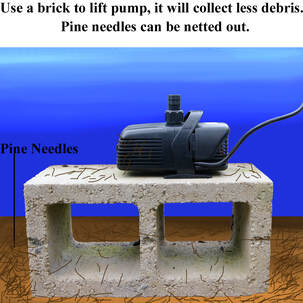
To protect your pump from large debris that can damage the impeller and impeller housing (this is a must with mag-drive impeller pumps), placing any water pump off the bottom of the pond on a cinder block or similar can keep large debris from quickly clogging pump intakes.
In my many years of pond maintenance using many different brands, I have found that regardless of what a pump manufacturer or retailer tells you, ALL POND PUMPS ARE EASILY CLOGGED OR EVEN QUICKLY RUINED BY DEBRIS! Restriction on the intake of pumps, in particular commonly used mag drive pumps equals early death!!
Whether you purchase one of our recommended pumps or use a pump you already have purchased; if you do not take steps to prevent debris from clogging your pump, you will be setting yourself up for future headaches and pond pump failures.
To protect your pump from large debris that can damage the impeller and impeller housing (this is a must with mag-drive impeller pumps), placing any water pump off the bottom of the pond on a cinder block or similar can keep large debris from quickly clogging pump intakes.
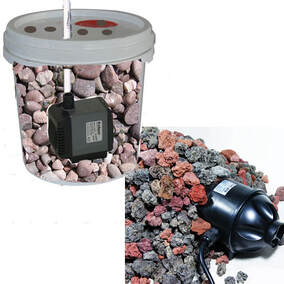
For further protection, you can place your pump in a DIY bucket (or box, etc.) pre-filter, or simply cover the pump with 1/2" to 1" rocks (porous lava rock is best).
Besides protection from debris, this added pre-filtration will provide some added biological filtration, but it does not replace a filter.
This is especially useful for pumps added solely to run UV Sterilizers due to added pre-filtration.
METHOD: Use a bucket, box, or similar container such as a Rubber Maid container large enough to house the pump; then add Volcanic Rock about ½” in diameter or larger, an outlet tube, then either seal the container with holes in the top OR simply leave the bucket, box, or similar container open with only the rocks/gravel exposed. A void space next to the pump intake will also extend time between rock rinsing.
To the left is a diagram of how this would basically work.
I recommend some sort of rock pre-filtration or similar with ANY submersible pump place on the pond bottom!! From my experience this GREATLY extends pump life regardless of any manufacturer claims as I have had very expensive pumps with so-called built in pre-filters fail in one season without this rock pre-filter.
Product Resource:
Volcanic Rock Bio/Mechanical Filter Media
It is noteworthy that this rock will likely need to be cleaned ever few weeks to a month depending upon bio load and whether or a not a REAL filter is also employed.
Better is to incorporate this as part of a REAL bio/mechanical filter such as some of the ideas in our Veggie/Bog Filters article.
Besides protection from debris, this added pre-filtration will provide some added biological filtration, but it does not replace a filter.
This is especially useful for pumps added solely to run UV Sterilizers due to added pre-filtration.
METHOD: Use a bucket, box, or similar container such as a Rubber Maid container large enough to house the pump; then add Volcanic Rock about ½” in diameter or larger, an outlet tube, then either seal the container with holes in the top OR simply leave the bucket, box, or similar container open with only the rocks/gravel exposed. A void space next to the pump intake will also extend time between rock rinsing.
To the left is a diagram of how this would basically work.
I recommend some sort of rock pre-filtration or similar with ANY submersible pump place on the pond bottom!! From my experience this GREATLY extends pump life regardless of any manufacturer claims as I have had very expensive pumps with so-called built in pre-filters fail in one season without this rock pre-filter.
Product Resource:
Volcanic Rock Bio/Mechanical Filter Media
It is noteworthy that this rock will likely need to be cleaned ever few weeks to a month depending upon bio load and whether or a not a REAL filter is also employed.
Better is to incorporate this as part of a REAL bio/mechanical filter such as some of the ideas in our Veggie/Bog Filters article.
For small to medium ponds (100–800 gallons):
The Rio 1700, SunSun HQB Series Pumps, or Supreme Aqua-Mag pumps all are proven in professional pond maintenance to be efficient and reliable, as well as reasonably economical pumps (the Rio 1700 has an available water Fountain Kit).
All have sealed electromagnetic motors and ceramic shafts.
Many pumps, such as the Rio and SunSun can be mated to a Fountain Head with built in diverter then connected to a Filter (such as a small Pressurized Filter), and a UV Sterilizer (such as the TMC Pond Advantage PRO UV) for up to a 500 gallon pond.
Product Resources:
AAP/Supreme Aqua-Mag Water Utility Pumps
The Rio 1700, SunSun HQB Series Pumps, or Supreme Aqua-Mag pumps all are proven in professional pond maintenance to be efficient and reliable, as well as reasonably economical pumps (the Rio 1700 has an available water Fountain Kit).
All have sealed electromagnetic motors and ceramic shafts.
Many pumps, such as the Rio and SunSun can be mated to a Fountain Head with built in diverter then connected to a Filter (such as a small Pressurized Filter), and a UV Sterilizer (such as the TMC Pond Advantage PRO UV) for up to a 500 gallon pond.
Product Resources:
AAP/Supreme Aqua-Mag Water Utility Pumps
For medium to large ponds (500 – 1500 gallons)
For even more head pressure for high pond features (such as a water fall or spitter) that require lifts of much more than 6 feet the Rio HF Water Pump line is without comparison with their Vortex Rotor Blade (which can lift up to 14 feet), especially for the price.
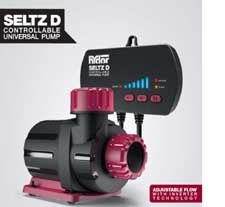
The AAP/Hydor Seltz D 1600 Controllable Pump (1600 gph) is a high end high efficiency pump that fits well into this size pond.
The Seltz D 1600 can be used internally or externally and has high flow with less power consumed. This pump is also controllable with six preset flow rates with 5-minute feed mode
For even more head pressure for high pond features (such as a water fall or spitter) that require lifts of much more than 6 feet the Rio HF Water Pump line is without comparison with their Vortex Rotor Blade (which can lift up to 14 feet), especially for the price.
The AAP/Hydor Seltz D 1600 Controllable Pump (1600 gph) is a high end high efficiency pump that fits well into this size pond.
The Seltz D 1600 can be used internally or externally and has high flow with less power consumed. This pump is also controllable with six preset flow rates with 5-minute feed mode
For Very large ponds; often the best way to go is with a heavy duty submersible pump with a directional vortex impeller or a pool/spa style pump that is designed for the harsh pond environment (some pumps cannot stand up to the debris and other elements of pond water circulation).
This said, my preference even with the 6000-8000 gallon ponds I have plumbed, I vastly preferred the redundancy of two or more heavy duty submersible or 'amphibious' pumps such as those suggested in the next paragraph over these pool/spa pumps such as the Seahorse (with the exception for use in skimmers, which I do not recommend anyway).
This way if one stops/fails for whatever reason, your pond will still be circulating; nothing is more frustrating than coming back from a summer vacation to find a stagnant & smelly pond with a dead pump
As well two or more somewhat smaller pumps will almost always provide a better flow pattern and work better with most filters and UV Clarifiers.
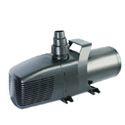
The AAP JAP-18000 Amphibious High Performance Pump at 4755 gph is an excellent heavy duty submersible pump (pictured below). These high performance pumps are unique in their category in that besides excellent flow and head pressure, they have a double guard to protect the pump (both an outer and inner screen guard)
The AAP/Hydor Seltz D 3200 Controllable Pump (3200 GPH) is a newer super high efficiency pump that is also controllable (I recommend keeping the controller protected from weather). At 3200 gph this pump can be used as a back up to a pool type Seahorse pump or as main pump, generally in multiples for larger ponds.
The AAP JTP-12000 pumps (pictured above) have now been out for a while, these have really impressed me as "the pump to have" for any medium to high flow submersible application due to reliability, flow and super high electrical efficiency!! The only negative with this pump is that while extremely efficient as per electrical usage, the head pressure is not as good as the AAP JAP pumps for a given flow rate.
For "out of the water" pumps, the Pentair SeaHorse line of pond pumps offers flow rates up to 4900 gph and are very well made reliable pumps that usually handle the harshest of conditions.
For those needing an out of the water pump of lower cost & more versatility, the before mentioned 'Amphibious' (in line OR submersible) AAP JAP line of pumps might be a good choice.
Product Resources:
AAP JAP-18000 Amphibious Water Pump (4755 gph)
For these heavy duty 1/2 to 3/4 hp pumps, Heavy Duty submersible Pumps, or similar I have generally used 1.25 to 1.5 inch PVC pipe and then split the return pipe suing PVC ‘Ts’ and valves to control flow through other pond filters such as a Pressurized Filter and a UV Sterilizer. The purpose for this is to run multiple filters, UVs and/or to have a slower flow through these devices which generally work much better than at the high flow rate provide by this type of pump.
This said, my preference even with the 6000-8000 gallon ponds I have plumbed, I vastly preferred the redundancy of two or more heavy duty submersible or 'amphibious' pumps such as those suggested in the next paragraph over these pool/spa pumps such as the Seahorse (with the exception for use in skimmers, which I do not recommend anyway).
This way if one stops/fails for whatever reason, your pond will still be circulating; nothing is more frustrating than coming back from a summer vacation to find a stagnant & smelly pond with a dead pump
As well two or more somewhat smaller pumps will almost always provide a better flow pattern and work better with most filters and UV Clarifiers.
The AAP JAP-18000 Amphibious High Performance Pump at 4755 gph is an excellent heavy duty submersible pump (pictured below). These high performance pumps are unique in their category in that besides excellent flow and head pressure, they have a double guard to protect the pump (both an outer and inner screen guard)
The AAP/Hydor Seltz D 3200 Controllable Pump (3200 GPH) is a newer super high efficiency pump that is also controllable (I recommend keeping the controller protected from weather). At 3200 gph this pump can be used as a back up to a pool type Seahorse pump or as main pump, generally in multiples for larger ponds.
The AAP JTP-12000 pumps (pictured above) have now been out for a while, these have really impressed me as "the pump to have" for any medium to high flow submersible application due to reliability, flow and super high electrical efficiency!! The only negative with this pump is that while extremely efficient as per electrical usage, the head pressure is not as good as the AAP JAP pumps for a given flow rate.
For "out of the water" pumps, the Pentair SeaHorse line of pond pumps offers flow rates up to 4900 gph and are very well made reliable pumps that usually handle the harshest of conditions.
For those needing an out of the water pump of lower cost & more versatility, the before mentioned 'Amphibious' (in line OR submersible) AAP JAP line of pumps might be a good choice.
Product Resources:
AAP JAP-18000 Amphibious Water Pump (4755 gph)
For these heavy duty 1/2 to 3/4 hp pumps, Heavy Duty submersible Pumps, or similar I have generally used 1.25 to 1.5 inch PVC pipe and then split the return pipe suing PVC ‘Ts’ and valves to control flow through other pond filters such as a Pressurized Filter and a UV Sterilizer. The purpose for this is to run multiple filters, UVs and/or to have a slower flow through these devices which generally work much better than at the high flow rate provide by this type of pump.
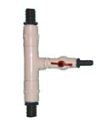
Using PVC 'T' Diverters also allows for the use of these large pumps for smaller ponds under 1000 gallons where multiple features and/or high head pressure features are being run.
Even with a large pump like the SeaHorse, I still recommend another smaller one for redundancy in case of failure, and often for large ponds I simply use several pumps like the Rio 32H or AAP Hydor 3200 or 1600.
Sometimes flexible/vinyl tubing will be difficult to connect, however by lubricating the connection, then heating the tubing, along with clamping with a standard hose clamp in some instances, this should not be a problem. This works for clear, black and ribbed tubing.
Aquarium and Pond Tubing Installation Tips
See this tutorial or help with tubing connections with your UV Sterilizer, Pump, Filter, etc.
Even with a large pump like the SeaHorse, I still recommend another smaller one for redundancy in case of failure, and often for large ponds I simply use several pumps like the Rio 32H or AAP Hydor 3200 or 1600.
Sometimes flexible/vinyl tubing will be difficult to connect, however by lubricating the connection, then heating the tubing, along with clamping with a standard hose clamp in some instances, this should not be a problem. This works for clear, black and ribbed tubing.
Aquarium and Pond Tubing Installation Tips
See this tutorial or help with tubing connections with your UV Sterilizer, Pump, Filter, etc.
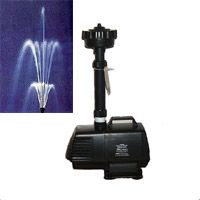
Dissolved oxygen is VERY important in ponds (partly for the Redox Balance). All oxygen is exchanged at the surface, so good surface agitation over the entire pond is best. Waterfalls, fountains, air stones all can achieve this.
Low dissolved oxygen levels and a low KH & GH (below 50/100 ppm respectively) affect your fish’ ability to perform osmoregulation & Redox Balance will be poor. If these parameters are poor, this will allow for much more opportunistic infections.
Further Reference:
Aquarium Answers; Fish Osmoregulation
Make sure in winter months to de-ice and circulate water to the surface for optimum fish health.
For further information about GH/KH, please see this article:
CALCIUM, KH, GH, IN AQUARIUMS & PONDS
For further information about Redox Potential, please see this article:
REDOX POTENTIAL IN AQUARIUMS & PONDS; How it Relates to Proper Aquatic Health
Low dissolved oxygen levels and a low KH & GH (below 50/100 ppm respectively) affect your fish’ ability to perform osmoregulation & Redox Balance will be poor. If these parameters are poor, this will allow for much more opportunistic infections.
Further Reference:
Aquarium Answers; Fish Osmoregulation
Make sure in winter months to de-ice and circulate water to the surface for optimum fish health.
For further information about GH/KH, please see this article:
CALCIUM, KH, GH, IN AQUARIUMS & PONDS
For further information about Redox Potential, please see this article:
REDOX POTENTIAL IN AQUARIUMS & PONDS; How it Relates to Proper Aquatic Health
Filtration
Good filtration, especially biological is essential to maintain a healthy pond with the only "maybe" exception being with a “flow through/spring fed” pond.
Understanding the Nitrogen Cycle, which is the same in a pond as in an aquarium with the added input of debris from trees, wind borne, and sometimes wild/domestic animals adding to this strain on the bio system.
More than one filter is always best when possible and this includes DIY natural plant/veggie/bog filters which add to the aesthetics and are an enjoyable DIY project based on my experience.
As per the overview section of this article, most often ponds I have consulted for over the years are woefully under filtered for the given bio load.
Looking at it another way, if what you have for pond filtration (as well as pond pumps) is clogging quickly (requiring cleanings every week or sooner), your filtration IS INADEQUATE!!
Further Reference:
Aquarium and Pond Nitrogen Cycle
Multiple types of filtration in combination are also excellent, such as these to name a few:
Pressurized filter
Bio falls combination
Submersible or Sponge filter
Fluidized
Barrel
Veggie filter.
Of which the Veggie/bog filter can be a great DIY filter project that if done correctly (which more often than not they are NOT built correctly), can perform mechanical as well as incredible bio filtration better than many purchased filters, often by a wide margin! A Veggie/Bog filter should be part of any pond much over 250 gallons.
Readers might note that I did NOT include skimmers in my list above. While popular only of late since mentoring and honesty has gone out the window by some in the industry, I personally do not recommend pond skimmers as these often tend to trap water lilies, hyacinth, and other floating pond plants all the while providing little to the quality of pond filtration (other than removal of floating leaf debris, especially in autumn).
As well their function in a pool can sometimes be problematic where debris is a common issue. In ponds, debris is normal and the way a skimmer functions, skimmers can kill a pump in short order (in particular mag drive pumps commonly used in ponds)
I have found when I took over a pond care contract for a client that already have a skimmer, I would later disconnect the skimmer after adding a Veggie Filter. Part of the problem is many of the ponds I was called to consult on "after they were built" were built by "pool guys" and skimmers are great for pools, but not ponds and these builders often knew little to nothing about building a living pond, including a bog/veggie filter.
In the end, the pond actually was MORE clear with more natural looking floating plants too!
So avoid the sales pitch by many, do NOT purchase a pond skimmer by ANY maker as these are simply profit makers for the builders and less than honest retailers and long term professionals know that these are simply a device to take money out of your pocket both up front and later due to constant pump replacement!
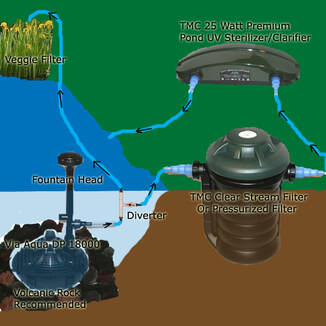
The picture to the above shows a High Output Pond Pump embedded in loose volcanic rock (for added pre-filtration as noted earlier) connected to a Pressurized Pond Filter and then to a High Output Pond UV Sterilizer/Clarifier.
This picture displays how a large pump (as shown with the high flow VA Pump) can be utilized for more than one function, including multistage filtration, UV Sterilization, a fountain and even can be diverted for watering a Veggie Filter.
Please note that a control valve may be needed on both sides of the diversion ‘T’, otherwise the water will follow the “path of least resistance”, put another way if your water flow is too slow through the UV Sterilizer/Filter side of this example, it may be that the return is too high above the other return and simply lowering the return will solve this problem. As well after splitting a return line, the lines should not be combined later in the return. Please read the UV Sterilizations section for more on this subject.
Product Resources:
TMC Pond Advantage Premium VERY High Output UVC Sterilizer
Understanding the Nitrogen Cycle, which is the same in a pond as in an aquarium with the added input of debris from trees, wind borne, and sometimes wild/domestic animals adding to this strain on the bio system.
More than one filter is always best when possible and this includes DIY natural plant/veggie/bog filters which add to the aesthetics and are an enjoyable DIY project based on my experience.
As per the overview section of this article, most often ponds I have consulted for over the years are woefully under filtered for the given bio load.
Looking at it another way, if what you have for pond filtration (as well as pond pumps) is clogging quickly (requiring cleanings every week or sooner), your filtration IS INADEQUATE!!
Further Reference:
Aquarium and Pond Nitrogen Cycle
Multiple types of filtration in combination are also excellent, such as these to name a few:
Pressurized filter
Bio falls combination
Submersible or Sponge filter
Fluidized
Barrel
Veggie filter.
Of which the Veggie/bog filter can be a great DIY filter project that if done correctly (which more often than not they are NOT built correctly), can perform mechanical as well as incredible bio filtration better than many purchased filters, often by a wide margin! A Veggie/Bog filter should be part of any pond much over 250 gallons.
Readers might note that I did NOT include skimmers in my list above. While popular only of late since mentoring and honesty has gone out the window by some in the industry, I personally do not recommend pond skimmers as these often tend to trap water lilies, hyacinth, and other floating pond plants all the while providing little to the quality of pond filtration (other than removal of floating leaf debris, especially in autumn).
As well their function in a pool can sometimes be problematic where debris is a common issue. In ponds, debris is normal and the way a skimmer functions, skimmers can kill a pump in short order (in particular mag drive pumps commonly used in ponds)
I have found when I took over a pond care contract for a client that already have a skimmer, I would later disconnect the skimmer after adding a Veggie Filter. Part of the problem is many of the ponds I was called to consult on "after they were built" were built by "pool guys" and skimmers are great for pools, but not ponds and these builders often knew little to nothing about building a living pond, including a bog/veggie filter.
In the end, the pond actually was MORE clear with more natural looking floating plants too!
So avoid the sales pitch by many, do NOT purchase a pond skimmer by ANY maker as these are simply profit makers for the builders and less than honest retailers and long term professionals know that these are simply a device to take money out of your pocket both up front and later due to constant pump replacement!
The picture to the above shows a High Output Pond Pump embedded in loose volcanic rock (for added pre-filtration as noted earlier) connected to a Pressurized Pond Filter and then to a High Output Pond UV Sterilizer/Clarifier.
This picture displays how a large pump (as shown with the high flow VA Pump) can be utilized for more than one function, including multistage filtration, UV Sterilization, a fountain and even can be diverted for watering a Veggie Filter.
Please note that a control valve may be needed on both sides of the diversion ‘T’, otherwise the water will follow the “path of least resistance”, put another way if your water flow is too slow through the UV Sterilizer/Filter side of this example, it may be that the return is too high above the other return and simply lowering the return will solve this problem. As well after splitting a return line, the lines should not be combined later in the return. Please read the UV Sterilizations section for more on this subject.
Product Resources:
TMC Pond Advantage Premium VERY High Output UVC Sterilizer
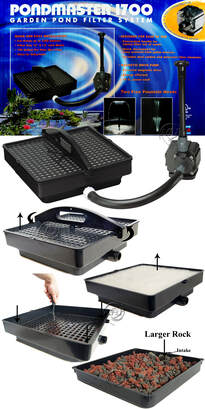
I generally do not recommend the Pond Master Submersible & especially the Becket filters as they come out of the box; they clog easily and are not efficient filters unless modified.
HOWEVER the Pondmaster 1000/1700 can be vastly improved by unscrewing the screws in each corner and adding select pond capable volcanic rock biological filter media to this area under the tray (as the Pondmaster only utilizes two pads that only perform mechanical, some chemical, & NO essential bio filtration).
In fact the PondMaster can be an excellent bio filter for the money if purchased with this volcanic rock which increases bio capacity by over 500%, however MOST Sellers of this filter sell it on the "cheap" and unfortunately do not include this, in part because they have no professional experience and because they are attempting to maximize profits while keeping the price artificially low.
Product Resource:
Pondmaster Submersible Pond Filters UNIQUELY sold ONLY at AAP with Volcanic Filter Media
Volcanic Rock is excellent for this or BETTER yet would be SeaChem Matrix. Both of these would add considerably to bio filtration of your pond by adding to your filter.
Product Resources:
Volcanic Rock- Nitrifying and de-nitrifying Filter Media
SeaChem Pond Matrix- High porosity media
HOWEVER the Pondmaster 1000/1700 can be vastly improved by unscrewing the screws in each corner and adding select pond capable volcanic rock biological filter media to this area under the tray (as the Pondmaster only utilizes two pads that only perform mechanical, some chemical, & NO essential bio filtration).
In fact the PondMaster can be an excellent bio filter for the money if purchased with this volcanic rock which increases bio capacity by over 500%, however MOST Sellers of this filter sell it on the "cheap" and unfortunately do not include this, in part because they have no professional experience and because they are attempting to maximize profits while keeping the price artificially low.
Product Resource:
Pondmaster Submersible Pond Filters UNIQUELY sold ONLY at AAP with Volcanic Filter Media
Volcanic Rock is excellent for this or BETTER yet would be SeaChem Matrix. Both of these would add considerably to bio filtration of your pond by adding to your filter.
Product Resources:
Volcanic Rock- Nitrifying and de-nitrifying Filter Media
SeaChem Pond Matrix- High porosity media
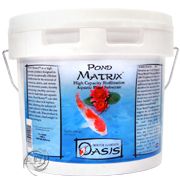
In fact Pond Matrix provides the best internal macroporous surface area of ANY product and is an excellent compliment to a pressurized filter, waterfall filter, drum, or large sand/bead filters such as the AquaBead.
These macropores are ideally sized for the support of nitrifying and de-nitrifying bacteria. This allows Pond Matrix, unlike other forms of biomedia, to remove nitrate along with ammonia and nitrite, simultaneously and in the same filter and rarely if ever needs to be changed if properly cared for.
Pond Matrix also makes an excellent support for root development of aquatic plants and may be used for Pond Veggie/Bog Filters or in pots
I also suggest replacing the black carbon impregnated pad in the Pondmaster with a cut to fit Poly Pad and add carbon or Zeolite underneath the tray (also in a filter bag).
Product Resources:
Poly Pad Micron filter media
These macropores are ideally sized for the support of nitrifying and de-nitrifying bacteria. This allows Pond Matrix, unlike other forms of biomedia, to remove nitrate along with ammonia and nitrite, simultaneously and in the same filter and rarely if ever needs to be changed if properly cared for.
Pond Matrix also makes an excellent support for root development of aquatic plants and may be used for Pond Veggie/Bog Filters or in pots
I also suggest replacing the black carbon impregnated pad in the Pondmaster with a cut to fit Poly Pad and add carbon or Zeolite underneath the tray (also in a filter bag).
Product Resources:
Poly Pad Micron filter media
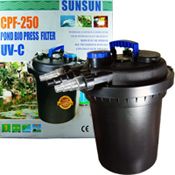
I prefer pressurized pond filters such as the SunSun UVC Pressurized or others for their efficiency and ease of hiding in the ground.
These filters include the popular Tetra, Lifeguard Pressurized, and Cyprio, which are excellent too, but tend to be over priced, especially considering Tetra charges almost $200 more for their UV feature when a separate and VASTLY better TMC Pond Advantage would be better (see the UV Section of this article).
Product Resource:
ressurized Pond Filter; SunSun with Volcanic Rock from AAP (Discontinued)
The SunSun model pictured to the left, is not much different in design than other pressurized filters, rather what sets it apart is that it is also is supplied with highly bio efficient volcanic rock and and yet is still a lower price and is my recommendation!
Pressurized filters can be buried in the ground or place behind a water feature easily. Pressurized pond filters are very good bio filters especially when price is considered and these are also excellent mechanical filters.
However many if not most pressurized pond filters are sold with attached/built in UV Sterilizers which when the flow rate/dwell time is considered usually provides only some green water clarification and absolutely NO level one sterilization.
A SEPARATE UV such as the TMC Pond Pro Advantage is vastly more effective when plumbed properly including placed after an otherwise excellent pressurized pond filter.
Product Resource:
TMC Pond Pro Advantage TRUE Level ONE UV Sterilizers
Further Reference, a MUST Read for pond keepers!!
UV Sterilization; Facts & Information; How Ultraviolet Sterilizers work in ponds
Do NOT confuse an aquarium canister filter with a pressurized pond filter, where as although a pressurized pond filter can be used for an aquarium, the use of an aquarium canister filter for a pond will result in failure since most aquarium canister filters have top mounted motors that will loose their siphon in most pond applications, as well an aquarium canister filter is not nearly as rugged in design for the pond environment (I had a couple of service calls many years back where customers attempted to utilize an aquarium canister filter for their pond and results were not good!).
Small or Patio Pond (under 250-500 gallons depending upon fish stocking and natural debris fallout):
These filters include the popular Tetra, Lifeguard Pressurized, and Cyprio, which are excellent too, but tend to be over priced, especially considering Tetra charges almost $200 more for their UV feature when a separate and VASTLY better TMC Pond Advantage would be better (see the UV Section of this article).
Product Resource:
ressurized Pond Filter; SunSun with Volcanic Rock from AAP (Discontinued)
The SunSun model pictured to the left, is not much different in design than other pressurized filters, rather what sets it apart is that it is also is supplied with highly bio efficient volcanic rock and and yet is still a lower price and is my recommendation!
Pressurized filters can be buried in the ground or place behind a water feature easily. Pressurized pond filters are very good bio filters especially when price is considered and these are also excellent mechanical filters.
However many if not most pressurized pond filters are sold with attached/built in UV Sterilizers which when the flow rate/dwell time is considered usually provides only some green water clarification and absolutely NO level one sterilization.
A SEPARATE UV such as the TMC Pond Pro Advantage is vastly more effective when plumbed properly including placed after an otherwise excellent pressurized pond filter.
Product Resource:
TMC Pond Pro Advantage TRUE Level ONE UV Sterilizers
Further Reference, a MUST Read for pond keepers!!
UV Sterilization; Facts & Information; How Ultraviolet Sterilizers work in ponds
Do NOT confuse an aquarium canister filter with a pressurized pond filter, where as although a pressurized pond filter can be used for an aquarium, the use of an aquarium canister filter for a pond will result in failure since most aquarium canister filters have top mounted motors that will loose their siphon in most pond applications, as well an aquarium canister filter is not nearly as rugged in design for the pond environment (I had a couple of service calls many years back where customers attempted to utilize an aquarium canister filter for their pond and results were not good!).
Small or Patio Pond (under 250-500 gallons depending upon fish stocking and natural debris fallout):
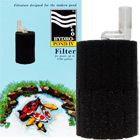
For small ponds and patio ponds (ponds built in above ground "Rubber Made" or other similar containers such as converted horse waterers), large sponge filters are excellent bio filters and reasonable mechanical filters. They are inexpensive, easy to service, and simple to attach with either a power head pump or and air stone.
There now is a specific patented Pond Sponge Filter called the Hydro-Pond by ATI, with three models; one air driven, two pump driven. They are useful up to 1500 gallons and more can be used for larger ponds or in combination with other filters. The Hydro Pond IV also makes an excellent pre filter for pond pumps before water is circulated to another filter such as a pressurized filter.
For "patio ponds", these filters can perform very well since the only weakness is inability to handle large debris, but with patio ponds this is rarely a problem. In fact one client of mine with a 150 gallon patio pond had a small Becket pond filter he purchased at Home Depot that did not keep his pond clean, however when he switched to a Hydro Pond #2 his water while still somewhat green was much more clean and the fish could be readily seen.
I highly recommend the Hydro Pond filters for small pond owners on a budget, owners of patio ponds, or just to add redundancy to existing pond filters (often is larger ponds)
Product Resource:
Patented Hydro-Pond; Sponge Filtration for Pond
There now is a specific patented Pond Sponge Filter called the Hydro-Pond by ATI, with three models; one air driven, two pump driven. They are useful up to 1500 gallons and more can be used for larger ponds or in combination with other filters. The Hydro Pond IV also makes an excellent pre filter for pond pumps before water is circulated to another filter such as a pressurized filter.
For "patio ponds", these filters can perform very well since the only weakness is inability to handle large debris, but with patio ponds this is rarely a problem. In fact one client of mine with a 150 gallon patio pond had a small Becket pond filter he purchased at Home Depot that did not keep his pond clean, however when he switched to a Hydro Pond #2 his water while still somewhat green was much more clean and the fish could be readily seen.
I highly recommend the Hydro Pond filters for small pond owners on a budget, owners of patio ponds, or just to add redundancy to existing pond filters (often is larger ponds)
Product Resource:
Patented Hydro-Pond; Sponge Filtration for Pond
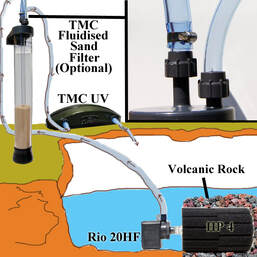
A top notch (& unique) filter for ponds up to 500 gallons would be a TMC V2 1500 Fluidized Filter when combined to a pre-filter system as pictured to the left.
This system would work for larger ponds when multiplied such as two for up to a 1000 gallon pond.
The "SunSun CHJ-1503; Small Pond Pump/Filter", "Pondmaster 1700" are other rgood filter choices for small/medium ponds under 500 to 1000 gallons. These filters along with the Hydro-Pond Sponge and Fluidized are an excellent compliment to a Veggie Filter (which I recommend for any pond).
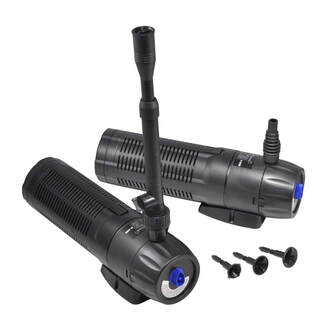
With the SunSun CHJ-1503 or similar Submersible Pond Filter you can easily attach a UV Sterilizer to the “diverter” valve (just above the filter and below the fountain head) for improved water clarity.
Another way to add filtration as well as a UV Clarifier is to use one of the before mentioned submersible filters along with the AAP CUP series true UV Sterilizers that are a self contained filter, pump, and UV clarifier (these are mentioned in more depth in the UV section of this article). This would make for a simple "plug & play" redundant pond filter system for most ponds under 750 gallons
See the UV Sterilizer section further in this article for a diagram.
Product Resources:
AAP CUP Submersible Internal Filter with UV
Pondmaster 1700 WITH Volcanic Rock ONLY at AAP
Premium Fluidized Sand Bed Pond or Aquarium Filters
This system would work for larger ponds when multiplied such as two for up to a 1000 gallon pond.
The "SunSun CHJ-1503; Small Pond Pump/Filter", "Pondmaster 1700" are other rgood filter choices for small/medium ponds under 500 to 1000 gallons. These filters along with the Hydro-Pond Sponge and Fluidized are an excellent compliment to a Veggie Filter (which I recommend for any pond).
With the SunSun CHJ-1503 or similar Submersible Pond Filter you can easily attach a UV Sterilizer to the “diverter” valve (just above the filter and below the fountain head) for improved water clarity.
Another way to add filtration as well as a UV Clarifier is to use one of the before mentioned submersible filters along with the AAP CUP series true UV Sterilizers that are a self contained filter, pump, and UV clarifier (these are mentioned in more depth in the UV section of this article). This would make for a simple "plug & play" redundant pond filter system for most ponds under 750 gallons
See the UV Sterilizer section further in this article for a diagram.
Product Resources:
AAP CUP Submersible Internal Filter with UV
Pondmaster 1700 WITH Volcanic Rock ONLY at AAP
Premium Fluidized Sand Bed Pond or Aquarium Filters
Medium Pond (250-2000 gallons depending upon fish stocking and natural debris fallout):
Bio falls such as the Savio Livingponds Filters are also excellent pond filters for medium and many larger ponds.
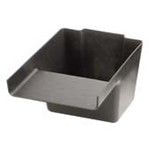
These filters can also be DIY (Do it yourself) or you can start with a basic Bio Falls “skeleton” filter (pictured to the left) and then add bio filter media (such as Volcanic rock) and place a Polyester Media on top.
However if you have purchased a unit such as Savio Livingponds Waterfall filter, you can add extra media to meet your pond needs and possibly save money. For instance I have often substituted Volcanic Rock of different sizes (depending on coarseness of filtration needed) for bio and mechanical media in these and similar filter.
This article about Aquarium filter media can also be applied to ponds:
Aquarium & Pond Filter Media, Material; Mechanical, Bio, Chemical
Bio falls such as the Savio Livingponds Filters are also excellent pond filters for medium and many larger ponds.
These filters can also be DIY (Do it yourself) or you can start with a basic Bio Falls “skeleton” filter (pictured to the left) and then add bio filter media (such as Volcanic rock) and place a Polyester Media on top.
However if you have purchased a unit such as Savio Livingponds Waterfall filter, you can add extra media to meet your pond needs and possibly save money. For instance I have often substituted Volcanic Rock of different sizes (depending on coarseness of filtration needed) for bio and mechanical media in these and similar filter.
This article about Aquarium filter media can also be applied to ponds:
Aquarium & Pond Filter Media, Material; Mechanical, Bio, Chemical
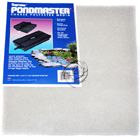
Plastic grates and even rocks formed into basin can be used to construct the bio and mechanical filter for flow through either prior to a water all or after (prior is more common). If a cement product is used in construction, I recommend sealing it with a water proof sealer available at most Home Improvement Stores.
Use of volcanic rock for bio filtration and Coarse Polyester Media (pictured to the left) can help with the filtration need of your bio falls project as well as other similar projects such as a Veggie Filter pre-filter trap.
Product Resource:
Coarse Poly Pads; Excellent for DIY Pond projects
Use of volcanic rock for bio filtration and Coarse Polyester Media (pictured to the left) can help with the filtration need of your bio falls project as well as other similar projects such as a Veggie Filter pre-filter trap.
Product Resource:
Coarse Poly Pads; Excellent for DIY Pond projects
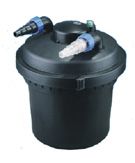
As noted earlier, Pressurized Pond Filters are an excellent choice for medium ponds. These can used with other filters for improved filtration and redundancy or even larger yet ponds.
You can also use multiples of Pressurized Pond Filters for larger ponds. As well even a smaller pond can utilize these simple yet effective filters, especially where the bio load is high.
This is probably one of my favorite pond filter types to use either by itself, in multiples or often with other pond filter types.
Two aspects of this filter type I like is their ability to go inline from the pump to any water feature, such as a water fall, while maintaining water pressure (no need for gravity feed). The other aspect I like is these can be partly buried to improve the pond aesthetics.
Product Resource:
SunSun Pressurized Pond Filter (Discontinued)
Another filter that works well with small and many medium sized ponds is the barrel style filter by Tetra and Coralife; these are excellent bio filters, but poor mechanical filters. They also are hard to hide as they have to use gravity to return water back into the pond after the pump first supplies these filters with un-filtered water.
This filter too can be a DIY project using a large sterilized drum.
You can also use multiples of Pressurized Pond Filters for larger ponds. As well even a smaller pond can utilize these simple yet effective filters, especially where the bio load is high.
This is probably one of my favorite pond filter types to use either by itself, in multiples or often with other pond filter types.
Two aspects of this filter type I like is their ability to go inline from the pump to any water feature, such as a water fall, while maintaining water pressure (no need for gravity feed). The other aspect I like is these can be partly buried to improve the pond aesthetics.
Product Resource:
SunSun Pressurized Pond Filter (Discontinued)
Another filter that works well with small and many medium sized ponds is the barrel style filter by Tetra and Coralife; these are excellent bio filters, but poor mechanical filters. They also are hard to hide as they have to use gravity to return water back into the pond after the pump first supplies these filters with un-filtered water.
This filter too can be a DIY project using a large sterilized drum.
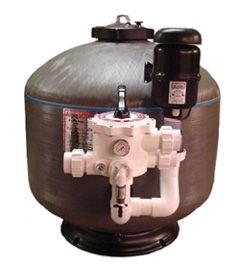
A filter that is also used is pool style sand filters. I have used these filters in many of my largest pond installations (over 5,000 gallons).
Despite what pundits for these over priced monstrosities say, they are not originally designed for ponds. The fine sand therein will often compact and the water then tends to follow the path of least resistance thru these filters, leaving areas on anaerobic bacteria producing poisonous Hydrogen Sulfide.
DO NOT be fooled by their high price (often well over $1000), I can tell you from vast experience with them that they are not worth it!!
That said, if you already have one, I recommend adding volcanic rock and/or SeaChem Pond Matrix to improve upon this problem and also allow for nitrate removal via de-nitrification.
Despite what pundits for these over priced monstrosities say, they are not originally designed for ponds. The fine sand therein will often compact and the water then tends to follow the path of least resistance thru these filters, leaving areas on anaerobic bacteria producing poisonous Hydrogen Sulfide.
DO NOT be fooled by their high price (often well over $1000), I can tell you from vast experience with them that they are not worth it!!
That said, if you already have one, I recommend adding volcanic rock and/or SeaChem Pond Matrix to improve upon this problem and also allow for nitrate removal via de-nitrification.
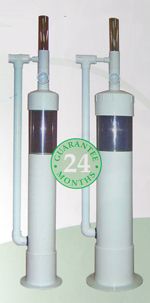
Fluidized Sand or Moving Bed Filters:
These types of filters are purely for nitrifying (removal of ammonia & nitrites but not nitrates), however they are excellent at performing this task (and in fact the BEST)!
I do recommend pre-filtration of some sort such as coarse rocks near an intake or at the very least a coarse mesh screen to allow for maximum effectiveness.
Product Resource:
Premium Fluidized Sand Bed Pond, Aquarium Filters
These types of filters are purely for nitrifying (removal of ammonia & nitrites but not nitrates), however they are excellent at performing this task (and in fact the BEST)!
I do recommend pre-filtration of some sort such as coarse rocks near an intake or at the very least a coarse mesh screen to allow for maximum effectiveness.
Product Resource:
Premium Fluidized Sand Bed Pond, Aquarium Filters
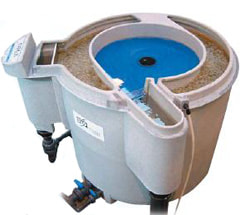
The Nexus Moving Bed Filter or TMC Pro Pond Fluidized Filters are a potential consideration for large ponds as their design lends itself better especially to ponds over 2500 gallons.
The best is the TMC Pro Pond FBF80 Fluidized Filters with the capacity to handle 176 lbs of bio mass respectively (this is a LOT of fish!). This works out on average to a 2500 gallon to 5000 gallon pond. Their size alone belies their large pond capacity with the FBF80 measuring 61 inches tall and 13 inches wide.
With either of these filters, I would strongly recommend a DIY Veggie/Bog filter to provide nitrate removal via plant roots end de-nitrification.
Further Information:
DIY Pond Veggie, Bog Plant Filters
The best is the TMC Pro Pond FBF80 Fluidized Filters with the capacity to handle 176 lbs of bio mass respectively (this is a LOT of fish!). This works out on average to a 2500 gallon to 5000 gallon pond. Their size alone belies their large pond capacity with the FBF80 measuring 61 inches tall and 13 inches wide.
With either of these filters, I would strongly recommend a DIY Veggie/Bog filter to provide nitrate removal via plant roots end de-nitrification.
Further Information:
DIY Pond Veggie, Bog Plant Filters
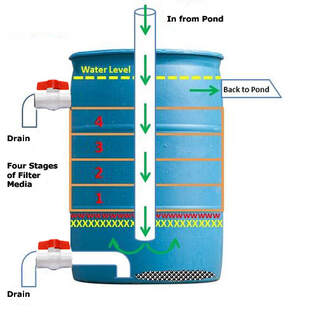
The picture to the left demonstrates a DIY barrel type pond filter that could be built by anyone with reasonable DIY abilities.
I would suggest using volcanic rock and/or SeaChem Pond Matrix in one of the filter media layers with poy pads or other mechanical media types in the other layers.
I would suggest using volcanic rock and/or SeaChem Pond Matrix in one of the filter media layers with poy pads or other mechanical media types in the other layers.
|
|
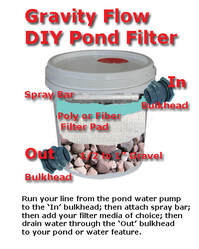
To the left is a diagram of a very basic "DIY Gravity Flow In-Line Pond Filter" (principle is similar to Tetra or Coralife barrel filters).
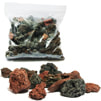
Volcanic rock makes an excellent filter media for DIY pond filters, waterfall filters, veggie filters (for the base), and many types of commercial filters such as the Savio.
Please click on the picture for more information.
For information about different filter media that can be used in your pond filter, please visit this article:
Aquarium and Pond Filter Media
Volcanic rock makes an excellent filter media for DIY pond filters, waterfall filters, veggie filters (for the base), and many types of commercial filters such as the Savio.
Please click on the picture for more information.
For information about different filter media that can be used in your pond filter, please visit this article:
Aquarium and Pond Filter Media
Plant Filtration
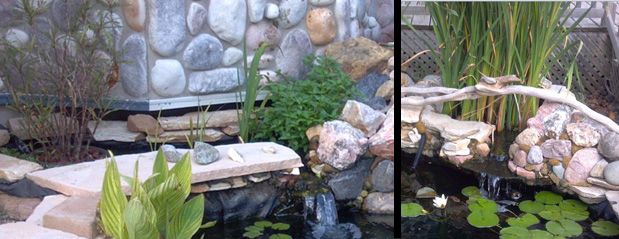
This is a very important part of pond keeping and filtration.
A well planted and diversified planted pond is VERY important for clarity (including green water control), pond and fish health, and even fish breeding.
Any plant with a good root structure that grows fast and has the majority of their leaves above water is a good candidate to start with.
I recommend water iris for their strong root structure, fast growth, great nutrient absorption, and a great place for baby fish (fry) to hide feed and grow (if you use an “in pond” Veggie Filter).
There are many other excellent plants as well such as Cattails, Sweet Flag, Parrots feather, Bluebells, Umbrella palm, Papyrus, & bull rush. Make sure these types of plants (plants with roots in water and leaves above) are planted in an area of good, but not strong water movement. This ensures that they will do their job as plant filters.
Other plants such as lilies and hyacinth are reasonable for nutrient removal too, but NOT at the rate of iris and similar plants. These plants also do not have the root structure that will aid in the rapid removal of nitrates and ammonia, and thus should not be a part of a true Veggie/Plant filter.
However, these floating plants are useful for shade, which will slow algae growth.
A well planted and diversified planted pond is VERY important for clarity (including green water control), pond and fish health, and even fish breeding.
Any plant with a good root structure that grows fast and has the majority of their leaves above water is a good candidate to start with.
I recommend water iris for their strong root structure, fast growth, great nutrient absorption, and a great place for baby fish (fry) to hide feed and grow (if you use an “in pond” Veggie Filter).
There are many other excellent plants as well such as Cattails, Sweet Flag, Parrots feather, Bluebells, Umbrella palm, Papyrus, & bull rush. Make sure these types of plants (plants with roots in water and leaves above) are planted in an area of good, but not strong water movement. This ensures that they will do their job as plant filters.
Other plants such as lilies and hyacinth are reasonable for nutrient removal too, but NOT at the rate of iris and similar plants. These plants also do not have the root structure that will aid in the rapid removal of nitrates and ammonia, and thus should not be a part of a true Veggie/Plant filter.
However, these floating plants are useful for shade, which will slow algae growth.
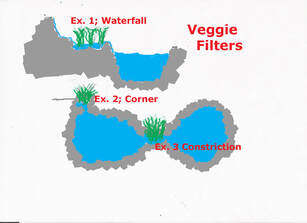
I will often place this plant/bog filter in an area of water constriction between two ponds or in an upper waterfall area with low to moderate current. In smaller Ponds I will just place this plant filter in a corner of the pond with a small water current applied to the planted area.
I prefer my plant filters within the pond as these look more attractive in my opinion and give the fish fry a place to hide (except in the case of the waterfall or cascade plant filter).
The area of the Veggie Filter should be relatively shallow as well to force water movement over and through the roots.
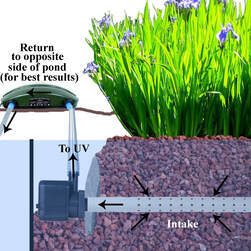
The key is also water movement along with a good media (Volcanic Rock is preferred) around the roots/tubers. While the flow does not need to be 'fast', there should be a definite flow of water through this Veggie/Bog filter. Often a lack of flow and use of a good media such as volcanic rock is why some Plant/Bog filters fail to work very well and algae such as hair algae will then grow out of control.
Using PVC pipe with holes drilled and then embedded in this volcanic rock with plant roots that then feeds into a True UV Sterilizer makes all the difference in the world (The cheap UV Clarifiers sold via Amazon, eBay, Lowes, Home Depot, etc. do NOT pass a true UV Sterilizer).
In other words, construction and proper equipment is key to the success. If done correctly, this is a DIY filter that often far exceeds anything you can purchase or at the very least will compliment any other pond filter.
Other methods include separate veggie filters in containers or pools. I am not as fond of this method for the reasons above, however these can work.
FOR MY FULL VEGGIE FILTER ARTICLE, please visit this link:
POND VEGGIE (BOG PLANT FILTERS)
I prefer my plant filters within the pond as these look more attractive in my opinion and give the fish fry a place to hide (except in the case of the waterfall or cascade plant filter).
The area of the Veggie Filter should be relatively shallow as well to force water movement over and through the roots.
The key is also water movement along with a good media (Volcanic Rock is preferred) around the roots/tubers. While the flow does not need to be 'fast', there should be a definite flow of water through this Veggie/Bog filter. Often a lack of flow and use of a good media such as volcanic rock is why some Plant/Bog filters fail to work very well and algae such as hair algae will then grow out of control.
Using PVC pipe with holes drilled and then embedded in this volcanic rock with plant roots that then feeds into a True UV Sterilizer makes all the difference in the world (The cheap UV Clarifiers sold via Amazon, eBay, Lowes, Home Depot, etc. do NOT pass a true UV Sterilizer).
In other words, construction and proper equipment is key to the success. If done correctly, this is a DIY filter that often far exceeds anything you can purchase or at the very least will compliment any other pond filter.
Other methods include separate veggie filters in containers or pools. I am not as fond of this method for the reasons above, however these can work.
FOR MY FULL VEGGIE FILTER ARTICLE, please visit this link:
POND VEGGIE (BOG PLANT FILTERS)
This article includes much more information on this subject, as well as links to resources for bog plants and similar.
The bottom line is few ponds in my opinion are truly complete without a "Veggie/Bog Plant Filter" as they can make a big difference when done right in pond clarity.
As an example, I had one pond I built for a client that had such a large and efficient Veggie Filter that it stayed clear without the UV Sterilizer running.
For those who read this, please note that my emphasis of the use of Veggie filters is not driven by financial gain, as although I obviously list products to sell through my many articles (as a means to pay for the time to keep these articles up to date), I have little to gain since Veggie Filters are primarily a DIY products.
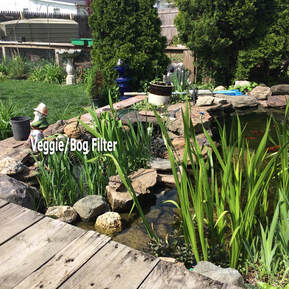
The picture above/right is of a pond with relatively new Veggie/Bog filter where water flow was also recently added improving the results.
The bottom line is few ponds in my opinion are truly complete without a "Veggie/Bog Plant Filter" as they can make a big difference when done right in pond clarity.
As an example, I had one pond I built for a client that had such a large and efficient Veggie Filter that it stayed clear without the UV Sterilizer running.
For those who read this, please note that my emphasis of the use of Veggie filters is not driven by financial gain, as although I obviously list products to sell through my many articles (as a means to pay for the time to keep these articles up to date), I have little to gain since Veggie Filters are primarily a DIY products.
The picture above/right is of a pond with relatively new Veggie/Bog filter where water flow was also recently added improving the results.
UVc Sterilization
Although not always necessary in a well planted, well shaded, well filtered aquarium; these devices are still very useful if only for the benefits of a true level one capable 'Category A or B' UV Sterilizer that goes beyond clarification.
True UV Sterilizers help not only with algae control, but also with disease prevention, and the Redox potential by lowering oxidative stress (which is important for fish health and proper filtration). While lower priced UV Clarifiers commonly sold via discounters online or big box stores like Home Depot ONLY help with Clarification and even then do a lessor job clearing a pond
The time it takes to clear a green pond with a UV Sterilizer/Clarifier can vary greatly from 1 day to a couple weeks to even never!
The reason for such wide variance is due to lack of adequate filtration which includes a good bio filter such as a veggie filter or use of de-nitrifying material/products such as SeaChem Matrix or Volcanic Rock.
This is why the formula I use to match a UV Sterilizer/Clarifier to an Aquarium or pond can be "off" by 50% or more, since this formula along with all reasonably honest manufacturer recommendations ASSUME a healthy bio filter. In other words, if a UV Sterilizer is rated to clarify a pond of say 1000 gallons, if its bio load exceeds the bio capacity of filtration, it may take a UV Sterilizer rated for 2000 gallons+!!
It is also noteworthy that the same UV or even a lessor UV may clear a pond one season and not the next; this is quite common as a pond matures, in particular in a pond with inadequate filtration!
Another common mistake is to simply run even an effective true "Category A or B" UV such as the AAP/TMC Pond Advantage, AAP Pro Clear Pond, or Emperor from just a water pump with no pre-filtration prior to entering the UV Sterilizer. This increases water turbidity considerably and thus lowers UVC effectiveness also considerably. Simply placing your water pump in a bed of volcanic rock can often work as a pre-filter, so can a Hydro Pond Sponge Pre-Filter.
Further Reference:
UV Sterilization; Water Turbidity
As well longer periods or never clarifying can simply be due to an inadequate UV and/or one that is properly plumbed.
It is also noteworthy than many so called UV Sterilizers are in fact ONLY capable of UV Clarification and therefore should be labeled as UV Clarifiers, but are unfortunately improperly labeled as Sterilizers.
This is an important point, even if you are not interested in improving water chemistry via Redox or killing disease pathogens, as a true UV Sterilizer can "Clarify" a pond much quicker than a UV that is ONLY capable of clarification. Also a true UV Sterilizer often works for green pond clarification when a UV clarifier fails due to high bio load, excess sunlight and other factors over load these devices limited capabilities.
For the UV to properly function in a pond for green water control (UV Clarification), the flow rate should not exceed 40-50 gph per watt of UVC in most Compact UV Sterilizers (such as the Tetra, or Terminator), or 50-70 gph per watt for most higher dwell time straight tube UV Clarifiers (some super high efficiency/dwell time UV Clarifiers such as the AAP Pro Clear UV30/UV55 can go to over 70 gph per watt).
Keep in mind these numbers are for UVC Clarification, not level 1 sterilization (which requires slower rates and higher pond or aquarium turnover).
Product Resource:
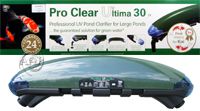
TMC Pro Clear UV30
The VERY BEST Pond UV at ANY Price!
In larger ponds with high flow rates I often recommend more than one UV sterilizer, with a by-pass from the main line to control flow rate, then each unit connected in parallel for best results, although in-line can work too, just not as effectively. Often a separate, slower pump (with a pre-filter) installed for the sole purpose to run the Pond UV sterilizer is the key to success when the main pump line runs at too high a flow rate for the UV to be optimally effective.
For this reason, I also do NOT recommend the popular filters with built in UVs as your Pond's sole UV Sterilizer/Clarifier.
The flow rate is usually too high to work properly. As well, the design of most I have seen and used have too high a gap between UV bulb/quartz sleeve sterilizer compartment wall, which is generally not adequate for good UVC exposure. The FACTS are that these filters with built in UV lights are UV Clarifiers AT BEST, and even then poor UV clarifiers.
A separate UV is always best! I have maintained ponds with UVs in filters and UVs separate and the difference in water quality in the separate UV ponds is significant!
However, do not take this advice to mean no pond filtration is needed, only a water pump and a separate UV run by this water pump is NOT adequate.
For CORRECT UV Sterilizer function, the pre-filtration of water prior to entering the UV is a MUST (even if just encasing the pump with volcanic rock as shown near the beginning of this article).
What is also noteworthy is that while a basic UV Clarifier can clear green water when properly installed, it WILL often takes days when under the SAME conditions a TRUE level one or higher UV Sterilizer (especially a high dwell time model) can take just a day or two or even as little as just hours while also having the bonus of improving fish disease resistance (via improved Redox Balance).
For more information about correct Pond UV sterilization and how it works please visit this site:
"HOW TO USE A UV POND OR AQUARIUM STERILIZER"
Many times I have heard of complaints that their UV did not help with algae control, when I checked this clients pond, I found inadequate filtration and an improperly installed UV sterilizer. Even a properly installed True UV Sterilizer cannot over come poor filtration and a poorly planted pond. As well, many manufacturers make claims of high flow rates that are impossible for proper contact time.
Another common problem I have encountered is a poor circulation pattern where-by the water pick up for the UV Sterilizer was near the water return, with the result that 3/4 or more of the pond water never made it into this flow pattern for proper UVC Sterilization.
True UV Sterilizers help not only with algae control, but also with disease prevention, and the Redox potential by lowering oxidative stress (which is important for fish health and proper filtration). While lower priced UV Clarifiers commonly sold via discounters online or big box stores like Home Depot ONLY help with Clarification and even then do a lessor job clearing a pond
The time it takes to clear a green pond with a UV Sterilizer/Clarifier can vary greatly from 1 day to a couple weeks to even never!
The reason for such wide variance is due to lack of adequate filtration which includes a good bio filter such as a veggie filter or use of de-nitrifying material/products such as SeaChem Matrix or Volcanic Rock.
This is why the formula I use to match a UV Sterilizer/Clarifier to an Aquarium or pond can be "off" by 50% or more, since this formula along with all reasonably honest manufacturer recommendations ASSUME a healthy bio filter. In other words, if a UV Sterilizer is rated to clarify a pond of say 1000 gallons, if its bio load exceeds the bio capacity of filtration, it may take a UV Sterilizer rated for 2000 gallons+!!
It is also noteworthy that the same UV or even a lessor UV may clear a pond one season and not the next; this is quite common as a pond matures, in particular in a pond with inadequate filtration!
Another common mistake is to simply run even an effective true "Category A or B" UV such as the AAP/TMC Pond Advantage, AAP Pro Clear Pond, or Emperor from just a water pump with no pre-filtration prior to entering the UV Sterilizer. This increases water turbidity considerably and thus lowers UVC effectiveness also considerably. Simply placing your water pump in a bed of volcanic rock can often work as a pre-filter, so can a Hydro Pond Sponge Pre-Filter.
Further Reference:
UV Sterilization; Water Turbidity
As well longer periods or never clarifying can simply be due to an inadequate UV and/or one that is properly plumbed.
It is also noteworthy than many so called UV Sterilizers are in fact ONLY capable of UV Clarification and therefore should be labeled as UV Clarifiers, but are unfortunately improperly labeled as Sterilizers.
This is an important point, even if you are not interested in improving water chemistry via Redox or killing disease pathogens, as a true UV Sterilizer can "Clarify" a pond much quicker than a UV that is ONLY capable of clarification. Also a true UV Sterilizer often works for green pond clarification when a UV clarifier fails due to high bio load, excess sunlight and other factors over load these devices limited capabilities.
For the UV to properly function in a pond for green water control (UV Clarification), the flow rate should not exceed 40-50 gph per watt of UVC in most Compact UV Sterilizers (such as the Tetra, or Terminator), or 50-70 gph per watt for most higher dwell time straight tube UV Clarifiers (some super high efficiency/dwell time UV Clarifiers such as the AAP Pro Clear UV30/UV55 can go to over 70 gph per watt).
Keep in mind these numbers are for UVC Clarification, not level 1 sterilization (which requires slower rates and higher pond or aquarium turnover).
Product Resource:
TMC Pro Clear UV30
The VERY BEST Pond UV at ANY Price!
In larger ponds with high flow rates I often recommend more than one UV sterilizer, with a by-pass from the main line to control flow rate, then each unit connected in parallel for best results, although in-line can work too, just not as effectively. Often a separate, slower pump (with a pre-filter) installed for the sole purpose to run the Pond UV sterilizer is the key to success when the main pump line runs at too high a flow rate for the UV to be optimally effective.
For this reason, I also do NOT recommend the popular filters with built in UVs as your Pond's sole UV Sterilizer/Clarifier.
The flow rate is usually too high to work properly. As well, the design of most I have seen and used have too high a gap between UV bulb/quartz sleeve sterilizer compartment wall, which is generally not adequate for good UVC exposure. The FACTS are that these filters with built in UV lights are UV Clarifiers AT BEST, and even then poor UV clarifiers.
A separate UV is always best! I have maintained ponds with UVs in filters and UVs separate and the difference in water quality in the separate UV ponds is significant!
However, do not take this advice to mean no pond filtration is needed, only a water pump and a separate UV run by this water pump is NOT adequate.
For CORRECT UV Sterilizer function, the pre-filtration of water prior to entering the UV is a MUST (even if just encasing the pump with volcanic rock as shown near the beginning of this article).
What is also noteworthy is that while a basic UV Clarifier can clear green water when properly installed, it WILL often takes days when under the SAME conditions a TRUE level one or higher UV Sterilizer (especially a high dwell time model) can take just a day or two or even as little as just hours while also having the bonus of improving fish disease resistance (via improved Redox Balance).
For more information about correct Pond UV sterilization and how it works please visit this site:
"HOW TO USE A UV POND OR AQUARIUM STERILIZER"
Many times I have heard of complaints that their UV did not help with algae control, when I checked this clients pond, I found inadequate filtration and an improperly installed UV sterilizer. Even a properly installed True UV Sterilizer cannot over come poor filtration and a poorly planted pond. As well, many manufacturers make claims of high flow rates that are impossible for proper contact time.
Another common problem I have encountered is a poor circulation pattern where-by the water pick up for the UV Sterilizer was near the water return, with the result that 3/4 or more of the pond water never made it into this flow pattern for proper UVC Sterilization.
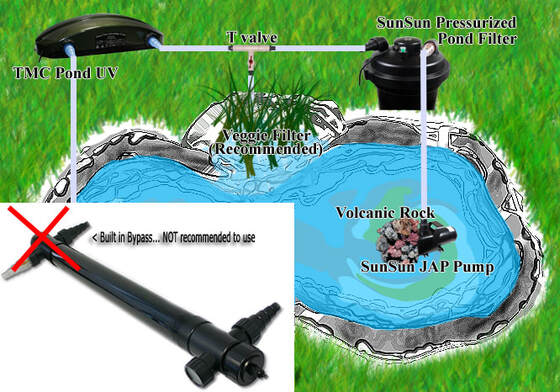
POND UV WITH BYPASS APPLICATION DIAGRAM; Click picture to enlarge.
To maintain a proper flow rate per watt per gph, connect a ‘T’ in line to your high flow rate pump, from there a reducing bushing (Ex. In 1-1/2” PVC I would step it down with a 1-1/2” by ¾ bushing), from there an in-line ball valve, from there to your Pond UV Sterilizer, then back to your pond or water feature (such as a waterfall or spitter).
I do NOT suggest the use of the built in "flow through" diverter common to many Chinese Pond UVs, these cause to much turbulence within the UV where water enters and in the end impedes optimum UV function (shown in cut-out in the picture to the right).
Another option is to split the outflow from a large, high output pump and place a UV Sterilizer on each line.
As an example with a 3600 gph pump (of which these gph flow ratings are based 0 head pressure and after real world applications that include lifting of water the actual flow would be less) could be split and two TMC Pond Advantage UV Sterilizers (or equivalent) placed on each line
You can also simply add a separate lower rate pump just for your Pond UV Sterilizer.
To maintain a proper flow rate per watt per gph, connect a ‘T’ in line to your high flow rate pump, from there a reducing bushing (Ex. In 1-1/2” PVC I would step it down with a 1-1/2” by ¾ bushing), from there an in-line ball valve, from there to your Pond UV Sterilizer, then back to your pond or water feature (such as a waterfall or spitter).
I do NOT suggest the use of the built in "flow through" diverter common to many Chinese Pond UVs, these cause to much turbulence within the UV where water enters and in the end impedes optimum UV function (shown in cut-out in the picture to the right).
Another option is to split the outflow from a large, high output pump and place a UV Sterilizer on each line.
As an example with a 3600 gph pump (of which these gph flow ratings are based 0 head pressure and after real world applications that include lifting of water the actual flow would be less) could be split and two TMC Pond Advantage UV Sterilizers (or equivalent) placed on each line
You can also simply add a separate lower rate pump just for your Pond UV Sterilizer.
The picture to the left depicts a UV flow diverter for use with high flow pond (or aquarium) pumps so as to achieve correct gph/per watt flow rate through the UV Sterilizer.
These diverter valves are listed/sold here:
Pond/Aquarium Plumbing Parts
Please note that these diverters only represent a fraction of PVC sizes and combinations, as well a ball valve may also be necessary on two sides of the diverter if head pressure is too high on the UV Sterilizer return side.
These diverter valves are listed/sold here:
Pond/Aquarium Plumbing Parts
Please note that these diverters only represent a fraction of PVC sizes and combinations, as well a ball valve may also be necessary on two sides of the diverter if head pressure is too high on the UV Sterilizer return side.
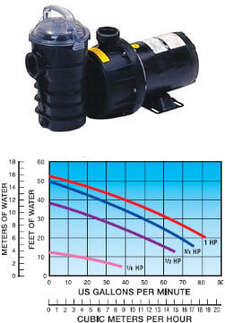
Often it is difficult to determine the flow rates of larger high pressure pond/pool pumps rated in HP (horse power) rather than flow rates that are occasionally used in larger ponds.
The diagram/picture to the left provides some flow rates for an average high pressure pump rated in horse power as per gallons per minute, then multiply by 60 to get gallons per hour.
This diagram can help determine flow rates at certain head pressures if you own such a pump (please click to enlarge). It is noteworthy that these pumps in 1/2 HP or higher do not even loose flow to head pressure until after 12 feet of head.
Here are a few solutions if the flow is too slow through your UV Sterilizer:
Add a ball valve to the other outlet to force more water through the UV Sterilizer
Lower the return for the UV Sterilizer to a place in the pond that is lower than the primary return, thus lowering head pressure through the UV and thus increasing flow.
Do not recombine the two (or more) return lines down line before entering the pond, this interrupts water flow and will increase back pressure and reduce flow. All return lines must enter the pond separately!
Submersible filter, Pondmaster 1700, with UV Sterilizer diagram
This diagram shows a Via Aqua BH2000 Filter/Pump (similar to the before mentioned Pondmaster or SunSun Pond Filters) connected to a UV Sterilizer via the built in diverter valve. This valve is common to most similar fountains and filters such as the Pondmaster 1700, SunSun CHJ-1503, and many more.
The diagram/picture to the left provides some flow rates for an average high pressure pump rated in horse power as per gallons per minute, then multiply by 60 to get gallons per hour.
This diagram can help determine flow rates at certain head pressures if you own such a pump (please click to enlarge). It is noteworthy that these pumps in 1/2 HP or higher do not even loose flow to head pressure until after 12 feet of head.
Here are a few solutions if the flow is too slow through your UV Sterilizer:
Add a ball valve to the other outlet to force more water through the UV Sterilizer
Lower the return for the UV Sterilizer to a place in the pond that is lower than the primary return, thus lowering head pressure through the UV and thus increasing flow.
Do not recombine the two (or more) return lines down line before entering the pond, this interrupts water flow and will increase back pressure and reduce flow. All return lines must enter the pond separately!
Submersible filter, Pondmaster 1700, with UV Sterilizer diagram
This diagram shows a Via Aqua BH2000 Filter/Pump (similar to the before mentioned Pondmaster or SunSun Pond Filters) connected to a UV Sterilizer via the built in diverter valve. This valve is common to most similar fountains and filters such as the Pondmaster 1700, SunSun CHJ-1503, and many more.
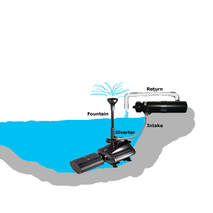
Further Pond UV Sterilizer/Clarifier Suggestions;
For Small Ponds, self contained Internal/Submersible UV Sterilizers are growing in popularity, however I would caution prospective buyers that the first generation models have problems with electrical failure and are not efficient.
The newer 3rd generation Internal UV Filter/Pumps (such as the AAP 13 Watt; picture to the left) are much improved, however even these are only best for ponds up to 1500 gallons (and this is assuming other filtration). In most real world ponds I would not use this past a 700 gallon pond and again this is assuming other filtration (although multiple units can be used together for larger ponds).
This said, for those desiring UV Clarification but not desiring to bother with plumbing, these Submersible UV Pumps are hard to beat.
These can also be used for larger ponds by strategically placing 2 or more of these UVs in as far apart from each other as possible.
Product Resource:
AAP Submersible UV Sterilizer Pump, Filter
For Small Ponds, self contained Internal/Submersible UV Sterilizers are growing in popularity, however I would caution prospective buyers that the first generation models have problems with electrical failure and are not efficient.
The newer 3rd generation Internal UV Filter/Pumps (such as the AAP 13 Watt; picture to the left) are much improved, however even these are only best for ponds up to 1500 gallons (and this is assuming other filtration). In most real world ponds I would not use this past a 700 gallon pond and again this is assuming other filtration (although multiple units can be used together for larger ponds).
This said, for those desiring UV Clarification but not desiring to bother with plumbing, these Submersible UV Pumps are hard to beat.
These can also be used for larger ponds by strategically placing 2 or more of these UVs in as far apart from each other as possible.
Product Resource:
AAP Submersible UV Sterilizer Pump, Filter
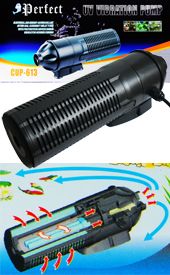
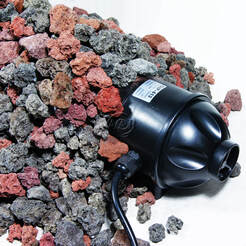
I would also point out that while these UV/Filters do provide some filtration, this is intended primarily for pre-filtration prior to water entering the UV-C chamber.
The use of Volcanic Rock around your Internal UV filter is strongly suggested to prevent clogging by acting as a pre-filter. This will yield better results with your UV Clarification and add to your pond filtration.
Do not believe web sites or other dealers stating this is an all in one filter UV.
What the best of these is (such as the AAP CUP-613 UV Filter); is a simple to use economical UV Sterilizer with filtration by itself maybe for a light bio load 100-200 gallon pond and otherwise additional filtration must be used (even a Hydro Pond Sponge Filter has vastly more bio capacity and would make an excellent inexpensive compliment to this UV Sterilizer in a pond under 500 gallons.
Product Resources:
Volcanic Rock Pond Filter Media
Hydro Pond Sponge Filters
The use of Volcanic Rock around your Internal UV filter is strongly suggested to prevent clogging by acting as a pre-filter. This will yield better results with your UV Clarification and add to your pond filtration.
Do not believe web sites or other dealers stating this is an all in one filter UV.
What the best of these is (such as the AAP CUP-613 UV Filter); is a simple to use economical UV Sterilizer with filtration by itself maybe for a light bio load 100-200 gallon pond and otherwise additional filtration must be used (even a Hydro Pond Sponge Filter has vastly more bio capacity and would make an excellent inexpensive compliment to this UV Sterilizer in a pond under 500 gallons.
Product Resources:
Volcanic Rock Pond Filter Media
Hydro Pond Sponge Filters
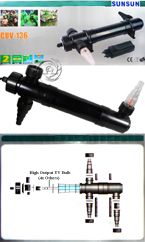
For larger ponds (over 2000 gallons) often placing two UV Sterilizers such as two AAP PRO Clear Ultima Pond 30 Watt UV Sterilizer will be more economical than one larger UV Sterilizer as when used with separate pumps, the flow pattern is often better, therefore the pond "turnover rate" (how often the entire pond water passes through the UV Clarifier) is generally slightly higher than one unit of say 75 watts that often costs more than double the price as well.
The use of one pump with two UV Sterilizers (or more) can also work well, provided the returns are in different locations of the pond for optimum circulation and water turnover in the UV Sterilizer, however I have still achieved the best results when two or more UVs are employed by using separate pumps with intakes and returns in separate locations of the pond to optimize water flow patterns through the UV Clarifier.
Product Resource:
AAP PRO Clear Ultima 30 Watt TRUE UV Sterilizer
For very high volume pumps or extra large ponds units such as the TMC Professional 110 Watt UV Sterilizer would be an excellent choice.
This in fact is of THE BEST UV Sterilizer in its class (based on dwell time), with high water exposure time even at high flow rates, without paying for often useless gimmicks (this includes superior dwell time over the Aqua Ultraviolet 114).
Although the advertised flow rate maximum is 9600 gph, I personally only recommend half this (about 4800 gph so as to aid in Redox balance), however this still allows for the largest of water pumps (especially once one considers loss of gph when head pressure is applied by lifting through water features and the UV itself). As well this would allow this UV Sterilizer to work via turnover of pond once every 2-3 hours of a pond up to 12,000 + gallons.
Product Resource:
AAP/TMC Professional 110 Watt True UV Sterilizer This is far and away the professionals choice for heavy duty premium UV Sterilizers!!
I should also note that spending more money for a pond UV Sterilizer/Clarifier with wipers or HO UV-C bulbs is often not money well spent, as the wipers are often gimmicks that easily break and do little even when functional. As well HO (high output) UVC lights often are very short and even with this higher output, these are often still not enough for the water flow that is usually applied to these UVs as per dwell time
For example, although a 50 Watt HO bulb of 18 inches will handle a higher water flow of a 25 watt UVC bulb of 18 inches, the flow rate is not doubled.
Product Resources:
25 Watt UV Lamp for Advantage, Custom Sealife and other UVs
The use of one pump with two UV Sterilizers (or more) can also work well, provided the returns are in different locations of the pond for optimum circulation and water turnover in the UV Sterilizer, however I have still achieved the best results when two or more UVs are employed by using separate pumps with intakes and returns in separate locations of the pond to optimize water flow patterns through the UV Clarifier.
Product Resource:
AAP PRO Clear Ultima 30 Watt TRUE UV Sterilizer
For very high volume pumps or extra large ponds units such as the TMC Professional 110 Watt UV Sterilizer would be an excellent choice.
This in fact is of THE BEST UV Sterilizer in its class (based on dwell time), with high water exposure time even at high flow rates, without paying for often useless gimmicks (this includes superior dwell time over the Aqua Ultraviolet 114).
Although the advertised flow rate maximum is 9600 gph, I personally only recommend half this (about 4800 gph so as to aid in Redox balance), however this still allows for the largest of water pumps (especially once one considers loss of gph when head pressure is applied by lifting through water features and the UV itself). As well this would allow this UV Sterilizer to work via turnover of pond once every 2-3 hours of a pond up to 12,000 + gallons.
Product Resource:
AAP/TMC Professional 110 Watt True UV Sterilizer This is far and away the professionals choice for heavy duty premium UV Sterilizers!!
I should also note that spending more money for a pond UV Sterilizer/Clarifier with wipers or HO UV-C bulbs is often not money well spent, as the wipers are often gimmicks that easily break and do little even when functional. As well HO (high output) UVC lights often are very short and even with this higher output, these are often still not enough for the water flow that is usually applied to these UVs as per dwell time
For example, although a 50 Watt HO bulb of 18 inches will handle a higher water flow of a 25 watt UVC bulb of 18 inches, the flow rate is not doubled.
Product Resources:
25 Watt UV Lamp for Advantage, Custom Sealife and other UVs
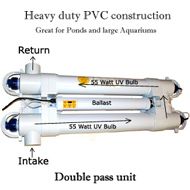
Better is a unit with long exposure such as the before mentioned TMC Professional 110 Watt UV Clarifier or a couple of TMC Pro Clear UV30s as compared a Smart HO Two-Lamp 100 Watt UV Sterilizer.
Or as another example, two AAP/TMC Pond Advantage Premium 25 Watt UV Sterilizer as compared to one Emperor 50 Watt UV.
The TMC Pro 110 Watt is not only vastly less expensive, it is a superior UV Sterilizer in terms of UVC exposure and performance.
As well the more efficient yet AAP/TMC Pro Clear UV30 is recognized by many pond keepers in Europe (where these are the #1 premium UV Sterilizer) as one of the best UVs for their ponds and two of these Sterilizers often cost less than many gimmicky 50 watt UVs as well as having vastly higher dwell time!.
Product Resource:
AAP Pro Clear Ultima 30- 55 Watt Professional Pond UV Clarifier & Sterilizer
For an article that deals with the question of pond filter placement in relation to a UV Sterilizer (as well as many other aspects of UV Sterilizer use), please follow this link:
Is the UV best placed after or before a filter in a pond.
Or as another example, two AAP/TMC Pond Advantage Premium 25 Watt UV Sterilizer as compared to one Emperor 50 Watt UV.
The TMC Pro 110 Watt is not only vastly less expensive, it is a superior UV Sterilizer in terms of UVC exposure and performance.
As well the more efficient yet AAP/TMC Pro Clear UV30 is recognized by many pond keepers in Europe (where these are the #1 premium UV Sterilizer) as one of the best UVs for their ponds and two of these Sterilizers often cost less than many gimmicky 50 watt UVs as well as having vastly higher dwell time!.
Product Resource:
AAP Pro Clear Ultima 30- 55 Watt Professional Pond UV Clarifier & Sterilizer
For an article that deals with the question of pond filter placement in relation to a UV Sterilizer (as well as many other aspects of UV Sterilizer use), please follow this link:
Is the UV best placed after or before a filter in a pond.
Another important consideration with the use of ANY UV Sterilizer for outdoor pond use is protection from direct weather exposure.
Despite some less than honest manufacturer claims, I have found that even UVs specifically designed for outdoor use succumb to the weather, often with damage to the ballast resulting in a UV Bulb failing to properly fire, especially a new premium hot cathode/low pressure bulb (these are much more efficient, but also require a higher voltage surge to fire). Even sunlight can cause indirect issues by causing too much heat build up that can damage ballast, connects, etc.
Ventilation is another common issue I have seen. Burying your UV or placing in an unventilated box is a sure fire way to shorten the life of your UV and lamps.
My suggestion is to cover the UV Sterilizer with flat rock (such as pictured) or suspend the UV in a structure that protects the UV from direct weather, including sunlight.
Maintenance:
Make sure to change your UV Bulb/Lamp once per season or twice per year in warm climates such as So. California or Florida.
Also of importance, especially in recent years, is to make sure you replace your UV lamp/bulb with a true level 1 UV capable low pressure high efficiency hot cathode UV Bulb.
With the popularity of late of sellers such as Amazon or eBay, along with other discounters, the pressure to sell medium pressure or cold cathode UV bulbs to keep the price low is very common. These lower price bulbs only have a useful UVC output of about 1/4 to 1/3 that of the better true UVC lamps/bulbs, resulting in lower performance. Often these sellers market nail curing bulbs as aquarium/pond capable UV bulbs and then sell these for better mark ups at lower prices.
Further Information:
Actual UV-C Emission from a UV Bulb; Aquarium or Pond
Product Resource:
True Level Capable Low Pressure UV bulbs
Finally, while I recommend a UV Sterilizer/Clarifier for most ponds, I find that many pond keepers are too dependent upon this device where as if the UV ceases to function the pond immediately turns pea soup green.
In my experience this indicates a pond that also is in need of better filtration, as the UV Clarifier should be a compliment to good filtration, not make up for poor filtration. The Veggie Filter I suggested earlier is a good idea, or simply adding more filters if your pond has some filtration, but your current filtration is not adequate.
Further Reference:
DIY Pond Veggie Filters
Despite some less than honest manufacturer claims, I have found that even UVs specifically designed for outdoor use succumb to the weather, often with damage to the ballast resulting in a UV Bulb failing to properly fire, especially a new premium hot cathode/low pressure bulb (these are much more efficient, but also require a higher voltage surge to fire). Even sunlight can cause indirect issues by causing too much heat build up that can damage ballast, connects, etc.
Ventilation is another common issue I have seen. Burying your UV or placing in an unventilated box is a sure fire way to shorten the life of your UV and lamps.
My suggestion is to cover the UV Sterilizer with flat rock (such as pictured) or suspend the UV in a structure that protects the UV from direct weather, including sunlight.
Maintenance:
Make sure to change your UV Bulb/Lamp once per season or twice per year in warm climates such as So. California or Florida.
Also of importance, especially in recent years, is to make sure you replace your UV lamp/bulb with a true level 1 UV capable low pressure high efficiency hot cathode UV Bulb.
With the popularity of late of sellers such as Amazon or eBay, along with other discounters, the pressure to sell medium pressure or cold cathode UV bulbs to keep the price low is very common. These lower price bulbs only have a useful UVC output of about 1/4 to 1/3 that of the better true UVC lamps/bulbs, resulting in lower performance. Often these sellers market nail curing bulbs as aquarium/pond capable UV bulbs and then sell these for better mark ups at lower prices.
Further Information:
Actual UV-C Emission from a UV Bulb; Aquarium or Pond
Product Resource:
True Level Capable Low Pressure UV bulbs
Finally, while I recommend a UV Sterilizer/Clarifier for most ponds, I find that many pond keepers are too dependent upon this device where as if the UV ceases to function the pond immediately turns pea soup green.
In my experience this indicates a pond that also is in need of better filtration, as the UV Clarifier should be a compliment to good filtration, not make up for poor filtration. The Veggie Filter I suggested earlier is a good idea, or simply adding more filters if your pond has some filtration, but your current filtration is not adequate.
Further Reference:
DIY Pond Veggie Filters
Cleaning & Maintenance
In a healthy pond, with a properly functioning nitrogen cycle, water changes can be minimal. I still recommend a water change of 10-20% per month on a healthy, fully functional pond. In a newer pond larger and more frequent changes may be necessary.
If your pond has a KH below 80 ppm and a pH below 7.0, I would first look to possible causes. One common one is the buildup of organic mulm on the bottom of the pond. The decomposition of this will produce nitric acids which will affect the pH and KH. Since most pond keeper have koi or goldfish, this is important to note, as both these fish do much better at a pH above 7.2 and need the calcium provided by the KH for proper osmotic function.
Further Reference:
“Proper Calcium, Magnesium and KH in Aquariums & Ponds”
Here are a few determining factors for water changes in a pond:
Nitrates- If they climb above 50 ppm
Phosphates- If they climb above 1.0 ppm
KH- If it falls below 80 ppm (assuming your tap/well water is higher)
GH- If it falls below 150 ppm (assuming your tap/well water is higher)
If a lot of leaves fall to the bottom of the pond vacuuming them or raking them out is important to prevent organic buildup.
Water changes also will help with pH and KH if your tap or well water is slightly alkaline and has a KH above 80 ppm.
Your pond filter should also be part of your pond cleaning schedule. With a pressurized filter such as a Pressurized Pond Filter, I recommend cleaning and rinsing once per month during pond season or more often if the flow rate slows down.
Veggie Filters should cleaned and trimmed at least once per season.
If your pond has a KH below 80 ppm and a pH below 7.0, I would first look to possible causes. One common one is the buildup of organic mulm on the bottom of the pond. The decomposition of this will produce nitric acids which will affect the pH and KH. Since most pond keeper have koi or goldfish, this is important to note, as both these fish do much better at a pH above 7.2 and need the calcium provided by the KH for proper osmotic function.
Further Reference:
“Proper Calcium, Magnesium and KH in Aquariums & Ponds”
Here are a few determining factors for water changes in a pond:
Nitrates- If they climb above 50 ppm
Phosphates- If they climb above 1.0 ppm
KH- If it falls below 80 ppm (assuming your tap/well water is higher)
GH- If it falls below 150 ppm (assuming your tap/well water is higher)
If a lot of leaves fall to the bottom of the pond vacuuming them or raking them out is important to prevent organic buildup.
Water changes also will help with pH and KH if your tap or well water is slightly alkaline and has a KH above 80 ppm.
Your pond filter should also be part of your pond cleaning schedule. With a pressurized filter such as a Pressurized Pond Filter, I recommend cleaning and rinsing once per month during pond season or more often if the flow rate slows down.
Veggie Filters should cleaned and trimmed at least once per season.
Cycling
Generally speaking this process is about 99% the same as aquarium cycling, so I would strongly recommend reading this excellent article:
The Aquarium and Pond Nitrogen Cycle- cycling
I would add in addition to this article that the process of cycling in a pond takes 6-8 weeks in warm months, but cooler temperatures such as a pond under 60 F can delay this process.
The amount of bio media such as Volcanic Rock or Pond Matrix available can also affect this “break in” time. As noted above, the addition of a well constructed Veggie Filter can not only increase filtration capacity, but also improve your ponds cycling process.
Products such as Pond Stability can also aid in "kick starting" your pond, as well this product in particular with its synergistic blend of aerobic (including encapsulated oxygen), anaerobic, and facultative bacteria will also prevent and reduce pond sludge build up.
Product Resources:
Volcanic Rock; Bio filter media
Pond Matrix; Pond Bio Filter Media, Plant Substrate
Pond Stability; Cycling, Biological Breakdown Aid
If your pond has been left with water, but no filtration or if you are moving a pre-fabricated pond from one location to another, do not assume that the essential aerobic bacterial that process nitrogenous waste (keeping extremely toxic ammonia levels low or 0) will immediately "bounce back". Adding aged filter media (as with aquariums) and/or NOT cleaning filters that are transferred other than a quick rinse with pond water or de-chlorinated tap water is essential to keeping a new or a re-set-up pond from having a deadly spike in ammonia.
Further Reference:
Aquarium & Pond Nitrogen Cycle, High Ammonia
The Aquarium and Pond Nitrogen Cycle- cycling
I would add in addition to this article that the process of cycling in a pond takes 6-8 weeks in warm months, but cooler temperatures such as a pond under 60 F can delay this process.
The amount of bio media such as Volcanic Rock or Pond Matrix available can also affect this “break in” time. As noted above, the addition of a well constructed Veggie Filter can not only increase filtration capacity, but also improve your ponds cycling process.
Products such as Pond Stability can also aid in "kick starting" your pond, as well this product in particular with its synergistic blend of aerobic (including encapsulated oxygen), anaerobic, and facultative bacteria will also prevent and reduce pond sludge build up.
Product Resources:
Volcanic Rock; Bio filter media
Pond Matrix; Pond Bio Filter Media, Plant Substrate
Pond Stability; Cycling, Biological Breakdown Aid
If your pond has been left with water, but no filtration or if you are moving a pre-fabricated pond from one location to another, do not assume that the essential aerobic bacterial that process nitrogenous waste (keeping extremely toxic ammonia levels low or 0) will immediately "bounce back". Adding aged filter media (as with aquariums) and/or NOT cleaning filters that are transferred other than a quick rinse with pond water or de-chlorinated tap water is essential to keeping a new or a re-set-up pond from having a deadly spike in ammonia.
Further Reference:
Aquarium & Pond Nitrogen Cycle, High Ammonia
Pond Care Bio Products
|
|
For bio bacteria maintenance, products such as AAP/SeaChem Pond Stability, which contains "Natural Environmental Beneficial Bacteria", is useful for aiding in the breakdown of organics and maintenance of the pond's natural nitrogen cycle.
AAP Pond Stability also can aid with mild buildup of organic matter
However if there more accumulation of mulm/sludge on the bottom of the pond, AAP Pond Zyme would be a better choice (or combined with Pond Stability).
I personally have used AAP Pond Zyme and have documented good results.
Even ponds with considerable accumulation from years of neglect have benefited for regular use of this product. In such instances of large accumulations, it takes multiple doses over some time to slowly remove this sludge.
For water clarity, PondCare Barley Clear is another useful product that uses the natural abilities of barley to control algae blooms as well as the natural properties of peat to buffer pH for a more stable environment.
I have used and sold these products in my Aquarium and pond Maintenance business with fair to good results. They are good at aiding in the breakdown of sludge and improving filter efficiency, however it is not a cure all for poor filtration and pond maintenance and some claims in my opinion are somewhat over blown.
Of these products, the newest and most effective is SeaChem Pond Stability followed by Natural Environmental Beneficial Bacteria Blocks are easy to use and when used properly can be a compliment to other good pond maintenance procedures.
The reason I now recommend Pond Stability over the other similar products is its blend of synergistic blend of aerobic (including encapsulated oxygen) and facultative bacteria. The Facultative bacteria contained there in can adapt to both sludge removal and aiding in the very important nitrogen cycle of your pond (conversion of ammonia & nitrites to less toxic nitrates and eventually total removal).
Product Resources:
AAP Pond Stability; Including Encapsulated Oxygen Aerobic and Facultative Bacteria
AAP Pond-Zyme Sludge Remover
PondCare Barley Clear
It is important to note that many of these products are primarily Heterotrophic Bacteria and other enzymes, NOT the nitrifying Autotrophic bacteria necessary for a healthy nitrogen cycle (although Stability has facultative bacteria too & is more helpful to pond cycling).
Please see this article for very in depth information about the aquatic Nitrogen Cycle:
“The Aquarium and Pond Nitrogen Cycle”
(The article is officially titled “Aquarium Nitrogen Cycle, however the information contained there in applies equally to ponds).
This is not to say these products are not useful as noted in the preceding paragraph, just not for seeding a new pond or making up for poor filtration or bio maintenance.
These products are also ineffective if used in a pond with no filter or at least gravel bottom for a place to accumulate these bacteria/enzymes. For example, dumping these products into a bare fountain/pond that only contains a pump for circulation will result in little effectiveness.
While on the subject biological nitrogen cycle, I should note that many pond filters are only designed to perform aerobic nitrification which is certainly very important, but only removes ammonia and nitrites.
The removal of nitrates is only performed by direct use by plants and their roots or be de-nitrification. For this reason the use of products such as SeaChem Pond Matrix inside filters, for use in around roots in Veggie Filters, or potted pond plants (with pond rocks placed on top to keep the very light Matrix from floating).
AAP Pond Stability also can aid with mild buildup of organic matter
However if there more accumulation of mulm/sludge on the bottom of the pond, AAP Pond Zyme would be a better choice (or combined with Pond Stability).
I personally have used AAP Pond Zyme and have documented good results.
Even ponds with considerable accumulation from years of neglect have benefited for regular use of this product. In such instances of large accumulations, it takes multiple doses over some time to slowly remove this sludge.
For water clarity, PondCare Barley Clear is another useful product that uses the natural abilities of barley to control algae blooms as well as the natural properties of peat to buffer pH for a more stable environment.
I have used and sold these products in my Aquarium and pond Maintenance business with fair to good results. They are good at aiding in the breakdown of sludge and improving filter efficiency, however it is not a cure all for poor filtration and pond maintenance and some claims in my opinion are somewhat over blown.
Of these products, the newest and most effective is SeaChem Pond Stability followed by Natural Environmental Beneficial Bacteria Blocks are easy to use and when used properly can be a compliment to other good pond maintenance procedures.
The reason I now recommend Pond Stability over the other similar products is its blend of synergistic blend of aerobic (including encapsulated oxygen) and facultative bacteria. The Facultative bacteria contained there in can adapt to both sludge removal and aiding in the very important nitrogen cycle of your pond (conversion of ammonia & nitrites to less toxic nitrates and eventually total removal).
Product Resources:
AAP Pond Stability; Including Encapsulated Oxygen Aerobic and Facultative Bacteria
AAP Pond-Zyme Sludge Remover
PondCare Barley Clear
It is important to note that many of these products are primarily Heterotrophic Bacteria and other enzymes, NOT the nitrifying Autotrophic bacteria necessary for a healthy nitrogen cycle (although Stability has facultative bacteria too & is more helpful to pond cycling).
Please see this article for very in depth information about the aquatic Nitrogen Cycle:
“The Aquarium and Pond Nitrogen Cycle”
(The article is officially titled “Aquarium Nitrogen Cycle, however the information contained there in applies equally to ponds).
This is not to say these products are not useful as noted in the preceding paragraph, just not for seeding a new pond or making up for poor filtration or bio maintenance.
These products are also ineffective if used in a pond with no filter or at least gravel bottom for a place to accumulate these bacteria/enzymes. For example, dumping these products into a bare fountain/pond that only contains a pump for circulation will result in little effectiveness.
While on the subject biological nitrogen cycle, I should note that many pond filters are only designed to perform aerobic nitrification which is certainly very important, but only removes ammonia and nitrites.
The removal of nitrates is only performed by direct use by plants and their roots or be de-nitrification. For this reason the use of products such as SeaChem Pond Matrix inside filters, for use in around roots in Veggie Filters, or potted pond plants (with pond rocks placed on top to keep the very light Matrix from floating).
Algone is a product I have used for many years now with my aquarium and pond maintenance company for water clarity, nitrate control, and as a part of string/mat algae control regimen.
Algone utilizes nitrate fixating microorganisms that incorporate excess nitrogen into the cellular mass, while bioactive enzymes assimilate nitrogen from the water column.
Product Resource:
Algone Water Clarifier & Nitrate Remover
Algone utilizes nitrate fixating microorganisms that incorporate excess nitrogen into the cellular mass, while bioactive enzymes assimilate nitrogen from the water column.
Product Resource:
Algone Water Clarifier & Nitrate Remover
Another before mentioned product that aids in natural water quality and clarity is Barley with Peat as this combines peat with the benefits of barley straw. The phenolic compounds found in the Barley naturally clears the pond while the peat contained in buffers the pH for a more stable pond environment.
Product Resource:
Barley Clear; Concentrated Natural Barley & Peat
The use of these two products can have the end result of lower algae growth (including green water) and over all improved water clarity.
I have found best results with ANY bio pond care products when added in the evening and if a UV Sterilizer is attached to the pond, turning this off for the evening and then back on in the morning (when the need for a UV Sterilizer/clarifier is highest).
This allows the bacteria/enzymes a better chance of getting into substrate and filter media where they will be most effective in digesting organic sludge and waste.
When/if organic decomposition is higher and more time is needed for products such as Stability to work, I would again suggest turning off the UV in the evening, adding the Stability or similar product, then leaving the UV off for the first two nights and one day; then turning the UV Sterilizer back on the second morning.
Product Resource:
True Level 1 UV Sterilizers for Pond
Product Resource:
Barley Clear; Concentrated Natural Barley & Peat
The use of these two products can have the end result of lower algae growth (including green water) and over all improved water clarity.
I have found best results with ANY bio pond care products when added in the evening and if a UV Sterilizer is attached to the pond, turning this off for the evening and then back on in the morning (when the need for a UV Sterilizer/clarifier is highest).
This allows the bacteria/enzymes a better chance of getting into substrate and filter media where they will be most effective in digesting organic sludge and waste.
When/if organic decomposition is higher and more time is needed for products such as Stability to work, I would again suggest turning off the UV in the evening, adding the Stability or similar product, then leaving the UV off for the first two nights and one day; then turning the UV Sterilizer back on the second morning.
Product Resource:
True Level 1 UV Sterilizers for Pond
Chemistry
This is important not just for fish health, but also for algae control as well.
Besides ammonia, nitrites, and phosphates kept near 0 ppm, nitrates should be kept under 50 and the often forgotten GH and KH should be kept no lower than 100 and 50 ppm respectively.
A good electrolyte level is an important aspect of pond chemistry many miss This is maintained by a constant supply of mineral positive ions (Cations) will also help maintain a good Redox which in turn aids in water clarity, not to mention the very important aspect of good osmotic function in fish for long term health.
Further Information:
Aquarium & Pond Redox Balance
Besides ammonia, nitrites, and phosphates kept near 0 ppm, nitrates should be kept under 50 and the often forgotten GH and KH should be kept no lower than 100 and 50 ppm respectively.
A good electrolyte level is an important aspect of pond chemistry many miss This is maintained by a constant supply of mineral positive ions (Cations) will also help maintain a good Redox which in turn aids in water clarity, not to mention the very important aspect of good osmotic function in fish for long term health.
Further Information:
Aquarium & Pond Redox Balance
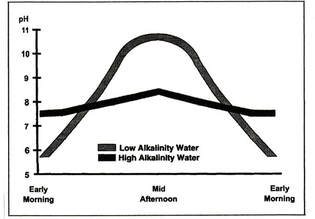
If your GH is low this can be a problem (with a stable pH) during the hours of the day when photosynthesis is high, even with an adequate KH.
It is possible in a pond with heavy plant growth and/or high algae growth WITHOUT adequate water hardness (GH), for aquarium chemistry to become problematic due to increased photosynthesis. So either the reduction of algae and/or an increase in minerals to aid GH is important if GH, pH, or KH are problematic.
It is possible in a pond with heavy plant growth and/or high algae growth WITHOUT adequate water hardness (GH), for aquarium chemistry to become problematic due to increased photosynthesis. So either the reduction of algae and/or an increase in minerals to aid GH is important if GH, pH, or KH are problematic.
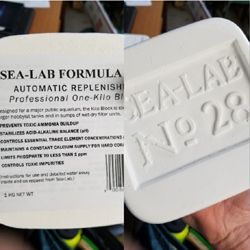
Products such as Wonder Shells (or Sea-Lab for larger ponds) can help with supplying essential mineral cations as well as oxidative stress/poor osmoregulation, ammonia, & stress from transfer.
Quite bluntly, these are a MUST USE product for any serious pond keeper.
Product Resource:
Wonder Shells/Sea-Lab; Pond, Aquarium Mineral Blocks, Unique version ONLY available at AAP
For more about how this affects algae, please follow this article:
Pond Algae
I recommend reading these articles for more about the aspect of mineral ions, KH, GH, & pH:
Calcium & Electrolytes in Aquariums and Ponds
Proper Osmotic Function in Fish
Generally most Pond Fish such as Koi and Goldfish like a higher ph of about 7.8 (although a pH in the range of 6.8 to 8.0 is often acceptable). A well planted stable pond usually does not have problems with too high or too low a pH.
Goldfish kept in ponds prefer a higher alkalinity and pH).
If your pH is too low/unstable, Sea Chem Buffer can improve the stability (I recommend the Marine version since the Koi and . For large volumes of water, aragonite may be more cost effective (Oyster shells are too slow to dissolve and do not work well from my experience).
However I do NOT recommend the use of Plaster of Paris or lime (CaO) as this is not balanced and not add the other necessary elements such as Magnesium, carbonates.
Further Reference:
Why to NOT use Plaster of Paris in Ponds, Aquariums
Product Resource:
Marine Buffer; Excellent for Pond Use
For too high a pH (rare), these are cost effective ways in a pond:
Barley Straw pellets or extract (great for algae control too, although so-so for ph)
Almond shells (this is really good for lowering ph, more effective than peat and with the side effect of being antibacterial)
A veggie filter (this helps with a stable pH and produces nitric acid).
Quite bluntly, these are a MUST USE product for any serious pond keeper.
Product Resource:
Wonder Shells/Sea-Lab; Pond, Aquarium Mineral Blocks, Unique version ONLY available at AAP
For more about how this affects algae, please follow this article:
Pond Algae
I recommend reading these articles for more about the aspect of mineral ions, KH, GH, & pH:
Calcium & Electrolytes in Aquariums and Ponds
Proper Osmotic Function in Fish
Generally most Pond Fish such as Koi and Goldfish like a higher ph of about 7.8 (although a pH in the range of 6.8 to 8.0 is often acceptable). A well planted stable pond usually does not have problems with too high or too low a pH.
Goldfish kept in ponds prefer a higher alkalinity and pH).
If your pH is too low/unstable, Sea Chem Buffer can improve the stability (I recommend the Marine version since the Koi and . For large volumes of water, aragonite may be more cost effective (Oyster shells are too slow to dissolve and do not work well from my experience).
However I do NOT recommend the use of Plaster of Paris or lime (CaO) as this is not balanced and not add the other necessary elements such as Magnesium, carbonates.
Further Reference:
Why to NOT use Plaster of Paris in Ponds, Aquariums
Product Resource:
Marine Buffer; Excellent for Pond Use
For too high a pH (rare), these are cost effective ways in a pond:
Barley Straw pellets or extract (great for algae control too, although so-so for ph)
Almond shells (this is really good for lowering ph, more effective than peat and with the side effect of being antibacterial)
A veggie filter (this helps with a stable pH and produces nitric acid).
Foam
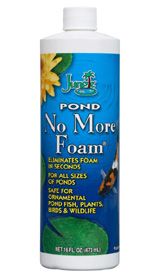
Foam around waterfalls and other water features is not uncommon, however if this is a persistent problem, there may be other issues at play in your pond.
Often this is caused by too many organics, so lowering you bio load, watching the amount of food you feed and most importantly; improving filtration can go a long way here.
This can also be caused by an excess of Phosphates (often related to organics in the water column already mentioned). Phosphates can be added from tap water or even more often, runoff from watering or rain water through your garden. For this make sure your pond has a raised ledge to prevent this problem (I talk about this further under Pond Bottoms).
For minor problems, especially foam that occurs only around water features, products such as Jungles No More Foam can be useful for blocking the waters ability to foam.
Often this is caused by too many organics, so lowering you bio load, watching the amount of food you feed and most importantly; improving filtration can go a long way here.
This can also be caused by an excess of Phosphates (often related to organics in the water column already mentioned). Phosphates can be added from tap water or even more often, runoff from watering or rain water through your garden. For this make sure your pond has a raised ledge to prevent this problem (I talk about this further under Pond Bottoms).
For minor problems, especially foam that occurs only around water features, products such as Jungles No More Foam can be useful for blocking the waters ability to foam.
Feeding
Feeding a quality diet can be beneficial for growth, breeding, color, and even the environment as there is less nitrogenous waste to add to the water column.
You want a food high in aquatic based proteins (although not too high in protein as most koi and goldfish are more “grazers”). Whole fish meal or white fish meal is a good source. An amino acid that is important to koi and goldfish is DL-methionine and is found in Whole fish meal as well as peas.
Cereal is not a good source of energy for fish as it is in humans, fish utilize fats more for energy. Cereal is mostly used as roughage and to move other nutrients thru the digestive tract.
In summer months I usually feed twice per day, as temperatures fall below 70 F (20 C) in the pond I feed once per day. When temperatures fall below 60 F (15 C) in the pond I feed every other day or less, depending on fish feeding habits. Below 50 F (10 C), I do not generally feed.
For adult Koi there are several quality foods available: Hai Feng, Sanyu, Hikari, and Nursery-Pro as well as premium brands such as Aqua Masters. Consider the highest grade food available AAP Custom, which limits energy to prevent fat related diseased and max fiber for beneficial bacteria for digestion.
For goldfish or shubunkins I also recommend Spirulina 20 Flake.
For fry (in addition to natural foods that will be available around the plant roots and other calm areas of the pond), I powder Spirulina Flakes and stir it into a cup of water, then pour this solution into the area the fish fry are at.
Product Resources:
AAP Custom Ultra Premium
Aqua Master- Premium Koi & Goldfish Breeder/Fancier Fish Foods
Spirulina 20 Flake Fish Food
For even more information about what constitutes a quality fish food and more, please visit this URL:
Quality fish Food; what Ingredients are needed for Proper Fish Nutrition, Health & Growth.
You want a food high in aquatic based proteins (although not too high in protein as most koi and goldfish are more “grazers”). Whole fish meal or white fish meal is a good source. An amino acid that is important to koi and goldfish is DL-methionine and is found in Whole fish meal as well as peas.
Cereal is not a good source of energy for fish as it is in humans, fish utilize fats more for energy. Cereal is mostly used as roughage and to move other nutrients thru the digestive tract.
In summer months I usually feed twice per day, as temperatures fall below 70 F (20 C) in the pond I feed once per day. When temperatures fall below 60 F (15 C) in the pond I feed every other day or less, depending on fish feeding habits. Below 50 F (10 C), I do not generally feed.
For adult Koi there are several quality foods available: Hai Feng, Sanyu, Hikari, and Nursery-Pro as well as premium brands such as Aqua Masters. Consider the highest grade food available AAP Custom, which limits energy to prevent fat related diseased and max fiber for beneficial bacteria for digestion.
For goldfish or shubunkins I also recommend Spirulina 20 Flake.
For fry (in addition to natural foods that will be available around the plant roots and other calm areas of the pond), I powder Spirulina Flakes and stir it into a cup of water, then pour this solution into the area the fish fry are at.
Product Resources:
AAP Custom Ultra Premium
Aqua Master- Premium Koi & Goldfish Breeder/Fancier Fish Foods
Spirulina 20 Flake Fish Food
For even more information about what constitutes a quality fish food and more, please visit this URL:
Quality fish Food; what Ingredients are needed for Proper Fish Nutrition, Health & Growth.
Treatment
This is a broad subject that is beyond the scope of this article, so I would suggest reading more specific articles, here are a few suggestions:
How Medications Work; Both Pond or Aquarium; Overview
Disease Prevention; Aquarium AND Pond
Ich; Treatment, Prevention, Lifecycle
This is far a complete list, however many more can found in our Aquatic Information drop down list in the header bar or at Aquarium/Pond Answers.
One important point I will make and that is the importance of changing water (at least 25%) prior to every single treatment.
The reason is that ponds in particular generally have a high content of dissolved organics, floating algae or similar bio substances, much more so than the average aquarium. These organics will absorb many treatments, especially chemical treatments such as those that contain Malachite Green (such as Quick Cure, which is a very effective pond treatment of many small pond parasites).
By changing water first, this allows for more medications to be delivered to the pathogens causing disease, as well this will generally improve water conditions which in turn helps the fish fight off the infections/infestation better. This can also lower the amount of medication that might be needed to treat your pond as well.
I recommend this water change prior to any and all treatments.
A few suggested pond use treatment products that are biologically safe when used correctly, in particular for prevention are:
Cupramine from American Products
Excellent for both treatment and more so prevention of Ich and other Ecto Parasites as well as mild fungus prevention. This is economical too with one approx. $15 bottle treating up to 2,500 gallons! Definitely a product to have on hand.
Discomed from American Products
Excellent treatment and preventative for Tapeworms, Flatworms (Planaria), Flukes
Pimafix from American Aquarium Products
Treats fungal & mild bacterial infections on body and fins
Herbal Ich Attack/Rid Fungus from American Aquarium Products
A safe herbal treatment that helps Prevent & treat single-celled external fish diseases such as Ich & Other Protozoans, Dinoflagellates, and Fungus
Medicated Wonder Shells from American Aquarium Products
An excellent preventative when new fish are added for smaller patio ponds
How Medications Work; Both Pond or Aquarium; Overview
Disease Prevention; Aquarium AND Pond
Ich; Treatment, Prevention, Lifecycle
This is far a complete list, however many more can found in our Aquatic Information drop down list in the header bar or at Aquarium/Pond Answers.
One important point I will make and that is the importance of changing water (at least 25%) prior to every single treatment.
The reason is that ponds in particular generally have a high content of dissolved organics, floating algae or similar bio substances, much more so than the average aquarium. These organics will absorb many treatments, especially chemical treatments such as those that contain Malachite Green (such as Quick Cure, which is a very effective pond treatment of many small pond parasites).
By changing water first, this allows for more medications to be delivered to the pathogens causing disease, as well this will generally improve water conditions which in turn helps the fish fight off the infections/infestation better. This can also lower the amount of medication that might be needed to treat your pond as well.
I recommend this water change prior to any and all treatments.
A few suggested pond use treatment products that are biologically safe when used correctly, in particular for prevention are:
Cupramine from American Products
Excellent for both treatment and more so prevention of Ich and other Ecto Parasites as well as mild fungus prevention. This is economical too with one approx. $15 bottle treating up to 2,500 gallons! Definitely a product to have on hand.
Discomed from American Products
Excellent treatment and preventative for Tapeworms, Flatworms (Planaria), Flukes
Pimafix from American Aquarium Products
Treats fungal & mild bacterial infections on body and fins
Herbal Ich Attack/Rid Fungus from American Aquarium Products
A safe herbal treatment that helps Prevent & treat single-celled external fish diseases such as Ich & Other Protozoans, Dinoflagellates, and Fungus
Medicated Wonder Shells from American Aquarium Products
An excellent preventative when new fish are added for smaller patio ponds
Winter Pond Care
It is important in winter to keep at least a small section of your pond open for proper exchange of gasses (O2, CO2), if water can still flow into the pond through a water or aeration device, that will work. A minimum depth of 24” (deeper in climates where soil temperatures drop below 32 F) will provide enough water space under the ice for fish to hibernate (even in the coldest climates, ice will really extend more than 6-8”).
However if you live in an area of hard freezes, you may need heaters or a device such as this Pond Master Deicer:
However if you live in an area of hard freezes, you may need heaters or a device such as this Pond Master Deicer:
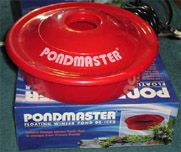
If an aquarium heater is adapted to your pond, make sure that there is circulation near the heater and keep in mind that all you are attempting to do is raise the temperature above freezing, so generally only about 1/2 watt per gallon is all that is necessary for most ponds to keep above freezing (assuming adequate circulation).
For example, a 300 Watt Heater should work for most 600 gallon winter ponds (unless you live in the arctic circle). Make sure to protect the heater from fish or turtles that may break the heater using a cinder block, brick, large rocks, etc.
For a smaller 100-200 gallon pond, such as patio or prefab pond, generally a 200 Watt or smaller heater is all that is necessary to take the edge off the cold.
Product Resource:
Via Aqua Premium Quartz Heaters
An aeration device or pump placed about midway from the surface/bottom that circulates upward generally will keep an area of the pond surface free of ice and allow proper gas exchange. In deep ponds over 5-6 feet (1.75 -2 meters), thermal layering, called thermoclines, may exist. This acts as sort of an “inversion layer” similar to how smog gets trapped in the air in Los Angeles. This traps CO2 and Hydrogen Sulfide near the bottom which is dangerous to fish and in this case you need to add water pumps or aeration devices at the bottom.
Product Resources:
Million Air & SunSun Air Pumps
Pond & Aquarium Pump
For example, a 300 Watt Heater should work for most 600 gallon winter ponds (unless you live in the arctic circle). Make sure to protect the heater from fish or turtles that may break the heater using a cinder block, brick, large rocks, etc.
For a smaller 100-200 gallon pond, such as patio or prefab pond, generally a 200 Watt or smaller heater is all that is necessary to take the edge off the cold.
Product Resource:
Via Aqua Premium Quartz Heaters
An aeration device or pump placed about midway from the surface/bottom that circulates upward generally will keep an area of the pond surface free of ice and allow proper gas exchange. In deep ponds over 5-6 feet (1.75 -2 meters), thermal layering, called thermoclines, may exist. This acts as sort of an “inversion layer” similar to how smog gets trapped in the air in Los Angeles. This traps CO2 and Hydrogen Sulfide near the bottom which is dangerous to fish and in this case you need to add water pumps or aeration devices at the bottom.
Product Resources:
Million Air & SunSun Air Pumps
Pond & Aquarium Pump
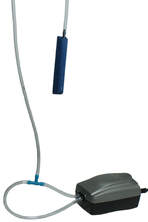
Here is an example of a simple aeration method using an air pump and air stone.
You can also connect an Air Pump to air driven Pond Filters such as the Hydro Pond II for added winter filtration (especially if your main water pump is shut off).
Product Resource:
Hydro Pond Filters
You can also connect an Air Pump to air driven Pond Filters such as the Hydro Pond II for added winter filtration (especially if your main water pump is shut off).
Product Resource:
Hydro Pond Filters
If you live in an area where leaves fall (even if there is no winter ice), removal of these leaves or covering of your pond is a necessity to prevent decay that will produce ammonia, CO2, nitric acid (which in turn lowers pH and KH to dangerously low levels).
Decay can also result in the production of Hydrogen Sulfide from anaerobic breakdown.
Decay can also result in the production of Hydrogen Sulfide from anaerobic breakdown.
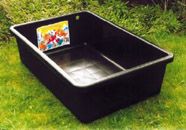
Sometimes removal of fish in the winter is also necessary when the pond is very shallow (under 18-24 inches). I recommend avoiding this if at all possible with larger mature fish as this can injure and often cause more stress than simply improving your pond to deal with winter conditions.
If this must be done with younger fish, you need to find a tub that is as large as possible (the tub pictured at the left or a plastic untreated livestock trough works well as well as sturdy "Kiddie pools").
I recommend using a simple pond filter such as the Hydro Pond II connected to an air pump to filter such a tub pond. Keep the pond in an area of your garage or similar that is above freezing but not too warm so as to minimize activity and need for feeding and thus pollution.
Product Resource:
Hydro Pond #2 Filter
Generally UV Sterilization does not need to be run in climates where hard freezes are common; however once most hard freezes are past (ice forming on the surface of the pond), UV Sterilization should be run again.
As long as circulation is good and overall water temperature is above freezing there is no danger to your UV Sterilizer/Clarifier. It is noteworthy that as your pond temperature increases your UV will become more effective, but then so does your potential for algae blooms.
If this must be done with younger fish, you need to find a tub that is as large as possible (the tub pictured at the left or a plastic untreated livestock trough works well as well as sturdy "Kiddie pools").
I recommend using a simple pond filter such as the Hydro Pond II connected to an air pump to filter such a tub pond. Keep the pond in an area of your garage or similar that is above freezing but not too warm so as to minimize activity and need for feeding and thus pollution.
Product Resource:
Hydro Pond #2 Filter
Generally UV Sterilization does not need to be run in climates where hard freezes are common; however once most hard freezes are past (ice forming on the surface of the pond), UV Sterilization should be run again.
As long as circulation is good and overall water temperature is above freezing there is no danger to your UV Sterilizer/Clarifier. It is noteworthy that as your pond temperature increases your UV will become more effective, but then so does your potential for algae blooms.

Here is a good article about Winter Pond Care:
Winter Pond Care
Winter Pond Care
Pond Bottom & Liner
Construction and make up of your pond can be done in three different ways (and there is no one best way; the best way fits your pond size needs, climate and budget).
A preformed pond is probably the most simple. With this method you basically dig a hole to the shape of the pond, remove sharp rocks, add sand for a cushion maybe cut a few holes on the size for bulk heads to add filtration and you're ready to add rocks, filtration and décor. This style is good for small applications (usually under 250 gallons) and where roots or gophers may be a problem.
A pond liner made of PVC material or EPDM. I prefer the EPDM in a 45 mil. Thickness.
With liners you can generally go up to a 1000 gallon pond. Preparation is similar to a preformed pond, however more care needs to taken with sharp rocks and a pre liner or sand should be used. Also in areas of high tree roots or gopher activity these can be compromised.
The other method is a concrete pond using rebar for support as well. This is probably the most expensive method however this is the method I recommend over 1000 gallons. I have subcontracted (installing the filtration) for many concrete ponds and it is important to use a good contractor or prepare and build this properly yourself as even a concrete pond that is poorly built can have problems. Make sure to not build a concrete pond on “fill” as the pond will often settle and crack.
Also proper use of rebar is a must especially in ponds over 3000 gallons.
Despite the popularity of drains, I do not install these as I prefer to allow the aerobic and anaerobic bacteria breakdown wastes (I will have a PVC T and ball valve near an outside filter to drain my pond via my pump for water changes and cleanings).
A preformed pond is probably the most simple. With this method you basically dig a hole to the shape of the pond, remove sharp rocks, add sand for a cushion maybe cut a few holes on the size for bulk heads to add filtration and you're ready to add rocks, filtration and décor. This style is good for small applications (usually under 250 gallons) and where roots or gophers may be a problem.
A pond liner made of PVC material or EPDM. I prefer the EPDM in a 45 mil. Thickness.
With liners you can generally go up to a 1000 gallon pond. Preparation is similar to a preformed pond, however more care needs to taken with sharp rocks and a pre liner or sand should be used. Also in areas of high tree roots or gopher activity these can be compromised.
The other method is a concrete pond using rebar for support as well. This is probably the most expensive method however this is the method I recommend over 1000 gallons. I have subcontracted (installing the filtration) for many concrete ponds and it is important to use a good contractor or prepare and build this properly yourself as even a concrete pond that is poorly built can have problems. Make sure to not build a concrete pond on “fill” as the pond will often settle and crack.
Also proper use of rebar is a must especially in ponds over 3000 gallons.
Despite the popularity of drains, I do not install these as I prefer to allow the aerobic and anaerobic bacteria breakdown wastes (I will have a PVC T and ball valve near an outside filter to drain my pond via my pump for water changes and cleanings).
Repair:
It is not unusual for a pond to have a leak from either time, poor construction, weather damage, animal damage or "you name it".
I would recommend products such as Pond Pro 2000 which are a liquid version of EPDM, basically the same as EPDM pond liners sold in pond supply stores. This product is a 100% liquid EPDM and 100% compatible to your EPDM pond liner sold in pond supply stores.
This type of product also works extremely well on all non-porous concrete ponds & fountains as well as EPDM fish ponds liners & prefabricated ponds.
DISCLAIMER: This website is not affiliated in any way with Pond Pro 2000, I/we only feel it is a very useful product and this article would not be complete without mentioning it or similar products.
Product Source:
Pond Pro liquid version of EPDM for repair
Bottom substrate:
Rock or large gravel on the bottom will aid in the growth of bacteria to break down organic matter.
In smaller ponds (under 200 gallons) I personally usually do not add a substrate per say, rather I allow the roots of potted plants (that will grow out of there pots) to collect there own debris. I do often add some zeolite or laterite both for absorption of some nutrients and for plant roots.
Drainage problems around your pond:
If you are having flooding problems around your pond, you may need to dig a trench to lay PVC drainage lines to an area of your property that is lower. If this is not possible, a dry well may need to be installed.
It is not unusual for a pond to have a leak from either time, poor construction, weather damage, animal damage or "you name it".
I would recommend products such as Pond Pro 2000 which are a liquid version of EPDM, basically the same as EPDM pond liners sold in pond supply stores. This product is a 100% liquid EPDM and 100% compatible to your EPDM pond liner sold in pond supply stores.
This type of product also works extremely well on all non-porous concrete ponds & fountains as well as EPDM fish ponds liners & prefabricated ponds.
DISCLAIMER: This website is not affiliated in any way with Pond Pro 2000, I/we only feel it is a very useful product and this article would not be complete without mentioning it or similar products.
Product Source:
Pond Pro liquid version of EPDM for repair
Bottom substrate:
Rock or large gravel on the bottom will aid in the growth of bacteria to break down organic matter.
In smaller ponds (under 200 gallons) I personally usually do not add a substrate per say, rather I allow the roots of potted plants (that will grow out of there pots) to collect there own debris. I do often add some zeolite or laterite both for absorption of some nutrients and for plant roots.
Drainage problems around your pond:
If you are having flooding problems around your pond, you may need to dig a trench to lay PVC drainage lines to an area of your property that is lower. If this is not possible, a dry well may need to be installed.
Garden/ Yard Drain with clean out and basic drain.
Spring Feed Ponds
If you live in an area of natural springs or have creek flowing nearby, this can make for a very healthy, clear and natural pond.
If it is possible to divert water into your pond (or just fill from below with a spring), this is always an excellent idea! This way you will likely maintain lower nitrates and phosphates, less algae, better Redox, and better electrolyte levels resulting in a clearer pond and healthier fish.
Make sure to have an overflow or skimmer to remove excess water. If you have a well you can achieve similar results (or even use your well during the dry season when the spring or creek diversion dries up).
I also have achieved a similar effect with just plain tap water used in a very slow flow (a 10% water exchange per day or less will not show any ill effects from chlorine). Make sure this is not a problem with local water companies first, although the ponds I used tap water overflow for used less than 200 gallons per day (for a 2000 gallon pond) which is less than watering ones lawn for an hour.
With this method, filtration and circulation are still needed in my experience, although this often allows for a more simple filter. A Veggie filter is very useful in this set-up too!
If it is possible to divert water into your pond (or just fill from below with a spring), this is always an excellent idea! This way you will likely maintain lower nitrates and phosphates, less algae, better Redox, and better electrolyte levels resulting in a clearer pond and healthier fish.
Make sure to have an overflow or skimmer to remove excess water. If you have a well you can achieve similar results (or even use your well during the dry season when the spring or creek diversion dries up).
I also have achieved a similar effect with just plain tap water used in a very slow flow (a 10% water exchange per day or less will not show any ill effects from chlorine). Make sure this is not a problem with local water companies first, although the ponds I used tap water overflow for used less than 200 gallons per day (for a 2000 gallon pond) which is less than watering ones lawn for an hour.
With this method, filtration and circulation are still needed in my experience, although this often allows for a more simple filter. A Veggie filter is very useful in this set-up too!
Another method for adding water simply is a float valve. These will add water due to evaporation or loss of water by other means and can even be used with flow through system to automatically regulate water level. Here is a picture of such a float valve by Hagen (Laguna).
Pond Predators
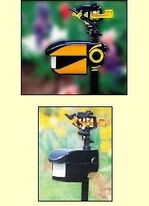
|
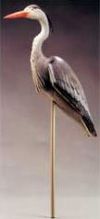
|
Herons have been the most common predator to my customers ponds that I have had to deal with. I do not like to add anything that detracts from the beauty of the ponds I maintained, so decoys were my first choice.
I found Heron decoys such as this one by Hagen: worked well at not only scaring away Herons, but other predatory birds as well such as Cormorants, Owls, etc. (I might note that these decoys do NOT work in breeding season which early March 'til late May where they actually may attract Herons!). I also suggest moving the decoy around as Herons can quickly learn that this is a fake Heron.
I also employed motion sensor scarecrows that connected to a water supply and then squirted ANYTHING that moved (such as other predatory birds such as Owls), this device also worked for dogs that would “play” in the pond (often destroying it and scaring fish), but was not as effective for raccoons.
Here is a video of a motion detector water sprayer scarecrow scaring off animals:
Video of animals being frightened away by a ScareCrow motion detector
I found Heron decoys such as this one by Hagen: worked well at not only scaring away Herons, but other predatory birds as well such as Cormorants, Owls, etc. (I might note that these decoys do NOT work in breeding season which early March 'til late May where they actually may attract Herons!). I also suggest moving the decoy around as Herons can quickly learn that this is a fake Heron.
I also employed motion sensor scarecrows that connected to a water supply and then squirted ANYTHING that moved (such as other predatory birds such as Owls), this device also worked for dogs that would “play” in the pond (often destroying it and scaring fish), but was not as effective for raccoons.
Here is a video of a motion detector water sprayer scarecrow scaring off animals:
Video of animals being frightened away by a ScareCrow motion detector
his Alligator decoy is another Heron deterrent that others have used successfully (I have not used this method myself, so I cannot personally vouch for it, but it certainly seems like a good idea and I trust those who have claimed to use it successfully).
Another way to protect your fish from predators is a 12” diameter drain pipe placed (and hidden) under water for the fish to escape and hide in. Cinder blocks placed ina way fish can hide also have worked for me.
One more idea is under water fish decoys combined with the drain pipe or similar methods. These ‘fake’ koi give the real fish time to escape (these last two suggestions have worked for me, but not in all cases).
I do NOT recommend wire mesh as some other sites suggest as this is very ineffective and just plain UGLY (why would you make a beautiful garden pond just to cover it in wire?).
I have seen raccoons and even Herons find a loose spot and go right under.
The only time I would recommend wire mesh or netting is in fall to stop leaf litters which can often over come a ponds bio capacity. Maples can especially be bad about ruining an otherwise healthy pond.
Another way to protect your fish from predators is a 12” diameter drain pipe placed (and hidden) under water for the fish to escape and hide in. Cinder blocks placed ina way fish can hide also have worked for me.
One more idea is under water fish decoys combined with the drain pipe or similar methods. These ‘fake’ koi give the real fish time to escape (these last two suggestions have worked for me, but not in all cases).
I do NOT recommend wire mesh as some other sites suggest as this is very ineffective and just plain UGLY (why would you make a beautiful garden pond just to cover it in wire?).
I have seen raccoons and even Herons find a loose spot and go right under.
The only time I would recommend wire mesh or netting is in fall to stop leaf litters which can often over come a ponds bio capacity. Maples can especially be bad about ruining an otherwise healthy pond.
Videos
|
|
|